









Caught between Vladimir Putin’s Russia, Donald Trump’s US and Xi Jinping’s China, Europe appears in a state of profound crisis, the narrative about its future often filled with fatalism. There is a paradox, however. Despite rising nationalism, the climate crisis and the economic slowdown, few would take issue with the claim that Europe still has a great deal going for it. Asked to choose where in the world they would want to live, there is a good chance that most Europeans would still pick Europe over other continents.
The news is not relentlessly negative either. While much of the political commentary in recent years has focused on the rise of far-right nationalism across the continent, its most prominent symbol, Hungary’s former autocrat Viktor Orbán, was ousted in a landslide election this month.
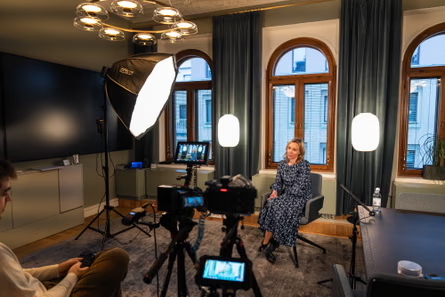
With this paradox in mind, we teamed up to try to unpack the continent’s biggest challenges and opportunities. As scholars, we have expertise on Europe’s foreign and security policy and the digital economy, but we knew we did not have all the answers and wanted to draw others into the conversation. We assembled a group of leading thinkers from across Europe whose collective expertise spans the economy, the climate emergency, migration, technology, defence, democracy, history and much more. We captured their thoughts for our new film as they grappled with the extraordinary convergence of different threats facing the continent, and shared their analysis and ideas.
The collective diagnosis of the continent’s perils set out in unvarnished terms by these experts is indeed sombre. The consensus on what presents the biggest threat is an expanded war in Europe – potentially spreading out from Ukraine to a Russian move on the Baltic states, perhaps by closing the Suwałki Gap near the Lithuanian-Polish border. When it comes to defending itself, Europe is even more vulnerable to an encroaching Russia because of our deep dependency on an increasingly hostile US, whose leadership is already weaponising that power imbalance.
“What we’ve discovered to our horror is that we simply can’t depend on the US as a backstop for our security in the way we have for the past 80 years,” historian Timothy Garton Ash told us. “So between the Russian aggression against Ukraine and the threatened withdrawal of the US, it comes back to us.”
And, despite the outcome of the election in Hungary, far-right nationalist populism is still on the rise, threatening democracy as well as principled, far-sighted policies on climate, energy, trade, technology and migration.
Our aim in collating these dangers was not to promote doom or alarmism. But a realistic assessment of the present is the precondition for any hopeful view of the future. So what is the answer? Most of the thinkers we spoke to believe it lies in a stronger Europe. The good news is they believe that this ambition is within reach. “I think we do have what it takes to get there because we are, at the same time, a small yet rich continent that has academic excellence, believes in science, still does climate policies and is also a place of liberties, freedoms and culture,” the Dutch philosopher Luuk van Middelaar said.
Europe has a large market and a wealth of talent. Its researchers are world class and its economy boasts important areas of excellence. Europe has vast pools of untapped capital that could be deployed in better ways to fund innovation. Its societies remain open and peaceful, and, for all its troubles, its democracies are still among the most vibrant in the world.
In key respects, Europe is already addressing its vulnerabilities. The twin threat from Putin’s Russia and US retrenchment are giving our governments the required push to invest massively in Europe’s self-defence. Trump’s protectionism has galvanised Europe to strike new trade deals with Latin America, India, Indonesia and Australia over recent months. The return of global protectionism has also given the continent the impetus to finally eradicate internal trade barriers to unleash the power of the truly integrated EU single market.

But when it comes to Europe’s future, optimism on its own is not enough to kickstart change. It must give way to activism – grounded in the conviction that a stronger Europe not only can, but must, be built.
It’s an activism we saw when young Europeans mobilised on the streets to demand climate action or protest against the war in Gaza. We saw it too at the ballot box in Hungary when unprecedented numbers showed up to oust Orbán’s authoritarian regime. And it’s an activism we saw in Barcelona last week when progressive politicians from Europe joined their counterparts from the Americas, Africa and Asia to develop a common platform to revamp democracy and promote peace, international law and multilateral cooperation. The energy is building through protest, voting and assembly, and leaders are called on to seize it.
For Europe to thrive – to be a continent capable of delivering security and prosperity while championing freedom and democracy – we need principled and competent leaders, ambitious companies and, perhaps most importantly of all, engaged citizens inspired to raise their voices. This continent and its future belongs to all of us – it needs our collective ideas and support.
-
Nathalie Tocci is a Guardian Europe columnist. Anu Bradford is the author of Digital Empires: The Global Battle to Regulate Technology. Their film, Why Europe Matters, is out on 24 April 2026.