


Amir Levine has been quietly working towards a second book for 16 years. When Attached, which he co-wrote with Rachel Heller, was published in 2010, it brought the categories for how we behave in relationships – AKA attachment styles – into the public consciousness. According to attachment theory, you could be anxious (often resulting in social hypervigilance), avoidant (independent, suppressing difficult emotions), fearful-avoidant (craving closeness, but often retreating in fear) or secure. Knowing which you were and where significant others sat on this spectrum provided helpful insights for self-awareness and relationship harmony.
Since then, Levine has received countless emails from readers around the world either seeking his advice or telling him how the book changed their life. “I got an email from a woman from Iran,” he recalls. “She said that she realised she was with someone very avoidant. She was able to cut off from him and she found someone else who was secure.” Also, because she felt better equipped “to communicate her needs with this new partner, she reached an orgasm for the first time”. From all of these stories, as well as research into the neuroscience of attachment and neuroplasticity and working with therapy clients, Levine has now compiled the tools needed to help anyone become more secure.
For a busy therapist and associate professor of clinical psychiatry at Columbia University in New York, I posit that these unsolicited emails must have been a whole new line in unpaid extra work over the years, but he doesn’t see it like that. “This is my longevity hack,” he says from his base in Miami. As his new book, Secure, states, these kinds of positive connections with others all help rewire our brains to become more secure – and if you can live in secure mode, you are more likely to live longer.
“Create what I call a secure village and facilitate secure bonds,” he says. “When they did a meta analysis with 300,000 people, they saw that this actually cuts mortality by 50%.” Different studies followed participants for periods varying from months to 58 years. “That’s crazy. No amount of supplements and peptides even gets close to that.” It makes sense – whenever you see centenarians interviewed, they seem to live in a tight-knit community.
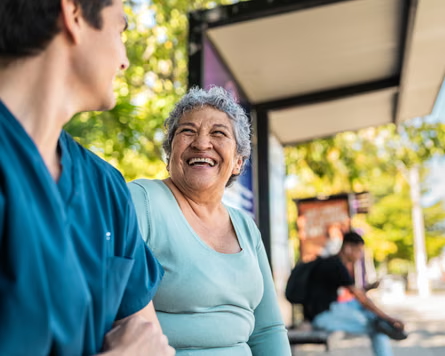
Secure people tend to be healthier, writes Levine. If they do get ill, they experience fewer symptoms and get less stressed about it. “When we feel safe, the whole stress response goes down, which goes with inflammation and all that stuff. It’s just so basic,” he says. In 1997, a study in which people were infected with a common cold virus found that participants who were more connected “were less likely to develop symptoms”. Similarly, secure types seem to be less susceptible to consumerism, better at resisting online adverts and less negatively affected by social media. Studies have also found that the more connected people are, the greater their cognitive functioning and brain volume in old age. They are even more effective and resilient when searching for jobs.
Levine has oodles of examples of how attachment style can affect one’s work, such as Luke, 32, who gets a well-earned promotion and finds himself managing a team for the first time. Because Luke is avoidant – which means he struggles with closeness and thrives on independence – he takes on all the complicated tasks himself and doesn’t delegate effectively. Despite him putting in extra hours, the team’s output falls and deadlines get missed.
Then there is Levine’s example of a worker with anxious attachment, who spends a whole week recovering from flu in emotional turmoil because when they emailed their boss to say they were ill, all they got in response was a curt “OK”. Someone with a secure mindset might have thought: great, they’ve replied even though they are really busy, I’ll get on with getting better.
Levine is confident that anyone can rewire their brain, luxuriate in secure mode and reap rewards far beyond better romantic and familial relationships. But he is keen to point out that character traits of anxious attachers or avoidants can also be superpowers.
Anxious people are extremely sensitive to what others are feeling and are the first to spot danger and raise the alarm. Just as these people have evolved to be community lookouts, so others have evolved to need time alone. Levine writes: “[Avoidants] often function well under pressure at work, are capable of making tough decisions on their own and executing them with precision.”
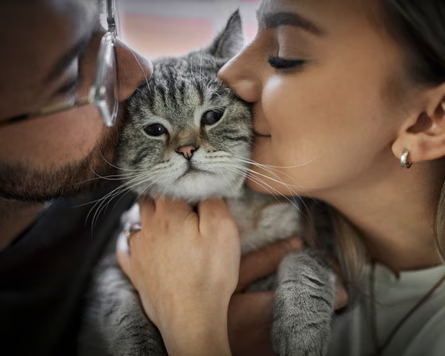
There are many portals to secure mode. Because Levine has been working with people on what he calls “secure priming therapy” for many years, his book answers every if and but that can arise. A vast array of nuances have emerged within attachment theory over the years. First, it is not set in stone that we are stuck with a certain attachment style our whole lives because of the way we were parented. Second, we can be in different attachment styles with different people. You can identify this by filling out Levine’s online attachment questionnaire for different relationships – you can even choose your pet. In fact, pets have attachment styles themselves, as evidenced by my clingy cat. “People think: oh, cats are really aloof,” says Levine. “Some cats really love closeness.”
It’s possible to be rendered insecure at any age. “I have a little bit of a sad story,” he says. A woman he knew who was single for many years – “so independent and cool” – suddenly, in her 80s, met someone, who moved in with her. “It sounds like such an amazing story, and initially it was, but this person was very easily hurt and jealous.” Whenever something upset him, he’d ignore her for weeks.
“It really did a number on her,” says Levine. “She died from heart disease. I personally think that it exacerbated her heart condition, because think about it: it’s up and down, up and down, and our body responds to it. But, at any age, you can all of a sudden be catapulted like this into very painful, difficult, insecure situations.” Scenarios such as this are partly why he wrote the book: “To provide the tools not to get there, because it’s a dear price that people can pay.”
There is also a questionnaire on Levine’s site to identify your general attachment style. This flurry of rational self-probing gives you “your attachment topography”, he says. Becoming better aware that attachment styles are less fixed and are often in response to others’ behaviour is liberating and validating in itself, while there is the added value of mapping whom you feel most secure with. “You can use that as a vehicle for change, to increase your interactions with them,” he says. Taking simple, consistent steps over time to embrace secure relationships and deprioritise insecure ones can help us rewire ourselves.
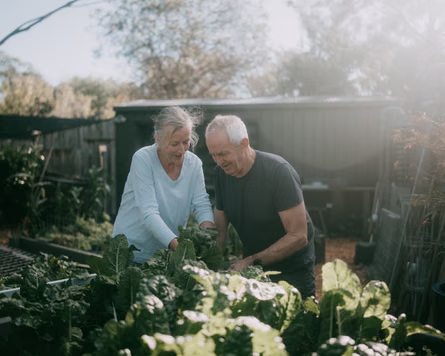
“Our brain is so socially savvy,” says Levine. “Our biggest asset, by far, is our ability to collaborate, because we’re very weak animals, yet we rose to the top of the food chain. We made it to the moon all because of our ability to collaborate.” Social species have evolved with an innate sense of safety in numbers and our brains constantly scan the environment for others. Humans have an extra prong to this “crowdsourcing neurocircuitry”, writes Levine. “Not only do humans have the capacity to sense the number of individuals around them and translate that to a greater feeling of safety, but they can simultaneously assess their level of safety based on the quality of those relationships.”
He also says that our brains can use only a finite dose of energy at any one time. If we’re feeling unsafe, anxiously scanning for elusive allies, ruminating over why someone didn’t call, we’re monopolising energy that could otherwise be channelled into creativity, ideas, making fun plans, investing in good relationships. In other words, feeling insecure is exhausting. If you’re avoidant, energy is spent suppressing parts of the brain that react to relationship interactions.
“When we get excluded and we get ignored, it elicits painful distress and self-scrutiny in our mind,” Levine says. “So when someone doesn’t reply to our call or someone ignores us, we’re left wondering: what does it mean? What did I do wrong? Are they not thinking about me any more? Am I less important to them?” If we’re snubbed, our brain reacts as if we’ve been punched in the face, he says. The same areas of the brain light up as they do during physical pain. Paracetamol dulls this snub response, just as it does physically induced pain.
Don’t be surprised to overhear people carping on about Carrp in the coming months. This is Levine’s acronym for his five pillars of a secure, connected life: consistent, available, responsive, reliable, predictable. (He has already overheard colleagues using it as a verb.) By being Carrp to others, and setting up your life to maximise your exposure to Carrpness, he says, you can step into the land of secure attachment.
Take Eric, who was seemingly never good enough for his undermining father. His loving and supportive mother wasn’t able to challenge this behaviour and simply encouraged Eric to avoid antagonising his father. Eventually, this social, sporty and academically successful teen started to retreat from his friends and his favourite sports.
By chance, a university friend told Eric he had to try his amazing therapist. It turned out that this woman’s modus operandi was totally Carrp. She encouraged him to call any time anything was amiss. When he told her about his retreat from sport due to his dad’s mocking, she suggested they jog together for their next session. Over time, as their relationship deepened, writes Levine, “he was able to silence the harsh voice he’d adopted from his father when speaking to himself, and he felt more content.” His brain rewired to secure mode.

Mercifully, Levine has only one more acronym: Simis, or seemingly insignificant minor interactions. When we greeted each other at the start of our conversation, Levine commented on the sun streaming through my window. Cue my typically British rundown of the sunny-but-cold weather, in contrast to last week when we were hotter than Ibiza! Classic Simi material. “When I was in London, people always liked to talk about the weather,” Levine says. “I now have a new appreciation for it. It’s actually really important, because it’s a joint experience that we both can relate to, and it’s important to us – it’s a way to connect.”
Neuroscientists have demonstrated that these small, everyday interactions, even with passersby on the street, can either strengthen “existing neurocircuitry or overwrite it to create new pathways. Positive Simis can provide us with the opportunity to heal past adversity as new experiences overwrite the old,” he writes.
One of the most liberating concepts Levine introduces is that – shock horror – our attachment style isn’t necessarily handed to us by our problematic parents. Even if it was, it doesn’t mean it’s indelibly branded on to our soul. In fact, such narratives can be a psychological trap. “We can’t be fixed by something that happened to us at the age of three; that doesn’t make sense,” he says. He points out that causality is complex and near impossible to pick out between life experiences, genetics, in-vitro influences. “Parental experiences can even epigenetically change the sperm and change the offspring,” he says. “We’re so far beyond nature versus nurture. It’s so wild and nuanced and complicated.”
He also wants to break the anxious cycle of parents overworrying that their behaviour has inflicted anxious attachment upon their child – it’s often chicken and egg. “Think about how much more challenging it is to raise a child that has this heightened sensitivity. It’s just harder.”
Besides, he says, causal inferences are not necessary for change; in fact, they can be “a form of internal gaslighting: because this has happened to me, that’s why I’m reacting”. This can detract from acknowledging that what’s happening to you is not good and needs to be tackled – it can diminish what you’re reacting to and what you’re legitimately feeling.
He is slightly nervous about how the book will be received. It’s not that he is saying there isn’t a place for trauma therapy, or that other more conventional methods are wrong, per se, he says. It’s more that this is what works for him and his clients and what his research in neuroscience and his therapy practice have landed on as effective. “I don’t know how people are going to respond to it,” he says. “I’m a little bit scared of it.”
Secure by Amir Levine was published on 14 April (Cornerstone Press, £22). To support the Guardian, order your copy at guardianbookshop.com. Delivery charges may apply. Levine will appear at the How To Academy at the Royal Geographical Society in London on 1 May