





Hello, and welcome to TechScape. I’m your host, Blake Montgomery, US tech editor at the Guardian, writing to you from beneath a cherry blossom tree in Prospect Park in New York City. Spring has arrived!
Elon Musk and Sam Altman’s court fight could have been a major moment for AI safety
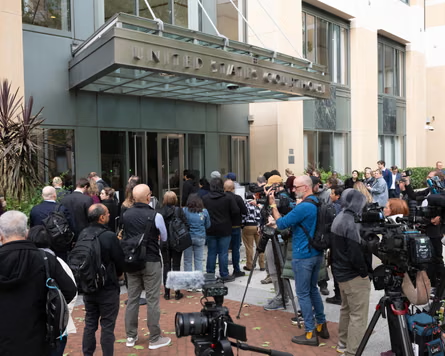
Monday marked the start of a major trial pitting Sam Altman against his OpenAI co-founder Elon Musk, who is suing the maker of ChatGPT for breach of contract.
Musk alleges that Altman, OpenAI’s CEO, broke the company’s founding agreement by restructuring and converting much of it to a for-profit enterprise. Altman and OpenAI counter that Musk, who left the firm in 2018 amid internal disputes and has since started his own rival AI business, xAI, is essentially a sore loser. Musk is seeking a range of remedies that include the removal of Altman and OpenAI president Greg Brockman and more than $134bn in damages, which Musk says would be redistributed to OpenAI’s non-profit arm. The company has denied Musk’s allegations.
The case, which pits the world’s richest man against the creator of the world’s most famous chatbot, in theory could pose consequential questions: what incentives should AI be oriented towards, benefiting humanity or making money? What does a responsible, maximally beneficial version of AI technology look like? What happened to OpenAI’s stated mission of benefiting humanity?
But the case is not posing that question. Instead, it’s a fight dominated by personal pettiness and specific bitterness, motivated by money and personal grievance.
Musk is no messenger for AI safety. His company’s chatbot Grok was the centerpiece of one of the most disturbing failures of generative AI to date: thousands of people used it to undress real women and underage girls via X, the social network Musk owns. xAI, the artificial intelligence arm of SpaceX as of February, has also been accused of negligently polluting its surrounding community with giant data centers. Why should we believe he would reorient OpenAI towards humanity’s collective benefit? He doesn’t lead xAI that way.
If Musk wins, he will kneecap a rival AI company. Without its for-profit arm, OpenAI will face difficulty attracting the level of investment it needs to compete in the AI race. If Altman and Brockman win, they can move forward with his for-profit enterprise as before. As Brockman wrote in his diary in 2017, which was made public during discovery: “It would be nice to be making the billions.” Perhaps his wish will be granted after the trial, and he will have pulled off a feat of corporate subterfuge that has made him and Altman billionaires. Neither that outcome nor Musk’s victory seems promising for an AI industry aligned less with monetary incentives and more with humanity’s collective betterment.
“Can’t see us turning this into a for-profit without a very nasty fight,” Brockman wrote. “[Musk’s] story will correctly be that we weren’t honest with him in the end about still wanting to do the for profit just without him.”
The public stands to gain little in the way of greater understanding of AI, and the trial offers no promise of sending a greater message to the AI community. What the public will receive, though, is a litany of dirty laundry. In addition to embarrassing diary entries, discovery and depositions have unearthed questions to Musk about his ketamine usage at Burning Man and Musk’s one-on-one correspondence with Mark Zuckerberg. The mother of four of Musk’s children, also an OpenAI board member, is set to testify at trial about their relationship as well. Perhaps airing out a juicy feud will be a consolation prize.
Reworked: a Guardian series about AI and the future of work
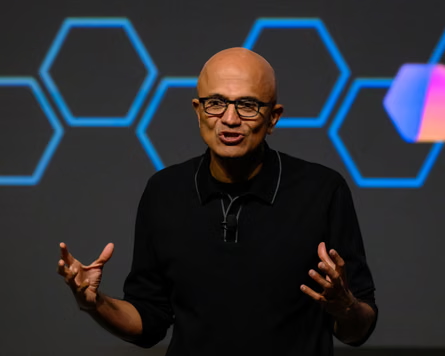
Last week, Meta and Microsoft announced major layoffs and voluntary buyouts respectively. Both companies are leading spending in the massive buildout of data centers and AI infrastructure, which is forcing them to offset costs by pruning their payrolls. Other tech companies are beginning to adopt similar logic.
My colleague Sanya Mansoor reports:
Meta told staff on Thursday it would cut some 10% of its personnel – just under 8,000 employees– to boost efficiency, part of a layoff plan made months ago. The company is also closing about 6,000 open roles. The same day, Microsoft announced to employees, for the first time, that it would offer voluntary retirement to about 7% of its American workforce of roughly 125,000.
In an internal memo to Meta’s staff, Janelle Gale, the chief people officer, didn’t mention AI explicitly but said the cuts would allow the company to “offset the other investments we’re making”. In Meta’s fourth-quarter 2025 earnings presentation, the CEO, Mark Zuckerberg, spoke about a “major AI acceleration” that included plans to spend from $115bn to $135bn on AI – nearly twice the company’s capital expenditure the previous year and more than half of its annual revenue, according to the Wall Street Journal.
In July 2025, Microsoft forecast that it would spend some $100bn on AI infrastructure in the coming fiscal year. Analysts now estimate that figure to be $110bn-$120bn.
Zuckerberg and Microsoft CEO Satya Nadella alike have claimed AI is handling larger and larger amounts of their employees’ workloads and meeting their productivity needs. Mustafa Suleyman, Microsoft’s AI chief, said in February that he believes that AI will be able to replace most white-collar work within the next 12 to 18 months.
Though Meta and Microsoft are reducing their workforces at the greatest scale, other companies in tech are likewise allocating their future spending towards AI rather than human employees. Smaller businesses and teams within large enterprises are fixated not on massive data centers but on tokens, the unit of measurement and payment for AI chatbot usage. “For my team, the cost of compute is far beyond the costs of the employees,” Bryan Catanzaro, vice-president of applied deep learning at Nvidia, said to Axios.
Goldman Sachs economists found in a recent survey that companies are using up their yearly AI budgets in a matter of months, which could lead to spending more on tokens than on new hires. Jason Calacanis, a host of the Silicon Valley podcast All-In, asked his co-host Chamath Palihapitiya two months ago: “When do tokens outpace the salary of the employee? You’re about to hit it. I’m about to hit it.”
The wider TechScape
-
Apple’s Tim Cook leaves behind complicated legacy on privacy
-
Altman apologizes after OpenAI failed to alert police before fatal Canada shooting
-
Democratic Maine governor vetoes first US state freeze on new datacenters
-
The Guardian view on Anthropic’s Claude Mythos: when AI finds every flaw, who controls the internet?
-
AI hallucinations found in high-profile Wall Street law firm filing