
惯性聚合 高效追踪和阅读你感兴趣的博客、新闻、科技资讯
阅读原文 在惯性聚合中打开

推荐订阅源

OSCHINA 社区最新新闻
OSCHINA 社区最新新闻
博客园_首页
雷峰网
雷峰网
Cyber Security Advisories - MS-ISAC
WordPress大学
WordPress大学
腾讯CDC
T
Tailwind CSS Blog
A
About on SuperTechFans
H
Hackread – Cybersecurity News, Data Breaches, AI and More
The GitHub Blog
The GitHub Blog
T
The Blog of Author Tim Ferriss
G
Google Developers Blog
The Cloudflare Blog
D
DataBreaches.Net
Recent Announcements
Engineering at Meta
Engineering at Meta
B
Blog
博客园 - 聂微东
阮一峰的网络日志
阮一峰的网络日志
月光博客
月光博客
博客园 - 司徒正美
MongoDB | Blog
MongoDB | Blog
Google DeepMind News
Apple Machine Learning Research

The Guardian

Rory McIlroy surges into six-shot Masters lead with stunning second-round flourish ‘That’ll be the end’: actor Sam Neill joins fight to stop controversial goldmine near his New Zealand vineyard Roberto De Zerbi targets ‘Ange-ball’ revival to save Spurs from relegation Bath hit back to reach semi-final after stunning Northampton in 11-try epic Secret Garden to Outcome: the week in rave reviews Zebras, wealth and power: Hungary’s election tests Orbán’s grip on power ‘TikTok effect’ brings sellout crowds and younger fans to Grand National meeting The war over Omagh’s gold: the £21bn mine plan tearing a community apart Britain’s shadow workforce is paid as little as 65p an hour. Who cares for the carers? From You, Me & Tuscany to Euphoria: your complete entertainment guide to the week ahead Six great reads: the man who let snakes bite him, masked heavy metal and the brutal reality for foreign students in the UK American Classic review – I defy you not to fall in love with Kevin Kline and Laura Linney’s tender comedy Cuba’s doctors were a lifeline for the world. Now the Caribbean is shamefully complicit in the US drive to expel them An environmental disaster in Moldova has Russia’s fingerprints all over it RMIT drops misconduct case against student who accused university of being ‘complicit in Gaza genocide’ Ichiro Suzuki statue unveiling goes awry as bronze bat snaps during ceremony Survivors of Epstein’s abuse accuse Melania Trump of ‘shifting burden’ on to victims European football: Real Madrid held at home by Girona to extend winless run Arne Slot insists he is ‘aligned’ with Liverpool board and fans as squad is rebuilt Kamala Harris ‘thinking about’ running for president again in 2028 JD Vance warns Iran against trying to ‘play’ the US in peace talks West Ham double up twice to thrash Wolves and put Spurs in relegation zone Trump administration releases new renderings of so-called ‘Arc de Trump’ Crispin Odey drops £79m libel claim against FT over sexual misconduct allegations Bafta apologises for events surrounding John Davidson’s Tourette’s outburst Cocktail of the week: Bar Shrimp’s la rosita – recipe New drug may extend survival in aggressive ovarian cancer, trial shows One dead and 27 injured after bus with British passengers crashes in Canary Islands Pope adds to Smith’s mass of Surrey runs with England woes a world away OpenAI CEO Sam Altman’s home targeted with molotov cocktail
Bioluminescent algae’s blue light harnessed to make 3D-pr...
Chris Barani · 2026-05-07 · via The Guardian

The captivating blue glow emitted by a sea-dwelling species of algae has been harnessed by scientists in the US to make light-emitting structures.

Pyrocystis lunula is a bioluminescent single-celled organism that sometimes produces brief flashes of blue light. Large clumps of the algae are known to emit sparkling displays in waves breaking against beaches.

Giulia Brachi, of the University of Colorado Boulder, had been experimenting in a darkened laboratory, looking for a way to cause the algae to give off a more sustained glow. “We were trying to squish them very slowly,” said Brachi, explaining how she and her colleagues had attempted to replicate the mechanical stress of waves. “They weren’t really responding to that.”

Other researchers have had success with such an approach but one downside is that mechanical stimulation can be difficult to control. So Brachi and her colleagues tried another tactic. Previous studies indicated that when the algae were exposed to acid, the pH level within the light-emitting part of their cells dropped, triggering light production. Brachi added a slightly acidic solution to a glass lab flask containing the algae.
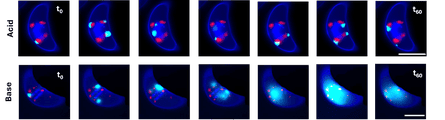
Blowing blue cells after the addition of an acidic solution to the bioluminescent single-celled algae.
Scientists added a slightly acidic solution to the bioluminescent single-celled algae.

“I was like: ‘Wait a moment, is that the light [reflecting] from a laptop?’” she said. Rather, the algae inside the flask had taken on an appearance like living glitter. In a paper published in Science Advances, she and her co-authors describe how they were able to induce glowing for up to 25 minutes at a time.

The scientists encapsulated the algae within a hydrogel – a jelly-like substance made with water – and were able to 3D-print various blobby shapes with it, including a crescent moon, in homage to the algae’s appearance under a microscope. All the shapes glowed a strong cyan shade of blue.

Bioluminescent algae contain an enzyme called luciferase, which reacts with a light-producing compound called luciferin – these names come from the Latin “lucifer”, or light bearer. “They’re pretty self-sustaining provided that they have access to seawater,” said Prof Wil Srubar, also of the University of Colorado Boulder.
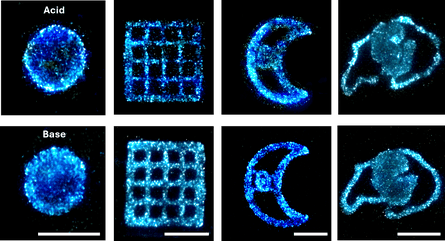
Eight images of 3D-print blobby shapes glowing a shade of cyan blue
Scientists encapsulated the algae within a hydrogel and were able to 3D-print blobby shapes with it.

Srubar suggested that this “living light” could be used for glowsticks or glowing bracelets at raves. Or the algae could theoretically be embedded within biosensors that glow when they detect toxins in the environment.

Prof Chris Howe, of the University of Cambridge, who was not involved in the work, said: “Moving it from what works under controlled conditions in the lab to what works in the real world will be a challenge – but this is a really interesting first step.”

He added that for small, light-emitting devices that rely on disposable batteries, switching to bioluminescence in some cases could drastically reduce the waste created when those batteries run out of juice.

That acid induces bioluminescence in certain algae species is well known, said Anthony Campbell, a professor emeritus at the University of Cardiff. He said he was sceptical the algae could survive for long in the solution used in the study, which had a pH of 4. That’s about as acidic as a tomato and “they don’t like it, it stresses them”, Campbell said.

One mystery remains. Scientists still don’t know why algae such as Pyrocystis lunula evolved to emit light in the first place. It could be that their sparkling displays play a defensive role, perhaps deterring organisms that would otherwise eat the algae.

Howe said: “To my mind, that’s a fairly plausible explanation – but it’s certainly not known for sure.”