


He was a reclusive author, who revealed little about himself or the inspiration for his 1951 masterpiece The Catcher in the Rye. Now letters that JD Salinger wrote to his editor have come to light for the first time, offering significant insights, literary and personal.
A previously unpublished correspondence reveals the author’s intervention over how he and his novel would be presented and his unease about his writing being viewed through an ethnic or religious lens.
When Salinger emerged in the early 1950s as one of the most influential literary voices of his generation, one personal detail was conspicuously absent from his public profile: his Jewish and Irish Catholic heritage. That omission was not accidental, the letters show.
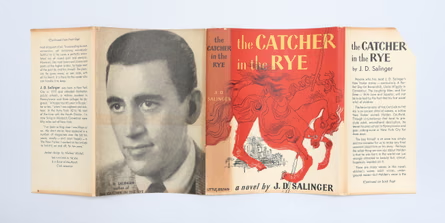
In the final stages of production for The Catcher in the Rye, Salinger asked his editor, John Woodburn, to remove his “Jewish-Irishness” from the book jacket. He wrote: “I don’t know that I’d like to have that Jewish-Irish business slapped on the jacket … Surely it’s as bad to advertise worthy information as it is to withhold it – if it’s catchy, that is.
“Second-rate reviewers would probably find the information just provocative enough to use and misuse over and over again and I’d end up being expected to wear a Star of David and a Shamrock on the back of my sweatshirt. So, please, let’s be careful.”
Salinger signed off: “Yours, Jerry”. Woodburn’s reply, which has survived on a carbon copy alongside Salinger’s letters, confirms that he had agreed to the request.
The first-edition dust jacket bears no reference to the author’s cultural or religious lineage, noting only that he was born in New York City. The correspondence – which includes an autograph postcard and two typed letters – has been acquired from a private collector by Peter Harrington Rare Books, a leading antiquarian bookseller, in London.
Sammy Jay, its senior specialist, said: “It’s very exciting to have letters of consequence from a major writer, particularly ones that are revelatory for their books and their intentions around them. For Salinger, this is really rare because he was very private. Occasionally, you see a letter here or there, but ones where he’s actually writing about his books are very unusual.
“This exchange provides the clearest primary-source documentation yet of Salinger’s resistance to biographical framing and his determination to control how his identity intersected with his work.”
Salinger once described publishing as a “terrible invasion of my privacy” and this correspondence reflects his wish “to separate authorial identity from textual interpretation”, Jay added.
In these letters, Salinger also discussed an unpublished “long story” involving “three brothers from the novel,” a reference to The Ocean Full of Bowling Balls, his prequel to Catcher, which has long fascinated his fans because Salinger suddenly cancelled its publication, stipulating in his will that it must remain unpublished.
That restriction remains in place until 50 years after his death in 2010 although, in 2013, the prequel was leaked from Princeton University Library, where it had been held, and pirated editions circulated online.
“Holden doesn’t actually appear,” Salinger wrote to Woodburn, “but his name comes up so often, and so importantly, that he’s really in the story.” Holden Caulfield is the fictional disaffected New York teenager who is the protagonist and narrator of The Catcher in the Rye.
Jay said that, in this unpublished letter, Salinger was giving his editor a sense of the story that he was expecting to edit: “He tells him that Holden doesn’t appear, but that he haunts this story too. In his short stories and novels, he weaves together a lot of characters, all loosely part of the same world, and so it’s nice to see that he has the same intentions for this other story that he then retracted.”
Salinger is known to have become a recluse after publishing The Catcher in the Rye, refusing rights to adapt it for Broadway or Hollywood. But, even before its publication, Woodburn’s letter notes, in a jocular tone, that he wanted to coax him from his “hermit’s life in Westport [Connecticut]”.
The correspondence will be presented by Peter Harrington at the New York International Antiquarian Book Fair, which opens on 30 April.