








Gordon Stevenson was a mover and a shaker within late-70s New York, back when the city was, in the words of photographer Julia Gorton, “a nihilistic playground for people with trauma”. Tall, rail-thin, hair cut into a severe widow’s peak, Stevenson was an artist, jewellery designer, musician and the auteur behind one of no wave cinema’s most notorious works, Ecstatic Stigmatic.
Four decades after his death, however, he’s best remembered as a footnote in other people’s stories. That’s all about to change, however, with the discovery of a storage unit full of his lost work, including jewellery, collaborations with mail-art pioneer Ray Johnson, and even clues to the whereabouts of a surviving print of Ecstatic Stigmatic. Meanwhile, his family have recovered hundreds of letters Stevenson wrote to his parents, chronicling life in his downtown demimonde and his experiences as one of New York’s first Aids patients.
“Gordon always belonged in New York,” says his sister Barbara Stevenson, but his story begins 900 miles south, in the small town of Dublin, Georgia. The second of four siblings in a family of “emotionally repressed stoics”, Stevenson was a maths prodigy with a taste for Flannery O’Connor, Nietzsche and Sartre, who argued about the Vietnam war with his warehouse foreman father every dinnertime.
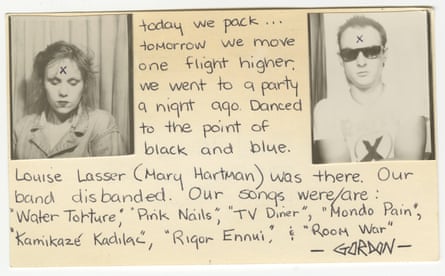
Offered a maths scholarship at the prestigious Georgia Tech, he instead chose the liberal arts campus of Eckerd College in St Petersburg, Florida, widening the rift with his parents. In one of a series of letters home, Stevenson reports that at one of St Petersburg’s many flea markets he met Mary Kathryn Cervenka, who lived nearby with her sister Christine. “She supports herself selling vintage clothes,” Stevenson writes. “She says you’ve got to live by your wits. But I’m not sure if I’m that witty.”
Cervenka was as much a maverick as Stevenson, and the couple and Christine got up to plenty of mischief in St Petersburg. Deciding Mary Kathryn was too “Catholic schoolgirl” she renamed herself Mirielle, while Stevenson recommended Christine swap out her “Christ” for an X, renaming herself Exene. “Gordon and Mirielle were passionately in love, and of a like mind: creative, unconventional,” says Barbara. Arto Lindsay, another Eckerd alumnus, likens them to “those couples in Harajuku, Tokyo, who always dress alike”.
The couple celebrated 4 July 1976 – the US bicentennial – by getting married at a Florida rubbish dump, and relocated to New York the following year. “The city was very destroyed by the drugs and violence,” says Maripol, a European émigré designer and film-maker friend who later worked with Grace Jones and Madonna. “But there was freedom. That the city was bankrupt meant low rents. Creative people could afford to live there.”
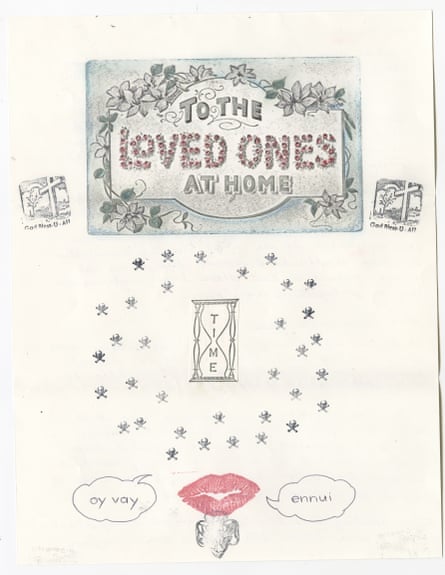
At first, Stevenson and Cervenka survived on her income from vintage shop Reminiscence; in letters home, he confessed money was so tight he’d considered taking the exam to work in the civil service. He’d write to his parents for the rest of his life, the letters often scrawled on the back of pieces of his work, like the mail art of Johnson, with whom he’d been corresponding since his teens. But, notes Barbara, “there’s in an edge to these letters. The emotions are complicated. Gordon was justifying and defending his lifestyle, something our parents never accepted.”
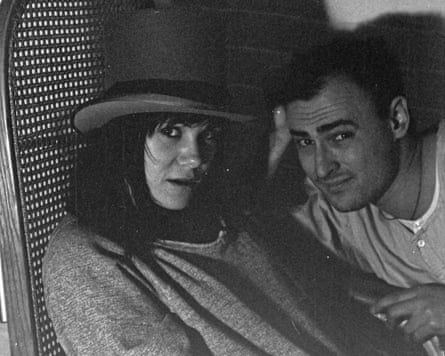
By early 1977, the couple’s jewellery brand, LHOOQ, began selling through boutiques like Fiorucci and Saks. Upcycling vintage trinkets from the previous couple of decades, their output “repositioned the jewellery for the punk market”, says Gorton. Stevenson’s “memento mori” series, meanwhile, focused on crosses and skulls, anticipating gothic fashion and showcasing a macabre sensibility he’d first exhibited in high school, when he wore the ear of a foetal pig he dissected in biology class around his neck.
The jewellery paid the rent – but Stevenson’s ambitions lay elsewhere. He and Mirielle participated in early jams from which sprang groups of the no wave movement such as Arto Lindsay’s DNA, Mars and James Chance and the Contortions. Stevenson joined Lydia Lunch’s Teenage Jesus and the Jerks, who were, Gorton says admiringly, “really intense, abrasive, not friendly – just a perfect band”. Jim Sclavunos, who later drummed for Sonic Youth and Nick Cave and the Bad Seeds, remembers Stevenson “had only three strings on his bass guitar. The top string broke early on and he never bothered replacing it. He was a very striking presence, depraved in the right ways.”
Stevenson’s tenure with Teenage Jesus was brief, though it included their eventful December 1977 trip to London, during which the band were strip-searched and almost deported. Stevenson and Cervenka befriended Vivienne Westwood, who wanted them to run a New York branch of her shop Seditionaries. Upon their return home, Lunch sacked Stevenson. “Mirielle was their manager, and Lydia didn’t think much of what she was doing,” says Sclavunos, who was given Stevenson’s role by Lunch. “Lydia said: ‘If you want to be in the band, you have to fuck me.’ Not that I needed to be persuaded. She was an intimidating figure to a virgin, but it was clear it was going to be something special.”
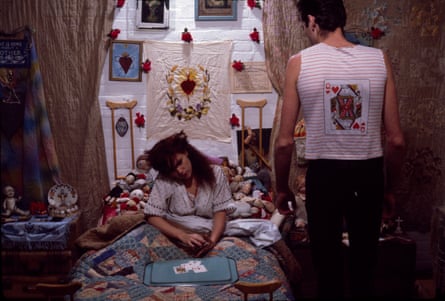
Stevenson transferred his energies to film-making. Filmed throughout 1979, to a tight $5,000 budget, Ecstatic Stigmatic (subtitled “the film with a disease”) was inspired by Marie Rose Ferron – a Catholic mystic whose various illnesses were proclaimed to be stigmata – and the 1978 Jonestown massacre. “Gordon was an existentialist, an atheist. He wanted to take on religion and cults,” says Barbara.
It isn’t just the poor quality of the VHS-rip that makes Ecstatic Stigmatic a hard watch in 2026; the scenes of child abuse, with Mirielle as the stigmatic and Lindsay as her sinister father, are particularly disturbing. But Sclavunos, a film school graduate, was “surprised by how good it was. A lot of no wave cinema looked juvenile. But Ecstatic Stigmatic was very shadowy, sleazy and sexual.” Lindsay, meanwhile, commended Stevenson’s “graphic sensibility. There was a scene where I’m blindfolded, thrashing around at the bottom of the stairs, which was his homage to [performance artist] Vito Acconci.”
But Stevenson and Cervenka’s relationship was fracturing. “They were the Sid and Nancy of no wave,” says Barbara. “But Mirielle needed her own space.” By early 1980, they had separated and wound down LHOOQ, but continued to promote Ecstatic Stigmatic – which, Stevenson wrote to his parents, he believed “cursed”. The movie screened in New York, but fell afoul of a projectionists’ strike, while a print sent to distributors in Italy was censored for being too violent and pornographic (“which it is not”, wrote Stevenson).
They pinned their hopes on Hollywood, booking screenings to coincide with the launch party at the Whisky a Go Go for the debut album by Exene’s band, X. Mirielle rode to the gig alongside her Ecstatic Stigmatic co-star Johnny O’Kane. En route, their car was hit by a drunk driver; Mirielle was killed in the resulting crash.
Her death was “a tremendous blow”, Barbara says. “Gordon handled the grief by throwing himself into work.” He continued promoting Ecstatic Stigmatic, partly out of respect for Cervenka’s memory. He rebuilt the jewellery brand, now renamed Junk, and developed a creative relationship with up-and-coming designer Anna Sui. He worked on further movie scripts and planned to publish a book about mail art.
Cervenka remained, as one friend put it, “the altar at which Gordon worshipped”. But he began dating again: first Terence Sellers, a bohemian author and dominatrix, and then Cookie Mueller, an actor who starred in numerous John Waters movies and was a regular subject of Nan Goldin’s photographs. He immersed himself in the downtown drug culture. “He liked to go to these parties where they’d all sit in a circle, somebody would get out a needle and inject themselves with heroin, and then they’d pass it on to the next person, and so on” says Barbara. “It was like a ritual.”
At the end of 1982, Stevenson fell ill, developing sores on his body. “This isn’t an external condition – I can feel sores on my insides,” Barbara remembers him saying. Realising the lesions were Kaposi’s sarcoma, by early 1983 the doctors diagnosed Stevenson with Aids. News of his illness shook the downtown scene. “Gordon got Aids before anyone knew what it was called,” remembers Lindsay. “He was devastated, so angry that the Reagan government was ignoring Aids – or secretly welcoming it.” Sclavunos remembers everybody on the scene being “convinced they had it. Everyone was very paranoid, because we’d all slept with each other, we’d all done drugs together, and we only had this vague understanding of what caused Aids.”
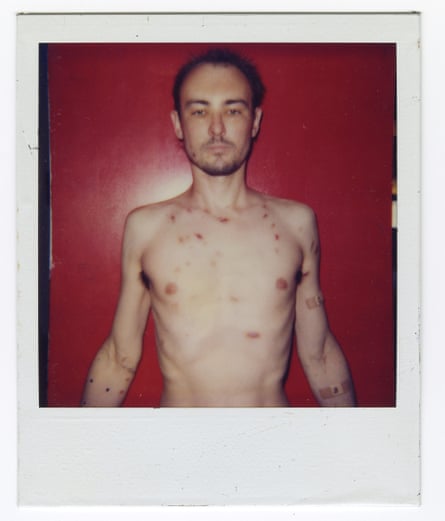
“Gordon’s physical and mental health deteriorated quickly,” says Barbara. He documented his illness via his letters home, which grew increasingly harrowing. In May 1983, as he was accepted to the experimental Sloan Kettering treatment programme. He sent a Polaroid in which, he wrote, he looked “fashionably thin”; a month later, he sent another Polaroid, looking even more gaunt, and displaying the lesions all over his body. In another letter from June – with which he enclosed a clipping of a news story from the New York Times about Aids and the Reagan government’s mismanagement of the crisis – he predicted the disease would kill him and his brother Davey (who had not yet contracted Aids, but would die of the disease a decade later), and raged at his parents for “voting for the type of politicians” who tacitly endorsed the disease’s impact on the LGBTQ+ community.
Stevenson’s parents travelled up to be with Gordon, and finally saw the New York their son loved, at its most benevolent. Sui doted on the couple, taking them under her wing and showing them Chinatown; the Gay Men’s Health Crisis society, which had formed in the absence of meaningful government assistance over Aids, introduced themselves to the family at Sloan Kettering. “My father said: ‘It’s nice of you to drop by, but Gordon isn’t gay,’” remembers Barbara. “They said: ‘It doesn’t matter. We believe in helping Aids patients.’”
The treatment caused a high fever Stevenson wasn’t strong enough to fight off. In his last days, before he lapsed into a coma, he wrote to Mueller, who had also contracted Aids (they’d accused each of infecting the other), It was a rambling, poetic letter that raged at the “McCarthyist witch-hunt” Aids patients were subjected to, and dreamed of “a paradise, far away” where they would be reunited. On 14 August 1983, he died aged 29.
His parents were grief-stricken. In the years that followed, their innate stoicism stopped them visiting Gordon’s grave often. But his mother kept every one of his letters, which Barbara and her sister Cheryl rediscovered after her death. “She’d say: ‘One day, when he’s famous, I can bring out these letters and show his development.’” Not long afterwards, Stephanie Quinn Jackson and Henry Owings, founders of the Chunklet Music Preservation Project, contacted Barbara while researching post-punk band Limbo District, hoping for information on that group’s bassist, her brother Davey.
“We didn’t realise Gordon was Davey’s brother,” says Jackson. Soon, their research led them to a storage unit in Chelsea, New York, where Gordon’s business partner, Anthony Robinson, had stored his belongings since his death. “Anthony had said he and Anna would take care of it all,” remembers Barbara. “We’d imagined they’d disperse the work among his friends, or dispose of it, but they’d preserved it all: his jewellery, reels of dailies from Ecstatic Stigmatic and what we estimate to be tens of thousands of dollars’ worth of mail art created with Ray Johnson.”
Moma and New York University are both in negotiations to acquire Stevenson’s archive, while Barbara is writing a book about her brother, in which she’ll reprint many of his letters. Meanwhile, the family also tracked down the last surviving print of Ecstatic Stigmatic. It had ended up in the hands of the film’s cinematographer, Johanna Heer, and is now the subject of a legal dispute between the family and Heer. In the meantime, Brooklyn-based production and distribution company Factory 25 are to release a reconstruction of Ecstatic Stigmatic this year from Stevenson’s archive, using alternative takes to substitute for missing pieces, with screenings planned in the US and UK, and a DVD and Blu-ray release to follow.
These discoveries have brought joy to Stevenson’s surviving family and old friends. For Maripol, the news brings to mind the famous maxim of another New York art luminary. “It’s like Andy Warhol said,” says Maripol. “Everyone one gets to be famous for 15 minutes. And now, Gordon gets to live on through his work.”