


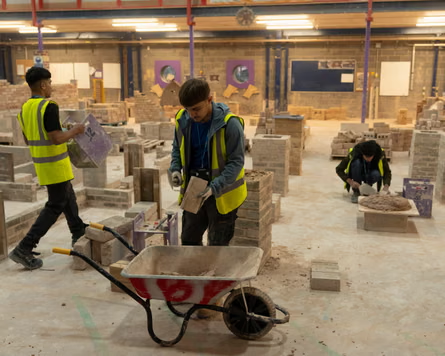
At South and City College in Birmingham, dozens of young people clad in hi-vis vests and hard hats are building mini-walls and plastering half-formed rooms.
Some weave in and out of stacks of bricks with wheelbarrows, while others use spirit levels to check the walls are straight and flat. In a few days time, these walls will be demolished and the plastering scraped away, for a new class to come in and try their hands.
This is the new generation of Britain’s construction workers, eager to rise to the task of building the 1.5m new homes the government has repeatedly proclaimed will solve the country’s housing crisis.
But despite ploughing ahead with extensive planning reform, cutting affordable housing targets and accessibility requirements in the name of a “Build Baby Build” philosophy, many in the sector think reaching the 1.5m target is impossible.
Just over 300,000 homes were added to the housing stock in the first 18 months of the new parliament, according to government estimates – nearly a third short of the pace needed to meet the manifesto target.
So what is happening with housebuilding in the UK, and will the government reach its goal by the end of this parliament?
Labour shortages
For years, experts have been ringing alarm bells about a growing skills crisis in the construction industry – there were 140,000 job vacancies stalling essential housing and infrastructure projects in 2025, according to Places for People, and it is forecast a third of construction workers will retire by 2035.
Staff at South and City College say the problem isn’t a skills crisis but an opportunities crisis. Their courses – from brickwork and plumbing, to electrical and carpentry – are busier than ever. They’re expanding their Longbridge campus to accommodate the rising demand, increasing class sizes and putting on extra cohorts.
More than 62,500 adults enrolled to study for a qualification in construction in England last academic year, according to the Department for Education data. It was the fastest-growing field of study in adult education, with enrolments up by nearly a third since 2021.
Informal training that does not result in regulated qualification also more than doubled from just over 10,200 students to 23,500 last year.
Awad, 19, said he had to be on a waiting list before he was able to get on the college’s plumbing course – something he was personally interested in, but also felt would provide a steady line of work with the government’s housebuilding ambitions.
“It means we know we’re going to be supplied with work, to help build all these houses. It feels like there’s a lot of opportunity,” he said. “There’s always going to be a lot of demand. If we make more homes, then obviously that means more jobs for us lot. And we get to help improve society.”
The problem isn’t finding the young people who want to work in the sector, but helping them find their way into the industry, staff say. There is a woeful lack of apprenticeships, and without two years of hands-on experience, young people struggle to find an employer willing to take them on.
Last year, only 24,500 people started an apprenticeship in construction in England. That is a fifth more than in 2020/2021 academic year – equivalent to 4,000 more people.

“We could fill most of our eight campuses with the demand in construction alone,” said Rebecca Waterfield, executive director of business development at the college. “What frustrates us is that I only had three brick apprentices start this year. So if there is such a big skill shortage, we’ve got the young people, but we need to work in collaboration with industry to make sure they’re going into those jobs.
“Employers are being quite shortsighted; they’re not taking on young people in apprenticeship roles or trainee roles, because of costs, because of time, because of quite a lot of things.”
The government has promised to train 40,000 new builders, bricklayers, electricians, carpenters and plumbers to help “turbocharge” building rates and help the working classes.
“They’re going to hit that easily. That’s the easy part. It’s about how many of that 40,000 actually end up in a job in the construction industry,” said faculty head, Andy Thompson.
Waterfield added: “It’s not a skills shortage. It’s a connectivity issue. If every construction employer in Birmingham took one student on for experience, they would have their next workforce.
“We get that it’s economically challenging. We’re not having a knock. But what we’re saying is, please stop telling us there’s a skills shortage.”
Cost of materials
At Emerys builders merchants in Stoke-on-Trent, workers are busy organising and stacking materials but there aren’t many customers around. It’s suspiciously quiet as a forklift trundles past with its load, and two workers pick up large boards of insulation.
“Just this morning we’ve had suppliers closing order books on those because of rising fuel costs,” said managing director James Hipkins, as he pointed to the boards. “That’s going to hold up housebuilding because companies just can’t get what they need.
“We’re starting to get product shortages, problems with supply. A lot of stuff comes from the far east, things like plywoods and timbers and imported stone. Everything is just rocketing in cost because of the Middle East crisis.”
But even before war broke out in the Middle East, things weren’t looking good for companies like Emery’s.
UK-produced brick prices are 80% up compared to a decade ago, ONS data shows. The cost of insulating materials, metal screws and precast concrete rose by about 50% in four years since 2021, while raw materials prices such as sand, gravel and cement as well as paint increased by about 30%.
Along with geopolitical instability and shipping disruption, rising energy costs and the need for more advanced low-carbon materials to meet green standards has driven up costs.
The result is that housebuilders can’t afford to buy as much. “We’re way adrift of those housebuilding targets and we can’t see how it’s going to get better,” said John Newcomb, CEO of the Builders Merchants Federation. “We will probably see somewhere between a 5% to 10% price increase in materials as a direct result of the Middle East situation.”
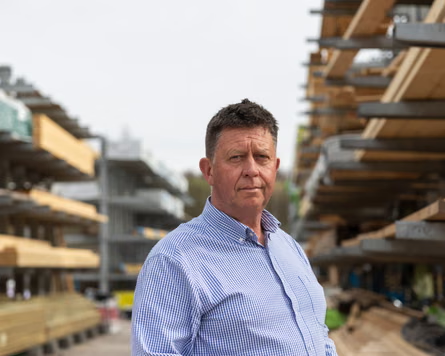
He said the sector was “full of hope and expectation” when the Labour party came to power and pledged 1.5m new homes. “A lot of our manufacturers clearly geared up and have invested quite heavily, but the upturn hasn’t happened,” he said.
By their analysis, across the sector, £1.4bn was invested by manufacturers and merchants to increase capacity in the materials supply chain in anticipation of a housebuilding boom which has yet to materialise – in the last year, 24 BMF members have gone into insolvency, and five more into administration.
“This is going to be the first time in 40 years we’ve posted an annual loss,” said Hipkins, Midlands Regional chair for the BMF. “This is much worse than after the 2008 financial crisis, because it’s insidious and it’s going undetected, unmentioned, unnoticed. We’re in a major cost of doing business crisis and no one seems to care.”
Affordability
At Woodberry Down in north London, diggers are in the process of demolishing a block of flats, phase four of a regeneration project to replace 2,000 homes – mostly council housing – with nearly 6,000 new ones that has already taken 15 years, and won’t be finished until 2035.
Berkeley Homes, the developer in charge, builds 10% of London’s homes. It is at the frontline of what has been described as a total collapse of housebuilding in the capital – only 3,248 new private homes began construction in London in the first nine months of 2025, less than 5% of the government’s forthcoming target of 88,000 per year.
“Economically, housebuilding is in a worse position than we were in 2010 after the financial crash,” said Rob Perrins, executive chair of Berkeley Group. “In the last 10 years, our costs are up 50%, but sales prices [of flats] haven’t risen at anywhere near the same rate, and that’s for a myriad of reasons. We’ve had the Ukraine disruption, the oil price increases – that’s caused huge issues in terms of viability.”

Earlier this month, Berkeley Group announced it would stop buying new land and hiring new staff due to the impact of “geopolitical volatility”, weak demand from buyers and “unprecedented” increases in costs and regulation.
This doesn’t bode well for housebuilding generally, but particularly not for affordable housing, which has stagnated across England in recent years. In an effort to boost building rates, the housing secretary, Steve Reed, cut affordable housing targets in London to 20% from 35% last year, prompting anger among homelessness campaigners and MPs.
Perrins insists it was the right thing to do: “If you kept to a 35% affordable housing fast track, no one was putting applications in. So do you want 20% of something, or 35% of nothing?” he said.
But there are concerns about who will be able to afford to buy whatever is built. Perrins said consumer hesitancy was the worst he had ever seen – now, one in three people who reserve one of their properties ends up cancelling, up from 15% a year ago.
“That shows how uncertain everyone is – there is a cost of living crisis, there is job losses. People aren’t buying,” he said. “So it’s first, can you make the site viable? And then, is the demand actually there?
“The numbers speak for themselves, people just aren’t investing. It’s affected everyone in building – local authorities and housing associations too. It’s not a private housebuilder issue. It’s a total market issue.”
On Woodberry Down, 43% of the new properties will be classed as affordable, including social rent and shared ownership.

But local residents said there are not enough social homes being built, and affordability is marred by service charges. Private developers provide the majority of new social housing, accounting for 83% of the total increase in affordable rent and 98% for low-cost home ownership properties.
Less than one in five homes in England are classed as affordable, according to government data. And social rent increased by 8% in the first financial year Labour was in power, from £471 to £510 per month with private providers and from £425 to £460 with local authority providers.
Cash-strapped local authorities have little capacity to boost their stock, too – almost 7,000 social rent homes were sold to right to buy and other schemes in the same period.
Experts say the country’s increasing reliance on a few large housebuilders to create most of its new housing stock – in England, about 40% of all new homes were built by the 11 largest developers in 2022 – is a fundamental issue.
“They’re private companies, they’re expected to make a profit,” said Dr Jonathan Webb, principal research fellow at the Centre for Regional Economic and Social Research at Sheffield Hallam University.
“The government are going to struggle to meet that 1.5m target and also make those homes affordable because there’s a fundamental misalignment in terms of what the government want to do and the interests of the people they’re ultimately reliant on to build those homes.”
Planning reform
Since coming to power in 2024, Labour have made planning reform a cornerstone of their policy – they’ve reinstated mandatory housing targets for local authorities, introduced a “grey belt” to bypass some green belt restrictions, and reduced the power of local planning committees.
They’re also consulting on a new policy that would create a presumption of approval for any housing development within walking distance of a train or tram station.
“It’s generational change – we’ve not seen anything like this since the 90s,” said Robert Boughton, CEO of Thakeham, a south-east-based housebuilder. “It’s not a free for all, but it’s night and day from where we were previously.”
But there are not enough planning applications. The latest data from construction consultant Barbour ABI showed there were applications for over 26,000 developments submitted in February this year – a third short of the number necessary to meet the government target, as not all planning applications will result in a house being built.
Boughton said there were still a number of day-to-day challenges holding up projects – things like highways approvals and water and power connections were still taking too long and costing too much. He said the cost of connecting a home to Thames Water had increased from £660 to £1,700 in a year.
“It’s like sludge in the system, dragging things down still,” he said, but added he was optimistic that, within a few years, the planning reforms would have a seismic effect – Thakeham hopes to go from building 500-700 homes a year, to 1,500-2,000.
Industry experts have also said that while planning reform is helpful, ignoring other key issues that are stalling building projects would undermine them.
“You risk wasting all the planning changes you’ve made and the pain you’ve gone through negotiating those, if you don’t address the other factors,” said Steve Turner, executive director of the Home Builders Federation.
“You’ve got this perfect storm in that, across the country for various reasons, many sites now just can’t be developed because it’s not viable to – there’s no confidence that people can actually afford to buy the houses.”