





A few years ago at the London Marathon, organisers wheeled out an industrial-sized treadmill called the Tumbleator. Then they tempted curious onlookers with a simple question: can you keep up with Eliud Kipchoge? The answer was obvious. But that didn’t stop people trying. Most lasted a few seconds before comically flying off the back into crash mats.
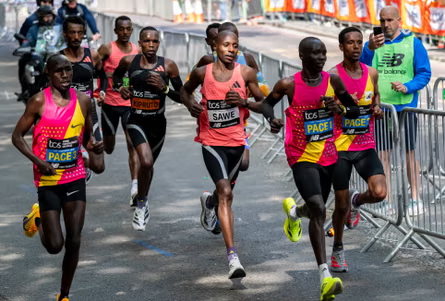
The Tumbleator has a fresh poster-boy now: Sabastian Sawe, who on Sunday claimed track and field’s last holy grail by running a sub two-hour marathon. Imagine sprinting 17 seconds for 100 metres, and then sustaining it across 26.2 miles. Or setting your treadmill at 4min 33sec per mile pace and carrying on for 1hr 59 min 30sec. It sounds ridiculous, impossible, laugh-out-loud stupid … until you realise that is what Sawe did in London.
Afterwards, in all the superlatives and search for perspective, the London Marathon’s race director Hugh Brasher made an extraordinary suggestion. Sir Roger Bannister’s four-minute mile had been the greatest sporting moment of the 20th century, he told us. And, just maybe, we had witnessed its 21st-century equivalent.
Your first instinct might be to flinch. But Brasher is not someone to be glibly dismissed. His father, Chris, paced Bannister to that famous 3:59.4 mile in May 1954, before setting up the first London Marathon with John Disley in 1981. Hugh also has a deep appreciation of the heritage of multiple sports.
So is he right? My first instinct is to separate sporting moments – such as Rory McIlroy winning the Masters for the first time – which are bound up with personality, atmosphere and expectation, and sporting feats, which are often against the clock.
I have been fortunate to witness many great sporting moments in the flesh and sub-two is up there with Super Saturday at London 2012, Novak Djokovic outlasting Roger Federer in the longest Wimbledon final, Zinedine Zidane’s head-butt at the 2006 World Cup final and Usain Bolt at three Olympic Games. Just don’t ask me to rank them.
However, if we are talking about a sporting feat, it is a different conversation. And here I am not sure Sawe has a 21st-century equal – even if Bolt’s 9.58sec 100m world record and Michael Phelps’s eight Olympic gold medals in Beijing run it close. Sunday’s landmark was not only unexpected, dramatic and historic. It was also one of those once-in-a-generation moments where a sport is immediately divided starkly between a before and an after. Before Sub-Two. After Sub-Two. Just like Bannister’s time.
And, just like running 3:59 for a mile, the idea of a sub-two marathon was once a pipedream. When Paul Tergat became the first runner under 2:05 in 2003, he dismissed the idea as fantastical. “I believe records are set to be broken, and to fall lower is possible,” he said. “But what remains impossible is running a marathon in under two hours.”
Admittedly Tergat did add: “Maybe time will chide me.” He also could not have foreseen the era of supershoes, which allow athletes to train more often at greater intensities as well as race faster. Or the arrival of Maurten hydrogels, which allow athletes to consume large amounts of carbohydrates without gastric problems.
On Sunday, Sawe ran in 97-gram Adidas shoes and also consumed 325g of carbs, which meant he didn’t hit the wall. Those developments have been gamechangers. Even so, what other sporting feat can you imagine generating similar global headlines? A women’s four-minute mile? A tennis or golf grand slam in a single year? Perhaps. But the list is short.
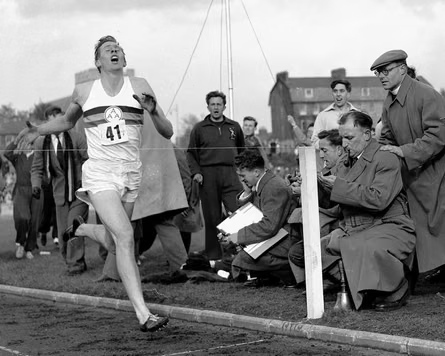
So what next for Sawe and the marathon? Here there is a historical precedent worth remembering. In April 1954, John Landy described the four-minute mile barrier as “a brick wall”. A month later, in Oxford, Bannister ran 3:59.4. By June, Landy had obliterated that old record by running 3:58 flat. Après moi, le déluge.
There are faster courses than London, including Berlin, Chicago and Valencia. The march of technology will also continue. Clothing will become lighter, the sports nutrition will get better, shoe foams will become springier.
Nick Anderson, a coach who has trained world level athletes and was part of the elite London marathon set-up, also points to another factor – that top middle-distance runners are moving to 26.2 miles earlier and earlier. “They’ve got great running mechanics. They’re fast. They’ve got real speed, but the endurance engine allows them to work for two hours and they train so well,” he says.
“So I think you are going to see further minutes off the world record. That said, they still need the absolute perfect storm – the right temperatures, very little wind, and then the right athletes there as well for the race to unfold, so that you get a genuine race in the last 10km.”
I have been fortunate enough to meet Bannister and Sawe and the similarities were uncanny. Both were distinctively modest about their achievements and had to have their recollections of their performances teased out of them. I remember Bannister telling me about the flash of anger he felt after a false start by Brasher, his first pacemaker. And feeling so full of energy on the first lap that he was shouting: “Faster” at Brasher. Then the fear at the end of the 62.4sec third lap when the record appeared to be slipping away, before that surge of adrenaline carried him into sporting immortality.
Sawe told me he only realised he was running under two hours when he saw the finish line. “I was so excited and tried to push and finally I did it,” he said.
If Sawe is as clean an athlete as he promises, then he is a worthy successor to Bannister. And so, undoubtedly, is Sunday’s staggering achievement.