





Families have a way of appointing their own historians, even if the recruitment process remains obscure. In the late 1990s, Caroline Huppert – the fourth of five siblings, of whom the youngest is actor Isabelle – found herself alone with her father and a tape recorder. Over five days, he opened up about his life before and during the second world war. “I think I had that privileged position with him, because he had a taste for history, too,” she says. “But we didn’t have the same vision. I like the approach of what is called the nouvelle histoire, things like details of daily life in the past. With him, it was more emperors, kings, dates.”
More than 25 years later, their exchanges have led to her memoir, Une Histoire Cachée (A Hidden Story), a work that bundles up quotidian intimacy and big-ticket history in telling the story of how her parents, Raymond and Annick, fell in love. Their relationship so easily might never have happened: he was Jewish, she Catholic, and after they met in 1934 at Paris’s HEC business school, her haute-bourgeois family were opposed to them marrying. A big enough obstacle even before the Nazis invade France, and the young lovers are forced to flee the capital for the Free Zone near Lake Annecy. “I wasn’t aware of any of it in the least,” says the 75-year-old on a phone call from her home in Paris. “My parents weren’t people who talked about the past. They were always absorbed in the present, in action.”
Thanks to her father’s nostalgic volte-face before he died aged 89 in 2003, Huppert began thinking about how to undertake the “archaeology of her family” (her mother died earlier, in 1990). But with a hectic career as director of TV films and screenwriter, she was intimidated by the task – even with her education in history. Then in 2024, another storybook miracle unlocked it for her. While fishing for a pushchair in a storage unit, Huppert’s daughter jostled an old desk her mum had left her; a cache of 150 old letters hidden in a false drawer fell out. “She sent me a photo of them, and I recognised my mother’s writing,” says Huppert. “And this goldmine allowed me to go to the very end of what I wanted to do with the book, because it was a really great source of information about daily life.”
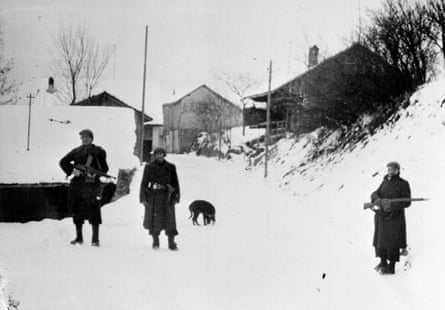
Her book closes with a high-wire climax – which Huppert prefers not to spoil. The courage they inspired in each other came as a surprise, notably “the intrepidness of my mother, who wasn’t afraid of anything and crossed the demarcation line in the boot of a car”. But it’s in the patient logging of banal wartime realities, thanks to Annick’s correspondence, where Une Histoire Cachée also fascinates: the struggles to find food, the freezing conditions in the Savoie house where Raymond ends up fabricating drill bits for a collaborator, how the couple still snatched moments of ephemeral pleasure amid this turmoil.
Such minutiae are especially important as they relate to the Franco-Jewish community during the time, of which there is only “piecemeal” documentation, according to Huppert. Soaking up Raymond and Annick’s routine, you realise how their privations were a direct consequence of pre-war prejudices – when a wary truce had been in place between Jewish and traditional French society since the Dreyfus affair. “I really wanted to describe what antisemitism looked like on a daily basis in French society, even before the Nazis’ racial laws,” says Huppert. “And show the continuity with what the Pétain regime decreed – and to what point it seemed natural to everyone, bit by bit, to put those laws in place.”
Huppert brings a distinctive Jewish slant to a recent mini-boom of Vichy lit and cinema that, like much French output on the occupation, tends to focus rather on questions of collaboration and resistance: the recent films Les Rayons et Les Ombres and Laszlo Nemes’ Moulin, the Cécile Desprairies novel The Propagandist. Daniel Auteuil’s drama La Troisième Nuit, premiering at Cannes, will bolster the Jewish side soon. But whatever the reasons for this surge of interest – whether it’s the looming prospect of a far-right government in France, or newly rising antisemitism – Huppert isn’t tempted to infer any contemporary resonances. “I don’t know anything about that. As an archaeologist, I lean more towards understanding the origins rather than the results. It’s sociologists who look at what is happening now.”
Not only is Huppert categorical about her work in this way, even after exploring her family’s mixed heritage, she seems detached about her Jewish roots. She says she doesn’t feel culturally or religiously more Jewish in the wake of writing – and in any case hates generalising: “It’s annoying to say ‘the Jewish people’. It’s a terrible expression. I don’t see where there’s a Jewish people – there are Jews of all different kinds.”
You wonder if this neutrality isn’t also part of her legacy from her secular father, who refused to convert to Catholicism in support of his kinsfolk – but still raised his family within Catholic norms in the postwar period. There’s something of the same withholding independence in her sister Isabelle’s acting; she has spoken of sharing her father’s tendency towards silence. At any rate, Isabelle is a fan of the book. In a text, she sums up: “A magnificent portrait of a woman, a highly moving homage to our family, and an exciting and superbly researched document of that time.”
If a rapprochement with Jewishness wasn’t Huppert’s principal aim, the notion of lineage does count for her – just as it did for her father a quarter-century ago when he decided to share: “I wanted my children and children’s children, my own posterity, to know this was their history.” But though she’s rescued her parents from the fog of time, she couldn’t do it for everyone. Huppert is still haunted by the story of Françine, a young refugee whom Annick teaches English in the French Basque country, and then crosses paths with a second time in Savoie. The references in her mother’s letters stopped there, and Huppert found no traces online. “I was very touched by the fate of this sensitive young girl whose adolescence was stolen from her. I’ve been worrying about her. I hope she survived.”