


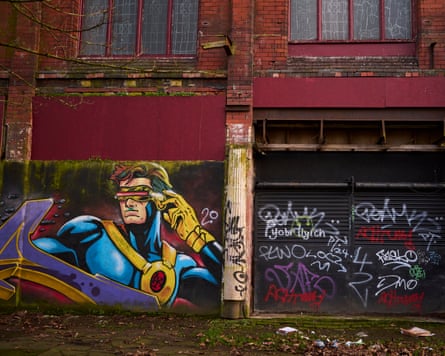
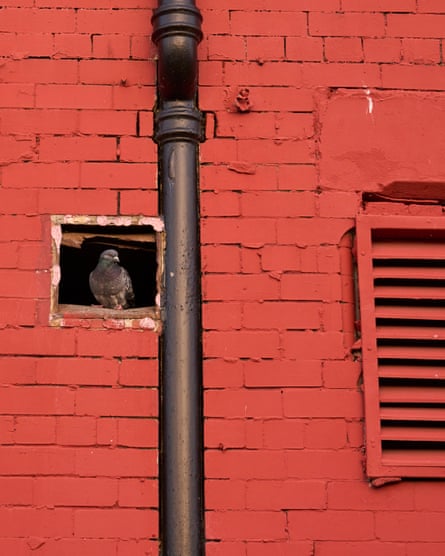
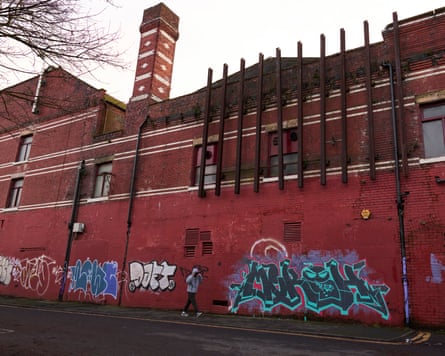
It doesn’t look like much from the outside. An inelegant, industrial redbrick block; if you didn’t know, you might guess it’s a biscuit factory. Make that a former biscuit factory, because this is clearly somewhere that was rather than is: entrances are bricked up, drainpipes hang loose, shrubs sprout from crumbling masonry, pigeons come and go from holes in the roof. Pretty much everything within reach of a spray can has been reached; there are tags, Marvel characters, the perhaps surprising news that “God is dead and sheep killed him”.
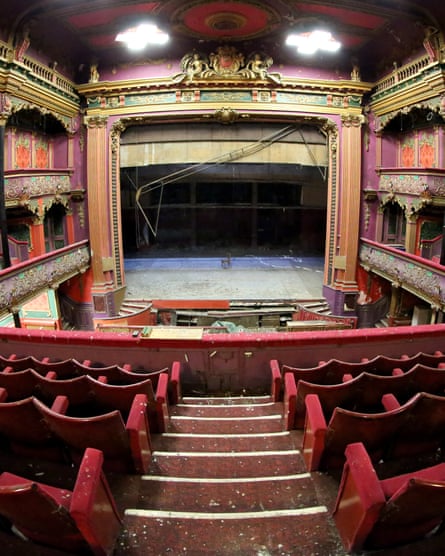
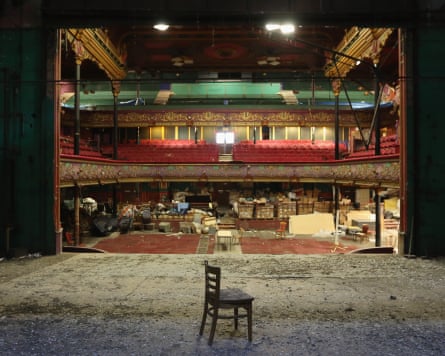
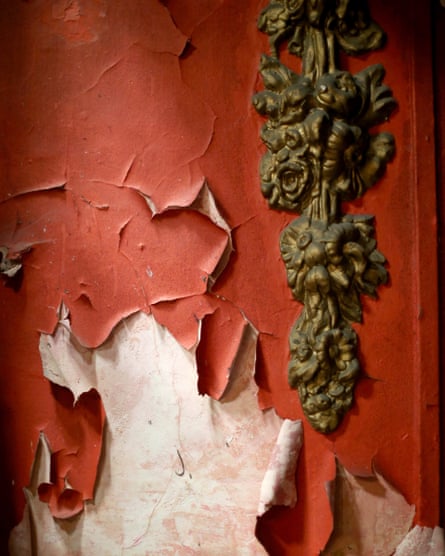
You know those rocks, though, that look like any old rocks, but when you smash them open they have amazing, sparkling, coloured crystals inside? Amethyst and the like. Well, this building is a bit like them. If you took a wrecking ball to it (and it’s not inconceivable that this will happen), inside you’d find a splendid Edwardian galleried auditorium with gilded rococo plasterwork and plush red velvet seats … albeit covered in pigeon shit.
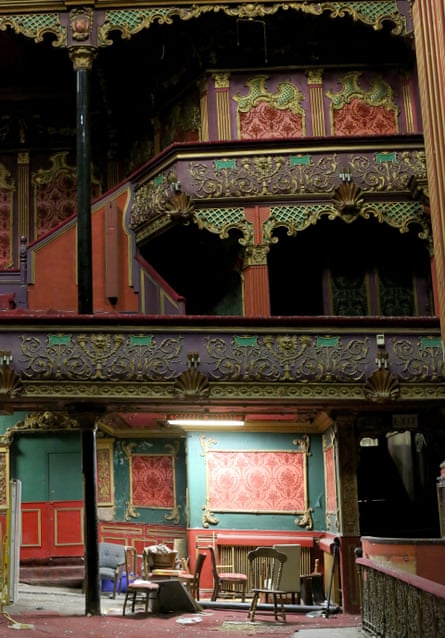
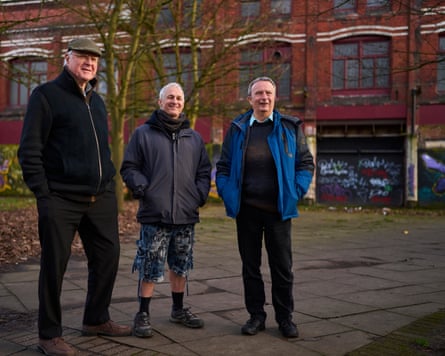
Sadly, I’m not going to get in to see it with my own eyes: the door that isn’t bricked up is locked. I’ll have to learn about the interior from others who have been inside, and from pictures. I’m walking round the outside of the building with three members of a local campaign group who want to save the theatre from further decline. They have ideas and plans for it, but there are obstacles, not least the owner. We’ll come to all that. But first to the past, a century and a quarter ago …
The Hulme Hippodrome, just south of Manchester city centre, was built in 1901 along with a smaller conjoined theatre at its south-east end. They were part of the Broadhead Circuit, which operated venues in working-class areas across the north-west of England. Not Shakespeare, or Verdi, but variety – and very varied it was too, by all accounts. Also starry. In February 1909 Harry Houdini performed at the Hulme Hippodrome, escaping from a contraption made by a local saddler. The following year the Fred Karno troupe, including a young comic actor called Stanley Jefferson, were on stage, shortly before relocating to America, where Stan changed his last name to Laurel. In 1915 Gracie Fields led in a variety review called Yes, I Think So. George Formby played the Hipp in the 20s and 30s.
Starry, starry nights
It became a repertory theatre in the 1940s, before reverting to variety. In the 50s it was used for BBC radio broadcasts, including a show called Variety Fanfare on which Bob Monkhouse, Frankie Vaughan, and Morecambe and Wise featured. Eric and Ernie’s own radio show was recorded here in the 50s; Ken Dodd and Max Miller played the Hipp; Barry Took made his professional debut here. When a 17-year-old Welsh singer took to the stage in 1954, the notices were favourable: the Manchester Evening News said, “Shirley Bassey sings old and new blues tunes with real zip.”
It was around this time, the early 50s, that an even younger Jeff Hill started to go to the Hulme Hippodrome. Not as a performer, but as a punter: he saw Bassey there. Born in 1946, 100 yards away in one of the Victorian terraces that would be knocked down to be replaced by the notorious Hulme Crescents, Jeff used to come to the Hipp with his family. “My mum would take me, and I would also go on a Saturday night with my grandparents. It was variety shows; I have memories of great comedians, like Jimmy James, and a wonderful Welsh comedian called Gladys Morgan, who’s worth a quick Google. I also loved Frank Randle; he was a vulgar man, a mucky bugger. My auntie wouldn’t go and see him. He’s worth a Google as well.”
Speaking to me from Staffordshire, where he now lives, Jeff says the family generally sat on the wooden benches up in the gods, which meant entering the theatre through a side door and scaling a lot of stairs. But with his grandparents they’d sit at the back of the stalls, which meant they could go in the front entrance and through the glass-roofed atrium known as the Floral Hall.
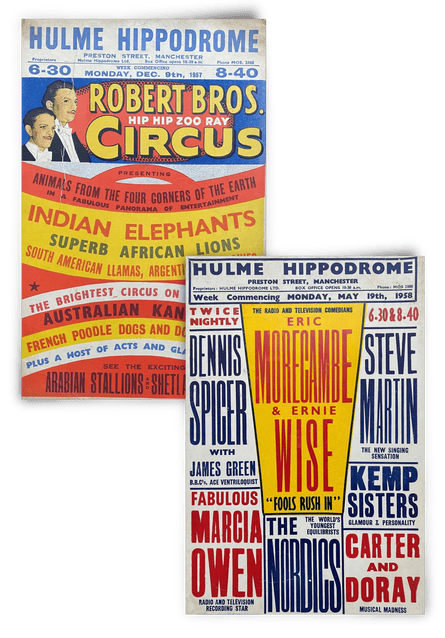
Fauna could also be spotted at the Hipp: travelling circuses would stop off there, with camels, tigers, even elephants. Though it’s now bricked up, you can see today that one of two stage doors at the back of the theatre was double height to allow loftier acts to enter. Jeff remembers seeing an act with a boxing kangaroo that members of the audience were invited to spar with. “If anyone could last three rounds, they might win a fiver.” The kangaroo escaped and was eventually found somewhere near Old Trafford. “Whether they did it on purpose, I don’t know – but it wouldn’t have done any harm in terms of ticket sales.”
The acts at the Hulme Hipp got seedier, including strip shows – “fairly mild by modern standards,” says Jeff, but it was no longer a place for a family outing. “There was one week where they had nudes posing with lions in a cage, and me and a mate were looking through holes in the door on Warwick Street. We always said it was just to try to see the lions …”
The smaller theatre, the Playhouse, was acquired by the BBC in 1955, and was used as a production studio for radio and television shows for more than 30 years. The Beatles played in front of an audience there in 1962. In a later incarnation, the Nia cultural centre, its stage was graced by Gil Scott-Heron, Fela Kuti, Gregory Isaacs, Baaba Maal and Nina Simone (who lives on, in paint, on the outside of the building). And it operates today, run by a non-profit organisation that hosts workshops and jams. This one I did get to go inside; it’s beautiful, its ornate galleried auditorium a tease to the grander scale of its bigger sibling hiding next door.
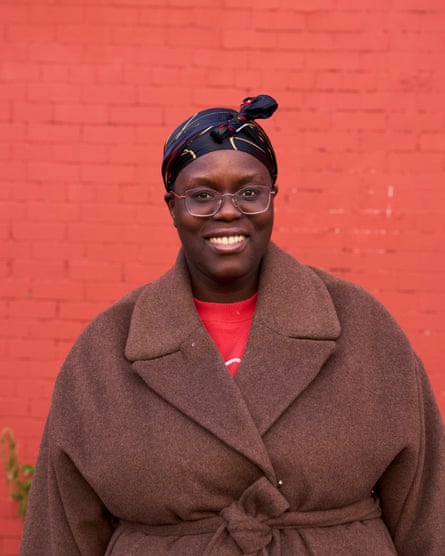
Back in the 50s another young audience member was Maggie Ollerenshaw, who would have been about eight when she went to a performance at the Hipp with her family. Not a seedy one, of course. “It was some kind of ice show; they did them at Christmas,” Maggie tells me. “And at some point they asked, ‘Are there any kids in the audience who’d like to come up and sing a song?’ My hand flew up, much to my mother’s amazement and consternation, because I was a very shy child.”
Maggie got picked, went up on stage, and sang “the best Rudolf the Red Nosed Reindeer you ever heard. It was the first time I ever appeared in public. I do remember it was thrilling, and that must have been the applause – it went down quite well. And the die was cast.”
There wasn’t much drama at Maggie’s school, but at university she got involved with the dramatic society, then did an apprenticeship at the Lyceum theatre in Crewe. Now 76, she went on to have a career on stage and television, most famously playing Mavis in Open All Hours and Still Open All Hours.
In 1962 Mecca bought the Hulme Hippodrome and it became a bingo hall. Meanwhile, the surrounding Victorian streets were bulldozed in what was referred to as “slum clearance”, though the Hulme Crescents – a vast housing complex described by the Guardian as “a morass in which design faults and tenants’ revulsion at their environment have combined to produce a staggering number of maintenance demands and angry howls of neglect” – were certainly not an improvement and were themselves demolished in the early 90s.
Like St Paul’s in the Blitz, the Hippodrome survived the devastation going on all around. Post-bingo it was a social club, a nightclub, then a snooker and billiards hall, before the venue was closed in 1988 and largely forgotten. Until 2003, when a controversial church took it over. Controversial not just because its leader, Bishop Gilbert Deya, claimed he could perform miracles – curing the sick, ridding the possessed of their demons, enabling infertile couples to conceive babies; he even dabbled in dentistry – but also because he was then extradited to his native Kenya to face charges of child trafficking. Deya was eventually cleared due to lack of evidence, but died in a car crash last year.
As it happens a member of the congregation from that time, Elizabeth Darko, originally from Ghana, is passing. She no longer lives in Hulme, but her kids go to school here and she’s come to pick them up. “It was nice in there,” she says. “We all came in, from Leeds, Birmingham, Sheffield, and gathered here.” She finds a couple of pictures on her phone of a service there, showing the stage, a balcony and a lot of people in the auditorium.
These give some idea of the scale and the grandeur of the space on the other side of the wall we are standing next to. But you get a better idea from Dean Cooper’s video, which also documents another chapter in this building’s extraordinary story. For a while, between 2017 and 2018, the Hulme Hippodrome was occupied by squatters. Dean, from Blackpool (from where he is speaking to me), was visiting the area frequently to see his daughter at Manchester Metropolitan University. He got interested in the Hippodrome building and its new residents, contacted them on Facebook, and asked if he could come in and have a look around. Yeah, no problem, replied a squatter called Syd Far-i, who seemed to be their spokesperson.
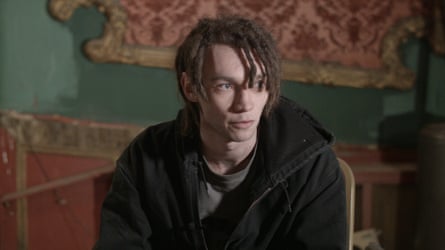
Dean, who’d never visited a squat before, tells me he went there but didn’t know how to get in. “I was walking around for ages, feeling like a bit of a dick. What am I doing? This is dangerous.” But then the fire door opened and he was let in. Syd showed him into some kind of foyer that had a PA, speakers and a drum kit. Clearly it was a place where music was happening.
“One of the first things he said was, ‘Do you want any artisan bread?’, which I thought was weird.” It turned out that the squatters were getting their food from the Waitrose skip. They showed him along a dark passage and into the auditorium, where they left him to wander around and take photos. “It was amazing, like something from Phantom of the Opera, a portal to another world I didn’t know existed.”
He bumped into other people; they said good morning to him. Someone had turned one of the private boxes into their bedroom; someone else took him backstage and showed him the dressing rooms, where over a century earlier Harry Houdini and Stan Laurel had got themselves ready to do their acts.
Dean went back to the squat at the Hipp several times, got to know them, went to see bands and to jam nights there. After his initial nervousness, he found it very positive, he says. “They were really nice; the vibe was very welcoming.” He made a short film about the people living in an Edwardian theatre, and about homelessness in Manchester. Syd is a big part of the film – a passionate, idealistic young man with dreadlocks, talking about housing, development, inflated rents, the squatting movement in Manchester, helping each other, and wanting to turn the Hippodrome into a community centre for the people of Hulme.
I’d love to have talked to Syd Far-i, whose real name is Stefan Hoyle, about squatting in the Hulme Hippodrome, but tragically he died last year, aged just 33. I do speak to his dad, Mark Hoyle, Manchester music legend and frontman of cult Hulme band Dub Sex. Stefan was a musician too, DJing using the name Syd Far-i, as well as playing guitar. They’d worked on things together.
Mark, who has always lived in Hulme, often visited the squat. They were idealistic, he says. “They didn’t just do nothing: they did bicycle repair workshops, put on events, planned to open food kitchens. Stef taught a bit of guitar. They wanted to restore that sense of community that people need and isn’t there any more.”
Manchester has one of the highest homelessness rates in the country. “And you can’t send people away if they turn up in real need and bring some of the urban problems they have had, if you know what I mean,” Mark says. “Which is why some of the idealistic side of things didn’t come to fruition as much as they should have.” Stef and the other squatters were evicted in April 2018.
Hulme has, Mark says, become “a big land grab for the university and for student accommodation. I’m in no way anti-education, or anti-student, but it seems that every bit of space or interesting building is being turned into a tower block of flats, using the facade of the building itself as a kind of cultural marker.”
He points to the Hotspur Press building a mile up the road, another squat that was evicted in 2017, burned down mysteriously last year and is due to become another high-rise block of student flats. It’s the worst thing that could happen to the Hulme Hippodrome, Mark says, and his son would have thought the same.
Mark Hoyle is clearly super-proud of his son and what he did, as well as finding it hard to talk about him. He chokes up a couple of times. “He was a diamond. I loved him to bits.”
A magical palace of secrets and treasures
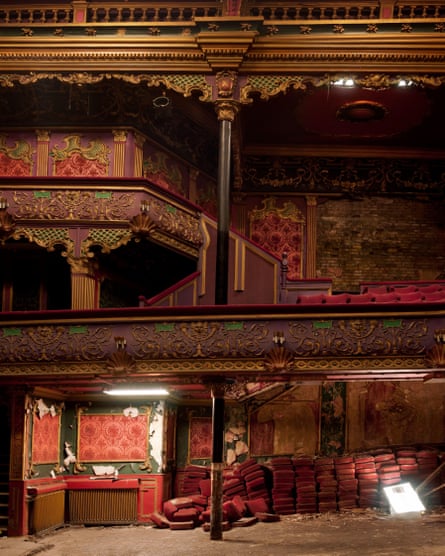
It’s frustrating not being able to see inside the Hippodrome, but speaking to all these people has brought it alive, turned it from something that looks like a biscuit factory into a magical palace full of secrets and treasures. If it was a biscuit factory, it would perhaps be one that produced those big variety tins with some of everything – chocolate-chip cookies, Hobnobs, Jammie Dodgers, the works.
The biscuit factory comparison was actually made by Tony Baldwinson, who I’m here with, along with Mike Bath and Paul Gardner. Together, they run the Save Hulme Hippodrome group. As well as filling me in on the history, pointing out architectural details – the Floral Hall, the extra-tall stage door, the open window and holes in the roofs where urban explorers and pigeons have gained entry – they tell me about their vision.
They want to restore the Hulme Hippodrome, not just as a theatre but perhaps as a production academy where young people can learn about set design, rigging, sound and lighting. There might be a bike hub and workshop, cafe, library, bakery and an employment academy for people who have been homeless. Owned by the community, run by the community, for the community. Not actually so different from the vision of Syd/Stefan and the young squatters, though Tony, Mike and Paul are going about it more formally and with different (less) hair.
They have support from the Theatres Trust, the national advisory body for the UK’s theatres, and I speak to its CEO, Joshua McTaggart, who says there are many beautiful, exciting spaces that are not being used throughout the country. “Because they are expensive to run and keep up, whether it’s a private landlord or a local authority, they’re seen as a liability. We’re forgetting they are cultural assets we should invest in as part of the infrastructure of any town or city.”
There is truth in the old adage that a place is nothing unless it has a pub, a post office and a theatre. “We found in the pandemic that we missed that opportunity to connect in person,” McTaggart says. “Since then there’s been a desire for communities to connect through gathering and storytelling.”
But Manchester has loads of theatres and performance spaces, no? “It’s not just about spaces with a stage – it’s about civic identity and connection,” says McTaggart. Towns and cities need more than one of these spaces because they serve different purposes, “in the same way that pubs have different locals and different clienteles. Some spaces are run commercially, some are subsidised. It’s really important that some are run by and for communities, whether it’s for performance, live music, going for a coffee or a baby yoga morning.”
Of course McTaggart understands the need for housing. “But I don’t think we should be taking away cultural infrastructure and replacing it with housing, because then we create places to live with no community space and culture.”
In November 2020 the Hulme Hippodrome was sold by Gilbert Deya Ministries for a reported £450,000 to a property developer from south London, who goes by several names including Charles Roberts, Charles Gordon and Gassel Gordon. The following February it was advertised for auction with a guide price of £950,000, and described as potentially suitable for redevelopment into apartments. But Hulme Hippodrome is a listed building, and no legal consent had been given for this change of use. This was when the Save Hulme Hippodrome campaign got going. Tony Baldwinson and his colleagues say that they, along with Manchester City Council and the Theatres Trust, managed to stop the auction.
In April 2024 it was sold for £600,000 to HHM 20 Ltd, also based in south London, and listed as buying and selling real estate.
Save Hulme Hippodrome is concerned that the building will be allowed to continue to deteriorate to a point where it has to be demolished. Save Hulme Hippodrome has calculated that 95 apartments could be built on the site, with a gross value of £23m. They reckon construction costs would be between £11m and £15m, leaving the rest as profit.
The campaign has called for the owner to be legally obliged to make repairs to the outside of the building to stop further deterioration. It has a business plan to save it, and a strategy to acquire the building for the community. And it has plenty of support. Hulme councillor Annette Wright tells me her ward is a special community and the Hippodrome should again be a part of that. “Hulme is a very diverse, very strong, very tolerant community. It’s a fabulous place. We’ve got this fabulous building and somehow we’ve got to get our hands on it.”
Afzal Khan, MP for Manchester Rusholme, says it’s important to save and restore local hubs of art and culture, and has written to chancellor Rachel Reeves asking for help with the way local planning authorities can fund the enforcement of urgent repairs.
But, as Tony Baldwinson says, it’s the property owner who holds the cards. “You can’t just come in and say, ‘You have to sell this building for the money these people have.’ It doesn’t work like that, unfortunately.”
I approached Mr Gordon/Roberts and HHM 20 Ltd multiple times to ask what plans there were for the building. I haven’t heard back.
In the meantime, this amazing space that has hosted Harry Houdini, Eric and Ernie, Ken Dodd, young Shirley Bassey, nudes, big cats, small boys, miracle babies and jamming squatters eating artisan bread is allowed to go to ruin. For now only the pigeons have access to the Hulme Hippodrome.
One former resident is not forgotten. Stefan Hoyle/Syd Far-i has been taken up as a symbol of hope and is remembered in graffiti all over Manchester. When he died he left behind some unfinished music that his dad and his sister, Ellis, are working on. They’re going to make an album, and are raising money to get a sound system in his name for the Nia centre, the old Playhouse next door to the Hippodrome. Stefan will also live on on the wall of the building – in a mural, alongside Nina Simone.