






Donald Trump’s indefinite shelving of the plan to bomb Iran’s bridges and power stations on Tuesday night is being widely described as leaving the conflict in limbo, but that is anything but the truth.
Pakistan insists the prospect of talks in Islamabad has not evaporated, and positive messages are still being exchanged, but in the meantime the site of kinetic activity has switched from land to sea.
Both sides are vying to prove they can enforce their blockade of the strait of Hormuz more effectively than the other. It has become a form of gunboat diplomacy brought to life in the most significant geopolitical waterway in the world.
Iran, by firing at and seizing commercial ships trying to navigate the strait, is trying to send a message that it can maintain its chokehold on the world economy.
The US, through its blockade of Iranian ports, is trying something more immediate. Through sanctions and naval action, it is attempting to make the Iranian economy collapse as Tehran runs out of space to store the oil it is producing and cannot export due to the blockade.
It is a trial of strength in which both sides believe they have time on their side.
Gholamhossein Mohseni-Eje’i, the head of the Iranian judiciary, said: “The enemy is not in a position to set a timeline for us.”
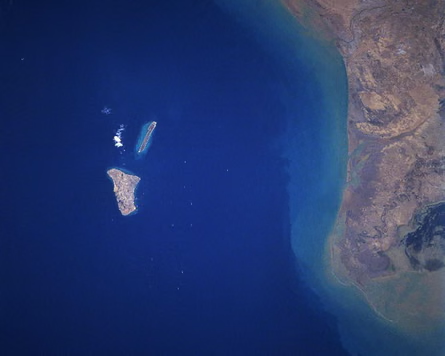
The US treasury secretary, Scott Bessent, said that in a matter of days “Kharg Island storage will be full and the fragile Iranian oil wells will be shut in. Constraining Iran’s maritime trade directly targets the regime’s primary revenue lifelines.”
This chimes with an analysis championed by the Foundation for Defense of Democracies. The FDD, a fiercely anti-Iranian regime thinktank, has argued that the strait is not a gamechanging weapon for Iran, but a source of weakness.
The argument runs that Iran will run out of oil storage by Sunday – 26 April.
Writing on the RealClearDefense website, Lance B Gordon, a retired naval officer, claimed: “Forcing Iran to shut in production due to lack of storage would risk long-term reservoir damage including permeability loss, water coning, and formation compaction – effects that could permanently reduce future output and cashflow.”
Forced shutdowns could permanently eliminate 300,000 to 500,000 barrels a day.
Mark Dubowitz, the chief executive of the FDD, says the strategy is now ceasefire on one front and intensifying pressure on the other, including US Central Command increasing the pressure by seizing ships.
The mix of blockade, sanctions enforcement and implicit threat of renewed strikes run in parallel with talks.
Iran insists it understands and can foil this US strategy, in part by refusing to restart talks until the US blockade is lifted.
The cargo tracking firm Vortexa has reported that at least 34 tankers linked to Iran have circumvented the US blockade since it began, with 19 exiting the Gulf and 15 entering from the Arabian Sea.
Six outbound tankers carried approximately 10.7m barrels of Iranian crude oil, generating an estimated $910m (£670m) in revenue at a discount to Brent crude.
Secondly, Iran does not need to look far for signs that its own blockade of the strait is working. The price of oil, manipulated downwards by Trump’s social media messaging, remains the key metric for Iran, and is above $100 a barrel.
But there are other signs, too – the cancellation of 20,000 Lufthansa flights due to the cost of jet fuel, hotel booking vacancies this summer, the level of oil reserves at the UAE’s Fujairah port, the price of copper and condoms, the cost to European treasuries of mitigating energy inflation and even the number of Senate “pick-ups” that the Democrats are now targeting in November.
In this global war the mood among Tennessee voters about Trump’s handling of the economy matters as much in Tehran as in the White House.
Seeing his country as joining the great power league, Iran’s Revolutionary Guards’ aerospace force commander, Majid Mousavi, said: “Iran’s southern neighbours should know that if their geographies and facilities are used in the service of enemies to attack the Iranian nation, they must say goodbye to oil production in the Middle East.”
But Iran is also hinting that it has other cards to play. Tasnim News Agency, affiliated with the Islamic Revolutionary Guard Corps, wrote about the potential of internet cable disruption.
It noted the concentration of Gulf countries’ communication infrastructures in the strait of Hormuz and said any disruption to these would lead to a catastrophe for the region’s digital economies.
But escalating the war in this way could cause strain inside Iran, itself exhausted by war. Trump claimed he detected signs of a deeply fractured Iranian leadership and that this was the reason Tehran was not able to reply to US proposals.
The degree of division is hotly contested, but what is undeniable is the pressure on ordinary Iranians. The continued internet blackout – a self-imposed security measure – is forcing thousands of often young entrepreneurs each day into unemployment.
There are also calls – likely to be disregarded – to use the ceasefire as an occasion to have a wider discussion inside Iran about how the country responds, rather than leaving the discussion to a security elite.
The reformist writer Ahmad Zeidabadi argued on Wednesday that the ceasefire extension should be an opportunity.
“Instead of aggression, accusation and fearmongering – which has become the primary mode of our political action as Iranians – we must create a safe, free and civil space for discussion of the country’s available options in the face of this crisis, so that in the end, the best and most rational decision can be made and announced with complete candour and courage.”