






There’s a lovely sequence in the second episode of this four-part documentary about the career of Spain’s greatest ever tennis player. It’s 2006 and Roger Federer and Rafa Nadal are walking on to Wimbledon’s Centre Court to play the first of the many finals they would contest there. Federer is poised and slightly smug; hair flopping perfectly over his headband, dressed in an immaculate white blazer. Nadal trails behind him, wearing a vest and baggy shorts, shaggy hair flowing and eyes wild, looking for all the world like a beautiful young caveman. It captures his initial appeal perfectly: in his early years, Nadal was elemental, athletic beyond description and impossibly charismatic: equal parts tennis player, action hero and acrobat.
It feels like our sporting legends are increasingly reluctant to leave the stage. Lionel Messi (38) and Cristiano Ronaldo (41) will both be at this summer’s football World Cup. One of England’s greatest ever cricketers, James Anderson, turns 44 this year and is still plying his trade in the County Championship. Becoming unsurpassably brilliant at something requires laser focus, but unlike music or acting or writing, there’s a definitive best before date. And once that date has passed, a big, scary void looms. If the miracles of modern medicine allow you to continue, it’s clearly incredibly hard to walk away.
As well as tracing Nadal’s remarkable career from Mallorca childhood to total fulfilment, this series should function as a meditation on this question. What drives someone like Nadal to keep going? In terms of access, it couldn’t get closer. Nadal himself speaks at length, as do his wife, his coaches, his parents, his most notable opponents, and many of his numerous doctors.
Access, though, doesn’t automatically equal insight. Possibly, this series is intimate to a fault. It’s too close to its subject to allow much perspective. We find out what Nadal achieved and how he did it. What drove his prodigious will to glory remains tantalisingly just out of reach. He’s a friendly if somewhat guarded enigma. At one point he refers to his wife, Maria, as “a very important support for me”. The language seems oddly distanced. There’s quite a lot of Rafa we aren’t getting here. There’s a sense that, like most extremely high achievers, he’s quite an unusual man. But it’s no more than a shadow crossing across this documentary’s luxurious surfaces.
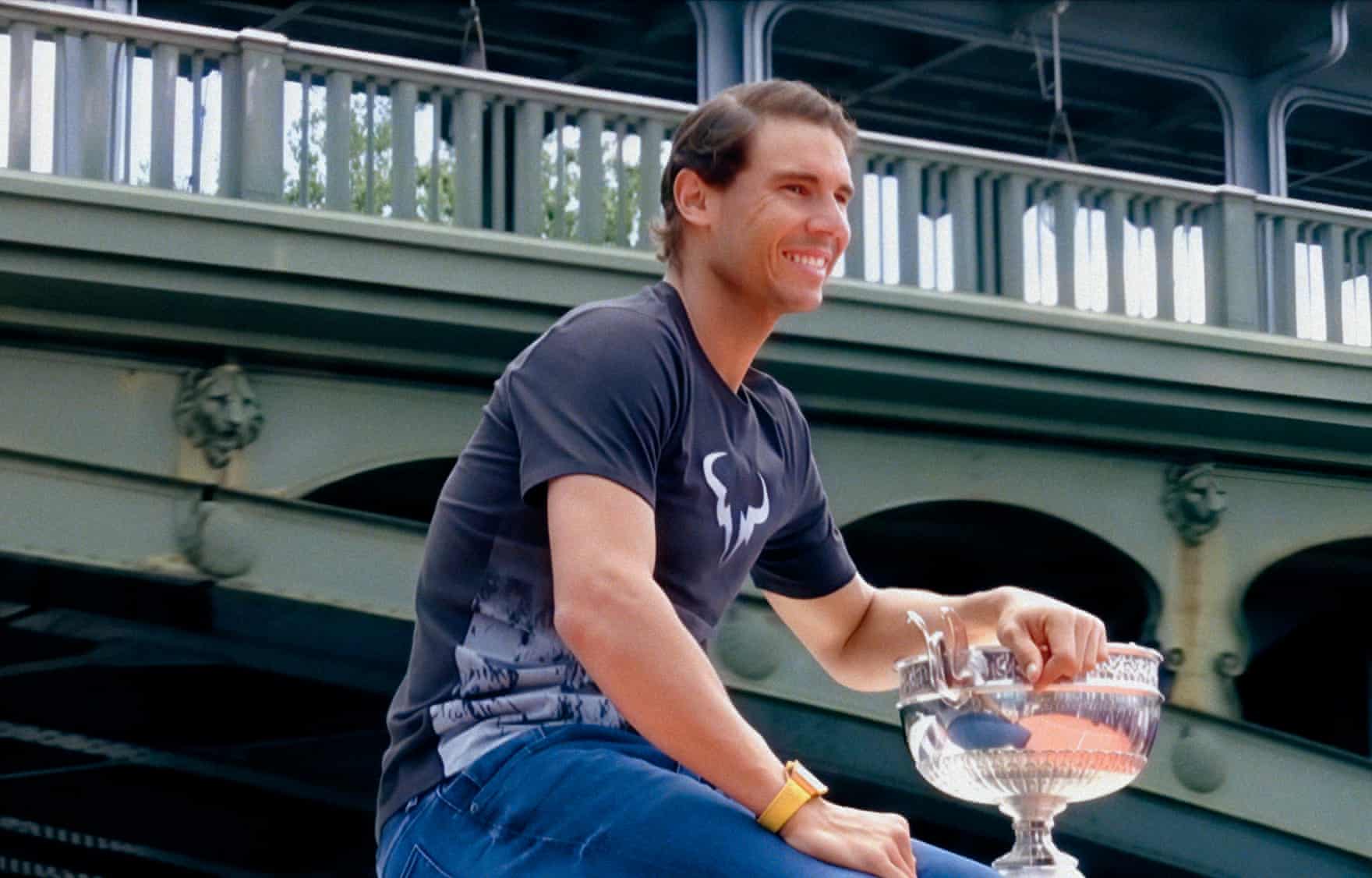
Instead of insight, there’s detail. There’s deep-dive analysis of his early rivalry with Federer. A meticulous tracing of the baton passing to Novak Djokovic, who would become his bete noire in later years. There are endless, agonised descriptions of Nadal’s struggles with injury. Massages. Scans. X-rays. Pained expressions in the back of cars after bad medical news. “I’m the most perforated player in the history of our sport,” Nadal jokes grimly. His game was based on endurance; making his opponent play one more shot. At various points, this series requires comparable levels of dedication.
And it’s infuriating, because the good bits make it just about worth sticking with. There’s lovely footage of his earliest years, a pocket-sized prodigy playing youth tournaments in Mallorca. His breakthrough in the 2004 Davis Cup where, ranked 51 in the world and to his own visible delight and surprise, he got the better of world No 2 Andy Roddick. We see him goofing around with his little boy, charmingly referred to throughout as “Rafalet”. But there’s a heaviness to the telling of this story that doesn’t quite seem warranted by its bottom line of consistent, almost unprecedented success. There is zero levity. Barely any laughter. Instead, it vacillates between skyscraping joy and utter despair. It occupies a two-note range. Maybe this is all the emotional scope sporting excellence allows? It would be nice to get a sense of the man at ease. Perhaps some cracks would let some light in?
In some ways, this series is a perfect product of the era of sport as endless content. Sport is ideal for the streaming era, each team or superstar bringing with them thousands of helplessly obsessive followers; the rhythms of competition constantly unspooling infinite vistas of fresh narrative. Sport is the ultimate, self-renewing TV franchise. For this to work, it has to mean everything. The solemnity is the point. It has to matter, absolutely and completely, or it’s barely worth doing at all.
There’s no point in pretending that this isn’t a deeper dive than would suffice for a casual observer. But for the true Rafa-stan, it’s a goldmine. During episode four, Nadal announces to his family that he’s decided to retire. “Tell absolutely no one,” he says. But retrospectively, we get to witness the moment. It feeds into the parasocial pseudo-intimacy that fuels this kind of series. And here, perhaps, is a measure of redemption for the reluctantly retiring sporting hero in the modern era. Maybe the ultimate message here is being sent to ageing sports stars. Haunted by the looming, ominous full stop? Don’t worry: via a documentary afterlife, it isn’t quite over yet.
-
Rafa is on Netflix