


惯性聚合 高效追踪和阅读你感兴趣的博客、新闻、科技资讯
阅读原文 在惯性聚合中打开

推荐订阅源

D
DataBreaches.Net
F
Fortinet All Blogs
D
Docker
让小产品的独立变现更简单 - ezindie.com
WordPress大学
WordPress大学
罗磊的独立博客
Y
Y Combinator Blog
Cyber Security Advisories - MS-ISAC
J
Java Code Geeks
T
The Blog of Author Tim Ferriss
U
Unit 42
N
Netflix TechBlog - Medium
OSCHINA 社区最新新闻
OSCHINA 社区最新新闻
V
V2EX
云风的 BLOG
云风的 BLOG
钛媒体:引领未来商业与生活新知
钛媒体:引领未来商业与生活新知
T
Tailwind CSS Blog
Hugging Face - Blog
Hugging Face - Blog
Stack Overflow Blog
Stack Overflow Blog
爱范儿
爱范儿
酷 壳 – CoolShell
酷 壳 – CoolShell
P
Proofpoint News Feed
G
Google Developers Blog
H
Help Net Security

The Guardian

Rory McIlroy surges into six-shot Masters lead with stunning second-round flourish ‘That’ll be the end’: actor Sam Neill joins fight to stop controversial goldmine near his New Zealand vineyard Roberto De Zerbi targets ‘Ange-ball’ revival to save Spurs from relegation Bath hit back to reach semi-final after stunning Northampton in 11-try epic Secret Garden to Outcome: the week in rave reviews Zebras, wealth and power: Hungary’s election tests Orbán’s grip on power ‘TikTok effect’ brings sellout crowds and younger fans to Grand National meeting The war over Omagh’s gold: the £21bn mine plan tearing a community apart Britain’s shadow workforce is paid as little as 65p an hour. Who cares for the carers? From You, Me & Tuscany to Euphoria: your complete entertainment guide to the week ahead Six great reads: the man who let snakes bite him, masked heavy metal and the brutal reality for foreign students in the UK American Classic review – I defy you not to fall in love with Kevin Kline and Laura Linney’s tender comedy Cuba’s doctors were a lifeline for the world. Now the Caribbean is shamefully complicit in the US drive to expel them An environmental disaster in Moldova has Russia’s fingerprints all over it RMIT drops misconduct case against student who accused university of being ‘complicit in Gaza genocide’ Ichiro Suzuki statue unveiling goes awry as bronze bat snaps during ceremony Survivors of Epstein’s abuse accuse Melania Trump of ‘shifting burden’ on to victims European football: Real Madrid held at home by Girona to extend winless run Arne Slot insists he is ‘aligned’ with Liverpool board and fans as squad is rebuilt Kamala Harris ‘thinking about’ running for president again in 2028 JD Vance warns Iran against trying to ‘play’ the US in peace talks West Ham double up twice to thrash Wolves and put Spurs in relegation zone Trump administration releases new renderings of so-called ‘Arc de Trump’ Crispin Odey drops £79m libel claim against FT over sexual misconduct allegations Bafta apologises for events surrounding John Davidson’s Tourette’s outburst Cocktail of the week: Bar Shrimp’s la rosita – recipe New drug may extend survival in aggressive ovarian cancer, trial shows One dead and 27 injured after bus with British passengers crashes in Canary Islands Pope adds to Smith’s mass of Surrey runs with England woes a world away OpenAI CEO Sam Altman’s home targeted with molotov cocktail
Tiny parasitic wasp named after David Attenborough for hi...
Patrick Bark · 2026-05-07 · via The Guardian

He has lizards, bats, frogs, weevils, flatworms, snails and spiders named after him. But now Sir David Attenborough can celebrate his 100th birthday with an entirely new genus named in his honour.

Scientists from the Natural History Museum in London have paid tribute to the world-renowned broadcaster for his 100th birthday on 8 May by describing a new genus of parasitic wasp and a new species found within the museum’s collections.
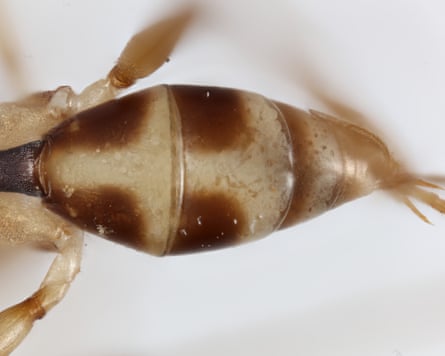
Body of new genus of wasp named after David Attenborough.
Details on the body of Attenboroughnculus tau. Photograph: Trustees of the Natural History Museum

Attenboroughnculus tau is an enigmatic ichneumon wasp with a body just 3.5mm long. The species name, tau, refers to a striking T-shaped marking on the insect’s abdomen.

The specimen was collected in 1983 in the Valdivia province of Chile but lay forgotten in an unsorted drawer in the Natural History Museum until recently, when its unusual characteristics were spotted by Augustijn De Ketelaere, a volunteer, during a detailed examination of the ichneumonid collections.

Dr Gavin Broad, principal curator for insects at the Natural History Museum, led the study of the newly described insect, which is so distinct from its closest relatives that it cannot logically fit into any established genus.

“When I was far too young, I learnt about taxonomy from David Attenborough’s Life on Earth series and resolved to be a taxonomist. Amazingly, I ended up a taxonomist, so I have Sir David to thank for that,” said Broad.
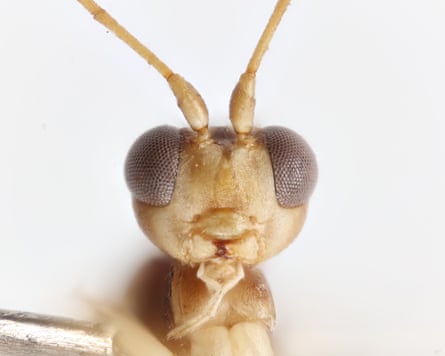
Head of new genus of wasp named after David Attenborough.
The head of Attenboroughnculus tau. Photograph: Trustees of the Natural History Museum

Nothing is yet known about the new species’ habits or life-cycle, apart from that its eggs are laid inside another animal.

Portrait of David Attenborough smiling into camera, arms crossed
Attenborough at the Natural History Museum in 2014. Photograph: Sarah Lee/The Guardian

“One of its fairly close relatives in Australia attacks spider egg sacs so that could be what this group of species does, but who knows?” said Broad. “I am sure it will still be found in Chile, where there are some weird and wonderful species, but trying to find particular wasps is the proverbial needle in a haystack. The vast majority of ichneumonid wasps are undescribed still, and even in Britain we’re describing new species every year.”

Broad said he hoped Attenborough would be pleased with the naming, particularly with the honour of having a entire genus, a taxonomical subfamily, named after him – although “he may not be quite as excited about it compared to the echidna”. Attenborough has said the Natural History Museum is one of his favourite buildings.

A critically endangered echidna was named Zaglossus attenboroughi in 1998, after a single individual was collected in the Indonesian province of Papua in 1961. There were no sightings of Attenborough’s long-beaked echidna again though until 2023, when the first video footage of a living individual was recorded.

Scientists hope that the discovery of a new subfamily of parasitic wasps will encourage other scientists and taxonomists to look again to see if further unique species are hiding in historic collections, requiring new scientific descriptions and names.

Jennifer Pullar, science communications manager at the Natural History Museum and co-author of the paper published in the Journal of Natural History, said: “We hope to inspire global scientists to take another look in their collections to see if there is something small that could contribute to our collective understanding and therefore the future of our natural world.”