



The world of cooking oils is confusing. I keep spotting new ones on supermarket shelves, trumpeting their health claims. Cold-pressed avocado oil, extra virgin macadamia oil, organic coconut oil, premium hemp seed oil … Even familiar oils are mired in controversy. Is it OK to cook with olive oil? Should you avoid seed oils? Meanwhile, prices keep rising – earlier this month, Walter Zanre, the CEO of Filippo Berio UK, said supermarkets were “taking the mickey” out of customers over olive oil pricing. I asked the experts which oils are really worth splashing out on.
What are the main differences between cooking oils?
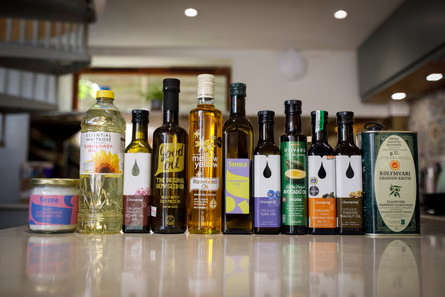
“All oils contain a combination of saturated, monounsaturated and polyunsaturated fats,” explains Lisa Howard, the Detroit-based author of The Big Book of Healthy Cooking Oils. Where they differ is in their ratio, which may be shown on the label (although in most countries only total fat and saturated fat is mandatory). Howard holds up three bottles of oil. “They’re all 14g of fat in total [per tablespoon]. The olive oil has 11g of monounsaturated fat out of 14g, so clearly this is a majority monounsaturated oil. With the walnut oil, 10g is polyunsaturated, so that’s a polyunsaturated oil. And then the coconut oil, 12g is saturated, so that is a saturated fat.”
And unsaturated is good, saturated is bad?
In health terms, pretty much. Dell Stanford, a senior dietitian at the British Heart Foundation, says: “Diets high in saturated fat can raise ‘bad’ (LDL) cholesterol in the blood. Replacing saturated fat with unsaturated fat helps to lower LDL cholesterol levels and reduce the risk of cardiovascular disease.” As well as avoiding animal fats such as butter, lard, goose fat and ghee, that means limiting coconut oil and palm oil, the two vegetable oils that are high in saturated fat. Many of the health claims made for coconut oil in recent years are based on a special formulation of the oil, which is not available in shops. “Coconut oil is about 86% saturated fat, roughly one-third more saturated fat than butter,” says Stanford. “Palm oil is often used in processed foods, so look out for it on ingredients lists, and avoid where possible.”
Should I choose monounsaturated or polyunsaturated?
Dr Sammie Gill, a specialist gastroenterology dietitian, says: “Although they differ chemically, both monounsaturated and polyunsaturated fats are linked with cardiometabolic benefits, such as improved cholesterol profiles and reduced LDL cholesterol.” Monounsaturated oils include olive, rapeseed (canola) and avocado; polyunsaturated oils include sunflower, walnut and groundnut (peanut). “Neither type is inherently better than the other. Both have important functions in the body. The key focus should be on swapping saturated fats for unsaturated fats.”
Howards has a simple way to remember which oil is which. “If you put it in the refrigerator and it comes out and pours right away, it’s a polyunsaturated fat. If you put it in the fridge and it doesn’t really pour, it’s a monounsaturated fat. And if you put it in the fridge and it turns into a rock, it’s saturated.” A Splash and a Drizzle by the Italian chef Ursula Ferrigno has a useful guide to the main culinary oils, from argan to walnut.
So … which is the best unsaturated oil to use?
There is a clear winner. Gill says: “Extra virgin olive oil is widely regarded as one of the healthiest and most versatile cooking oils. This is thanks to its high monounsaturated fat content and abundance of polyphenols (more than 30 different types), which are well known for their anti-inflammatory effects, and have also been shown to possess antimicrobial, anticancer and antioxidant capabilities.”
Polyphenols are a big buzzword, with some oil brands even putting a polyphenol count on their bottles. Gill explains why they matter: “Most of the polyphenols in extra virgin olive oil pass through the gut and reach the large intestine, where they are fermented by gut microbes and converted into other metabolites. Polyphenol metabolites produced during fermentation are regarded as key contributors linked to health benefits. A large body of evidence highlights extra virgin olive oil’s benefits on cardiometabolic measures including blood pressure, cholesterol and glycaemic control.”
Wrong. “Oils rich in monounsaturated fats – such as olive oil – are generally heat-stable and able to withstand higher cooking temperatures. Extra virgin olive oil is suitable for all types of cooking,” says Gill. Where harmful effects have been seen – in studies based on animals, not humans – they occur after “repeatedly heating and reusing oils at high temperatures, which is uncommon in everyday home cooking. Deep-fat fryers, where oil can be reused repeatedly over extended periods, are not widely used in most households today.”
That said, you’ll get the most health benefits – and taste – from unheated extra virgin olive oil. “Cooking with extra virgin olive oil decreases the polyphenol content by 40% at 120C and 75% at 170C,” says Gill. But as the polyphenol count is so high to start with, you’ll still get some benefits even after cooking with it.
It’s true that it doesn’t come cheap, and prices have increased for a host of reasons: wars, droughts, labour shortages … But there are still relative bargains to be had. In the UK, Asda sells a litre of extra virgin olive oil for £7.13, while Sainsbury’s and Tesco have a litre for £7.50. These are either from Spanish olives or a blend of olives from across the EU. The cheapest extra virgin olive oils with a protected designation of origin (PDO) or protected geographical indication (PGI) label – a guarantee of quality – are from Aldi (£5.49 for 500ml, from Puglia in Italy) and Lidl (£6.49, from Messenia in Greece).
Can’t I use cheaper virgin olive oil, or plain old olive oil?
In UK law, extra virgin olive oil must be “superior category olive oil obtained directly from olives and solely by mechanical means”. Virgin olive oil is made in a similar way, but with lower-quality olives. Olive oil is a blend of virgin and refined oils. Of the three, extra virgin has lowest acidity, indicating quality and freshness, the best taste, the highest polyphenols and by far the most health benefits. Howard is emphatic: “I only ever use extra virgin olive oil.”
How should I store my oil?
“Light, heat, time and exposure to oxygen degrade unsaturated oils,” says Howard. So buy extra virgin olive oil in dark glass or tins (never in plastic bottles); keep it in a cool, dark place; use it within 18 months of the harvest date (which should be on the label); and put the lid back on after use. She is appalled by the mistakes people make with their oil: “People store their nice quality unsaturated fats on the window sill because it’s pretty – my God, the sunlight! They put it next to the oven, even above the stove – the heat!”
Of course, if you’re splurging on a particularly expensive, high-quality extra virgin olive oil, it makes sense to savour it. I tasted some single-estate bottles from The Oil Merchant, which has been importing oil to the UK since 1984. The peppery Laudemio Fescobaldi from Tuscany (£25 for 250ml) is certainly too good to slosh into a stir-fry. But don’t save such oils for special occasions; enjoy them in Howard’s three Ds: “drizzles, dressings and dips”. Olive oil is more like a freshly squeezed juice than a fine wine: it gets worse, not better, with age.
Olive oil is ideal for Mediterranean-style dishes, but for other cuisines you may sometimes want a more neutral-tasting oil. “Both rapeseed oil and sunflower oil are high in healthy unsaturated fats and good value for money,” says Stanford. Of the two, rapeseed has the edge: “Rapeseed oil contains nearly half as much saturated fat, and it also contains healthy, anti-inflammatory omega-3 fatty acids, which sunflower oil does not.” Look for cold-pressed, unrefined rapeseed oil, which is easy to find in the UK, where it is widely produced, but may be more difficult elsewhere (a colleague of Howard’s sent her some from Canada, as it was impossible to find in the US).
I’ve heard I should avoid seed oils …
“No, absolutely not. The idea that seed oils cause ‘inflammation’ is nonsense,” says Gill. “For example, the claim that high levels of omega-6 – commonly found in seed oils – are harmful is inaccurate. Large-scale studies have shown that omega-6 is actually linked with cardiometabolic health benefits.”
I try to eat 30 different plants a week. Should I vary my oils, too?
“While the ‘30 plants a week’ message is popular, there isn’t a large body of evidence to support this specific number,” says Bridget Benelam, a nutrition scientist with the British Nutrition Foundation. “We know that eating a large variety of plant foods, including vegetables, fruit, pulses, wholegrains nuts and seeds, is important for health. But we don’t have studies showing that there are benefits for varying oil types. Provided unsaturated types are mainly used, it probably isn’t necessary to vary the type of oil that you use.”
I’ve noticed pricey avocado oil in shops recently. Is it worth the cost?
“Avocado oil is really surging in popularity. It’s a nutritious and versatile cooking oil, with several proposed health benefits, although evidence in humans remains limited,” says Gill. “It’s high in monounsaturated fats, especially oleic acid (omega-9). It has a high smoke point and high temperature stability, making it a high-quality cooking oil.
“Avocado oil is also rich in phytosterols and carotenoids, particularly lutein, which is known for its potent antioxidant and anti-inflammatory properties. There is evidence that lutein plays a role in eye health, protecting the retina and lens and delaying the progression of diseases such as age-related macular degeneration and cataracts.”

How about specialist nut and seed oils?
“The composition of fats varies widely among nut oils,” says Gill. “For example, brazil nut oil has the highest level of saturated fat (about 25%) compared with other nut oils, while walnut oil has the highest amount of omega-3 and omega-6 polyunsaturated fatty acids.”
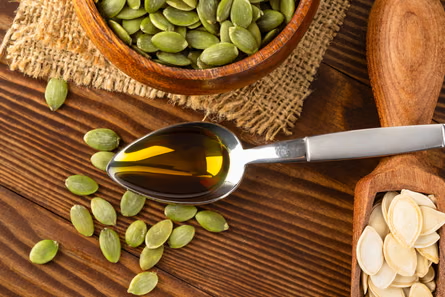
Benelam adds: “Hemp seed oil is high in omega-3s, and other nut and seed oils provide nutrients such as vitamin E and some minerals – although as they are consumed in small amounts, they are not a primary source of micronutrients. These oils often have low smoke points and are relatively expensive and so should be used for dressings rather than cooking.”
Howard has at least six oils on the go at all times. “I think variety is the spice of life. Unrefined pumpkin seed oil is wonderful, and when I was in New York, I picked up a butternut squash seed oil. I found argan oil in Germany and I was so excited – it’s especially prevalent in Moroccan and Tunisian cuisine. Sometimes I’ll use hazelnut oil to make a nice chocolate cake.” She also uses nut oils to flavour homemade lattes: “If you use pistachio oil, it turns green! It’s a fun experiment, and far better than buying fake hazelnut flavouring.”
Isn’t it better to cut out oils altogether?
No – they are part of a balanced diet and a source of essential fatty acids, which the body can’t make itself.
“Americans went through a big period of fatphobia in the 80s and 90s where everybody was told: don’t eat fat,” says Howard. “But vitamins A, D, E and K are all fat-soluble vitamins, which means that if you consume food such as carrots without fat, you won’t get those vitamins from it. If you eat a salad with only veggies – no nuts, no cheese, no avocado, no olives, no dressing – that’s not really getting you anywhere.” Make the dressing yourself, she stresses: “You just need a good-quality oil and an acid – lime, lemon, orange juice, vinegar … It’s so simple.”
I’m still confused …
In short, use extra virgin olive oil as often as you can afford. For a more neutral flavour, use cold-pressed rapeseed oil. On a tight budget, any unsaturated oil (eg sunflower, groundnut) is better than a saturated fat.