








When Fidelma O’Kane retired more than a decade ago from her career as a social worker and lecturer, she thought she would be “travelling and having a glass of wine and eating chocolate and reading books” while based in the quiet, hilly corner of rural County Tyrone where she has lived almost all her life.
It didn’t quite work out that way. Instead, an idle remark from a neighbour would set O’Kane on a path that would become an all-consuming mission. A mining company, the neighbour told her, was planning to drill for long-rumoured reserves of gold in the Sperrins, the low peatland mountain range in Northern Ireland where O’Kane’s family has lived for generations.
“She was all excited about it,” O’Kane said. “But when I told my husband, he said to me: ‘Goldmining. That’s bad news.’”
Below the hills where O’Kane and her husband, Cormac McAleer, a retired community worker, sit today in their kitchen, sharing cups of tea and buttered toast, is one of the richest unexploited seams of gold anywhere in the world. It is worth many billions of pounds – and they are determined to keep it in the ground. Having been alerted by their neighbour, the couple threw themselves into researching global goldmining and, alarmed by what they discovered, began rallying with other locals who were equally committed to blocking the proposed mine.
“From when we get up in the morning to when we go to bed at night, we are focused on this,” says O’Kane, who can rattle through topics from wastewater discharge consents to water table drainage to UN cross-border treaties, seemingly without pausing for breath. “I swear to God, our sons have even said: ‘Mum and Dad, can you not talk about something else?’ Even at Christmas Day [they said]: ‘Let’s not talk about the goldmining today.’”
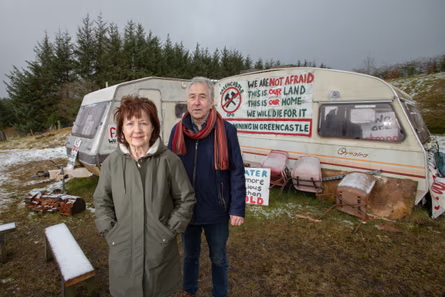
To the couple and other local people opposed to the plan, mining for gold in a landscape that holds deep cultural and family roots would risk desecrating an area of outstanding natural beauty, polluting their wildlife-filled rivers and harming the health of their children.
To Dalradian Gold, a US-owned mining company that wants to extract the mineral from these hills, the proposed development could bring hundreds of jobs, a large tax windfall for the exchequer – and quite spectacular riches for its owners.
As well as dazzlingly valuable seams of gold, these fields and bogs also sit above significant reserves of silver, copper and critical minerals including antimony and tellurium. At current prices, the known gold reserves alone at the site are worth at least £21bn.
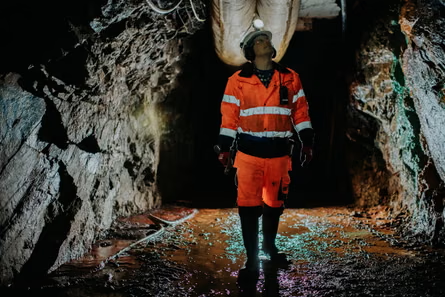
Dalradian, which is owned by a New York investment firm, says the mine project will be clean, carbon neutral and support a supply chain worth £1bn. Inevitably, some locals are in favour, including Gerry Kelly, 56, a local mechanic who lives a mile from the proposed site. “Most people want a quiet life,” he says, “but they would all grab a good high-paying job on their doorstep if it was available.”
It has led to a decade of often bitter division in these tiny rural townlands, where everyone knows who lives where, who owns which field – and where each of them stand on the goldmine. Formerly close friends no longer speak to each other at the local chapel or petrol station, several people say. People who are both for and against the mine say some of their supporters are afraid to share their views openly. Both sides describe instances of intimidation and even death threats – in a part of the world where such things have historically been taken seriously.
On Monday 13 April, this long and toxic battle will finally take what both sides hope will be a significant step towards resolution – even if they each want very different results. Nine years after Dalradian submitted a planning application to extract 3.5m ounces of gold over 20 to 25 years from a site called Curraghinalt near the townland of Greencastle, a public inquiry into the application will reopen in nearby Omagh.
That it has taken so long to reach this point is thanks to a range of factors including dogged opposition campaigning, the complicating proximity of the Irish border, and Northern Ireland’s devolved and often glacial planning system, which in this case, say mine supporters, has been choked by bureaucracy and systemic dysfunction.
The stakes, for both sides, are sky high – perhaps best illustrated by the fact that Dalradian says it has already spent more than £250m on the project without any guarantee it will get the eventual go-ahead.
That investment can be explained by the mind-boggling potential riches in these hills, which are geologically part of a vast supergroup of rocks running through Scotland and the north-west of Ireland, and analogous to similar gold-carrying deposits in eastern Canada and the US.
Gold is so valuable – many times more so today than when Dalradian first got involved here in 2009 – that in some mines around the world, ore carrying as little as 0.5g of the metal per tonne is considered worth extracting. Parts of the seam at Curraghinalt carry between 200g and 300g of gold per tonne. The planning application under consideration proposes extracting, every year, gold worth almost £500m at today’s prices. (“It’s stellar,” said a company source.)
Those who oppose the mine see this as a David and Goliath fight, and have mustered every modest weapon at their disposal against their well-funded opponents. O’Kane and McAleer are part of a group called Save our Sperrins, one of several small local campaign groups that have sprung up, and spent the early years of their campaign touring local villages and towns holding public meetings in pubs and village halls to rally opposition.
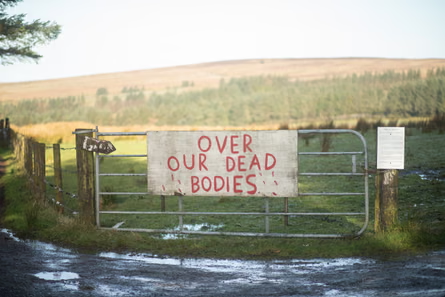
One of the couple’s four sons, an architect, made a scale model of Dalradian’s enormous proposed “dry stack” of processed waste rock, to help illustrate their point. Locals have placed video cameras in the area’s small rivers and burns to capture the diversity of wildlife they support, including otters, pine martens and an internationally important population of freshwater pearl mussels. A group of young mothers who meet to walk around Greencastle were enlisted to record the bird species they witnessed. Several years ago, a number of locals staged a rolling occupation of several caravans close to the proposed mine, declaring the encampment – today festooned with defiant signs – the “Greencastle People’s Office”.
Marella Fyffe, 67, who lives between Omagh and the mine site, gave up her job as a yoga teacher last year to campaign full-time against the mine.
The battle in Greencastle is “just a little act on a bigger stage”, Fyffe says, “but it’s a fight for the heart of humanity. Our values are our language, our home, our community – that’s what’s valuable to us. These other people – not making them wrong – but their values are money, growth, extractivism, capitalism. They’re different values. These things are playing out on a global stage, but here they are playing out in Greencastle as well.”
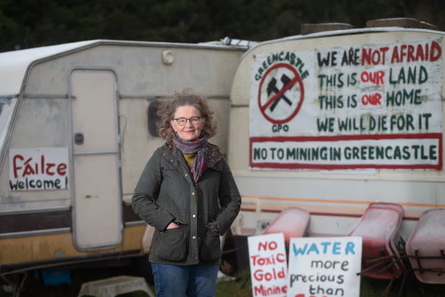
She now hosts a podcast in which she interviews supportive locals and fellow environmental campaigners around the world, some of whom have embraced the Sperrins protesters as fellow “frontline defenders” of the environment and human rights.
But the protesters’ opponents are not only Big Mining – they also include some of their neighbours. Kelly, the supportive local mechanic, is the chair of a group called The Silent Majority, and says most people locally back the mine, though he is one of very few prepared to speak out publicly – others, he says, are afraid of a backlash from neighbours who are opposed.
“There’s definitely a majority of people locally in support,” he says. “We haven’t put numbers on it, but when you speak quietly to people, they are mostly looking forward to the day when it opens. The main attitude in the area is that Dalradian are just a normal business putting in a planning application, and we have regulatory authorities whose job it is to go and regulate these things.
“It’s not hard to see how a thing like this could bring in good local economic benefits, to stop people always having to travel long distances or emigrate. We have been quarrying and using the land for generations, this is just another version of that industry.”
Kelly disputes that the area is divided. “The fact is that those who support the mine just want to get on with life, take care of their families, go to their work and pay the bills. The highly motivated people here are the protesters.”
Anti-mine campaigners, for their part, dispute the numbers who support it – “Calling yourself the majority doesn’t make you the majority,” says Sinéad Ní Mhearnóg, 37, an Irish language development officer who grew up and is building a home on family land close to the mine site.
They point to more than 50,000 letters of objection that have been submitted to the planning process. Pro-mine voices, in turn, note that there are many more signatories than the total population of Omagh. They dispute the number of individuals those letters represent and claim some people have had protest letters submitted in their names without their knowledge.
Meanwhile, at the school gates and the local Gaelic Athletic Association club, “it’s kind of become a thing where in some ways we don’t talk about it to get things done,” says Ní Mhearnóg, “because we still have to be a community and get on with things. But it has definitely changed the community.”
Dalradian claims the Curraghinalt mine will “set new standards in the industry” and become Europe’s first carbon neutral mine, which it says it will achieve by using electric and biofuel-powered vehicles where possible and carbon offsetting. It rejects that the mine will cause any risk to health. In a statement, the company said it “carries out vigorous, independently verified monitoring of local rivers over and above our regulatory requirement”.
It said: “Dalradian will create 1,000 jobs in our local community and complement Tyrone’s position as a hub for the global extractive engineering sector. Once permitted, the project will contribute circa £3bn in taxes, support a £1bn supply chain and generate £9bn for the economy (gross value add).” A percentage of revenues will also be paid to the crown estate, which legally owns almost all gold and silver deposits in England, Wales and Northern Ireland.
“We are looking forward to the start of the public inquiry which will provide an independent evidence-based assessment of the project and an opportunity for the public to engage with the planning process.”
The public inquiry, overseen by Northern Ireland’s Planning Appeals Commission, will sit in an Omagh arts centre until early June, after which commissioners will make recommendations to the Stormont assembly’s ministers for infrastructure and for agriculture, the environment and rural affairs, with whom the final decision will rest.
For the anti-mine campaigners, the inquiry will be the culmination of years of crowdfunding, concerts, coffee mornings, art exhibitions and garage sales, to pay for a handful of experts, including a Utah-based geophysicist and expert in mining and groundwater, to attend to give evidence on their behalf. Spare bedrooms have been cleared to host supporters, while other friends and connections with expertise in different areas have been pressed to give evidence.
What if the decision goes against them? “We would have to see if there were any points on which we could seek a judicial review,” says O’Kane. “But failing that – I mean, if it came to the point that it was going ahead and machinery arrived, we literally will have to lie on the ground and put our bodies in front of the machines. Because we are determined to protect the air, the water, the land and people’s health.”