

惯性聚合 高效追踪和阅读你感兴趣的博客、新闻、科技资讯
阅读原文 在惯性聚合中打开

推荐订阅源

Engineering at Meta
Engineering at Meta
The GitHub Blog
The GitHub Blog
博客园_首页
T
The Blog of Author Tim Ferriss
H
Hackread – Cybersecurity News, Data Breaches, AI and More
OSCHINA 社区最新新闻
OSCHINA 社区最新新闻
腾讯CDC
I
InfoQ
量子位
J
Java Code Geeks
P
Proofpoint News Feed
有赞技术团队
有赞技术团队
Webroot Blog
Webroot Blog
Martin Fowler
Martin Fowler
D
Docker
F
Fortinet All Blogs
云风的 BLOG
云风的 BLOG
V
Vulnerabilities – Threatpost
罗磊的独立博客
P
Proofpoint News Feed
T
The Exploit Database - CXSecurity.com
Cyberwarzone
Cyberwarzone
P
Privacy & Cybersecurity Law Blog
Last Week in AI
Last Week in AI
爱范儿
爱范儿
The Hacker News
The Hacker News
S
SegmentFault 最新的问题
钛媒体:引领未来商业与生活新知
钛媒体:引领未来商业与生活新知
博客园 - 三生石上(FineUI控件)
V
V2EX
Simon Willison's Weblog
AI
AI
Y
Y Combinator Blog
Security Archives - TechRepublic
让小产品的独立变现更简单 - ezindie.com
GbyAI
GbyAI
V
Visual Studio Blog
H
Heimdal Security Blog
S
Secure Thoughts
B
Blog RSS Feed
雷峰网
雷峰网
T
Tenable Blog
C
Check Point Blog
G
Google Developers Blog
大猫的无限游戏
大猫的无限游戏
D
Darknet – Hacking Tools, Hacker News & Cyber Security
Exploit-DB.com RSS Feed
Cyber Security Advisories - MS-ISAC
A
About on SuperTechFans
Recent Commits to openclaw:main

The Guardian

Rory McIlroy surges into six-shot Masters lead with stunning second-round flourish ‘That’ll be the end’: actor Sam Neill joins fight to stop controversial goldmine near his New Zealand vineyard Roberto De Zerbi targets ‘Ange-ball’ revival to save Spurs from relegation Bath hit back to reach semi-final after stunning Northampton in 11-try epic Secret Garden to Outcome: the week in rave reviews Zebras, wealth and power: Hungary’s election tests Orbán’s grip on power ‘TikTok effect’ brings sellout crowds and younger fans to Grand National meeting The war over Omagh’s gold: the £21bn mine plan tearing a community apart Britain’s shadow workforce is paid as little as 65p an hour. Who cares for the carers? From You, Me & Tuscany to Euphoria: your complete entertainment guide to the week ahead Six great reads: the man who let snakes bite him, masked heavy metal and the brutal reality for foreign students in the UK American Classic review – I defy you not to fall in love with Kevin Kline and Laura Linney’s tender comedy Cuba’s doctors were a lifeline for the world. Now the Caribbean is shamefully complicit in the US drive to expel them An environmental disaster in Moldova has Russia’s fingerprints all over it RMIT drops misconduct case against student who accused university of being ‘complicit in Gaza genocide’ Ichiro Suzuki statue unveiling goes awry as bronze bat snaps during ceremony Survivors of Epstein’s abuse accuse Melania Trump of ‘shifting burden’ on to victims European football: Real Madrid held at home by Girona to extend winless run Arne Slot insists he is ‘aligned’ with Liverpool board and fans as squad is rebuilt Kamala Harris ‘thinking about’ running for president again in 2028 JD Vance warns Iran against trying to ‘play’ the US in peace talks West Ham double up twice to thrash Wolves and put Spurs in relegation zone Trump administration releases new renderings of so-called ‘Arc de Trump’ Crispin Odey drops £79m libel claim against FT over sexual misconduct allegations Bafta apologises for events surrounding John Davidson’s Tourette’s outburst Cocktail of the week: Bar Shrimp’s la rosita – recipe New drug may extend survival in aggressive ovarian cancer, trial shows One dead and 27 injured after bus with British passengers crashes in Canary Islands Pope adds to Smith’s mass of Surrey runs with England woes a world away OpenAI CEO Sam Altman’s home targeted with molotov cocktail Reform UK local election candidate was twice disciplined by Tories over ‘racist comments’ Remaining in Nato is in best interests of US, says Keir Starmer Prince Harry sued for defamation by charity he co-founded Anthropic’s new AI tool has implications for us all – whether we can use it or not Concerns raised about motorbike tourist trail after death of British teenager in Vietnam The Guardian view on Trump’s civilisational threats: the words that fuel war must be condemned The Guardian view on dystopias for our times: the American nightmare Doctors’ leader claims new reduced pay offer killed chances of ending strikes in England Netanyahu-ism has achieved nothing for Israelis – and come at a monstrously high price Deborah Levy: ‘CS Lewis’s White Witch terrified me – but I wanted to meet her’ How I Shop with Michelle Ogundehin: ‘We grownups have enough stuff already’ Trump’s war and Melania’s Epstein statement, with US editor Betsy Reed – The Latest We have to stop killer motorists on Britain’s roads UK starts crackdown on EU citizens’ post-Brexit rights Londoners aren’t unfriendly – but don’t compare us to New Yorkers The religious right and the perversion of faith Artemis II images reignite moon mission memories Orbán and Magyar trade accusations in last days of Hungary election campaign Reckonwrong: How Long Has It Been? review | Safi Bugel's experimental album of the month Martin Rowson on Middle East peace talks – cartoon Masters magic, the Grand National and Premier League drama – follow with us Fears of UK and EU flight cancellations as airports warn of jet fuel shortages Reform’s petulance over slavery reparations shows it just doesn’t grasp Britain’s place in the modern world Peers vote to ban pornography depicting sex acts between stepfamily members Starbucks’s retail arm gets £13.7m tax credit even as sales increase Flyby review – interstellar musical is a voyage of epic strangeness Grand National preview: Jagwar can deny Irish cohort in Aintree classic Week in wildlife: an ostrich on the lam, a tortoise crossing a road and surfing seals Anger as swifts’ nesting holes in Derbyshire rail viaduct ‘blocked up’ Peter Mandelson faces fixed-penalty notice for urinating in public ‘There’s no shortage of terrifying technology’: how AI became TV drama’s new go-to villain ‘Fresher than anything in a shop’: the best recipe boxes and meal kits for time-poor foodies, tested Who was Hilma? Af Klint exhibition to highlight exclusion of women from abstract art Critics assemble! Here’s my list of the greatest superhero movies of all time US inflation soars in March as war on Iran drives economy into uncertainty Amazon to finally launch Leo satellite internet in ‘mid-2026’, says CEO Grand National 2026: horse-by-horse guide to all the runners Pete Hegseth’s holy war: the militant Christian theology animating the US attack on Iran Add to playlist: the beautifully dazed, countrified indie-rock of Tracey Nelson and the week’s best new tracks Not just about Gaza: the Muslim voters turning from Labour to the Greens ‘I’m worried there’s too much of me,’ says a birch: inside the interspecies council giving nature a voice Why is anyone surprised by the US and Israel’s latest war? It’s only what the world allowed them to do in Gaza Tori Amos review – fans hang on every note of this dramatic deep dive into her back catalogue Coachella 2026: Justin Bieber launches a major comeback in the desert Super Mario what?! The seven best obscure Mario games ‘An abomination’: the Lancashire town kicking up a stink over reopened landfill Pillion to Roofman: the seven best films to watch on TV this week Holly Humberstone: Cruel World review – Taylor Swift fave trades gothic melancholy for pop glow-up Thrash review – cursed shark thriller sinks like a stone on Netflix Gulf states rethink security in light of US-Israel war on Iran Go Gentle by Maria Semple review – a joyfully clever New York romcom Welcome to Y’all Street: bullish Dallas aims to steal New York’s financial crown Margo’s Got Money Troubles to Beef: the seven best shows to stream this week I baulked at the idea of ‘friction-maxxing’. But there’s more to it than meets the eye Reich: The Sextets album review – Colin Currie celebrates the minimalist master’s joy of six Benjamina Ebuehi’s sweet and salty chocolate chip cookies recipe Experience: my house was taken over by 70,000 bees Malcolm in the Middle: Life’s Still Unfair review – the TV magic they’ve created here is absolutely miraculous Lava bursts forth as Hawaii’s Kilauea volcano erupts Sonos review: Are these the best portable speakers that money can buy? I tested to find out Buy bread in the evening, hit the sales on a Tuesday: retail workers’ top tips to cut your shopping bill The best water flossers in the UK, tested for that dentist-clean feeling Where to start with: Muriel Spark You be the judge: should my girlfriend stop mixing gold and silver jewellery? The best carry-on luggage in the UK, tested on an assault course How games capture the awe and terror of cosmic isolation I never text back – and it’s ruining my relationships The pet I’ll never forget: Beau, the labrador who saved my life Life Is Strange: Reunion review – a decade-long story comes to an impassioned close Why is gaming becoming so expensive? The answer is found in AI
Oxford’s new £185m humanities hub is polished, refined … and funded by a Trump ally
Catherine Sl · 2026-04-29 · via The Guardian

When the wealthy Paduan banker Enrico Scrovegni commissioned the building of his eponymous chapel in the 14th century, he made sure that he was immortalised in the lavish frescoes adorning its interior. Florentine artist Giotto depicted Scrovegni, clad in robes of penitential violet, holding up a model of his chapel as a devotional offering. Just beyond Scrovegni’s eyeline, in a tableau of the Last Judgment, cavorting demons consign sinners to hell, a fate he presumably sought to avoid through his earthly largesse.

Stephen A Schwarzman portrait.
Stephen A Schwarzman portrait. Photograph: Catherine Slessor

Donors and patrons have always insinuated themselves into art and architecture – whether in name or depiction – reminding onlookers of them and their piety and munificence. The image of Scrovegni and his chapel reverberates across the centuries in the portrait of American private equity mogul Stephen A Schwarzman – another man of wealth and taste – which presides discreetly over Oxford University’s new Centre for the Humanities. Named after and bankrolled by Schwarzman to the tune of £185m, it is the largest single gift since the Renaissance.

Here, the fixed-in-time image of the donor is a soft-focused, chocolate box confection showing Schwarzman in dappled sunlight, smiling benignly, as well he might: his net worth in 2026, according to Bloomberg, is £32bn. This has enabled him to gild his reputation through the usual rich man’s philanthropy, but Blackstone boss Schwarzman is also a Trump ally, advising on policy, providing funding for election campaigns and, latterly, donating to the construction of Trump’s controversial new White House ballroom-cum-bunker, now rising over the ruins of the East Wing.
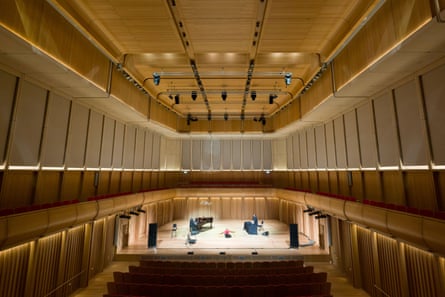
Sohmen Concert Hall at the Stephen A Schwarzman Centre for the Humanities, Oxford.
Rich cacophony … Sohmen Concert Hall at the Stephen A Schwarzman Centre for the Humanities, Oxford. Photograph: Richard Dawson/PA

So, aside from the portrait and his name tastefully chiselled across the door, how much bang has Mr Schwarzman got for his buck? Billed as Oxford’s largest and most programmatically ambitious academic project, the Schwarzman Centre fairly packs it in, yoking together seven humanities faculties, along with a 500-seat concert hall, a 250-seat theatre, a black-box immersive performance space, a white-box exhibition gallery, a dance studio, a cinema and a museum to house the Bate Collection of historic musical instruments, featuring everything from crumhorns to Javanese gamelans. The building also hosts the Institute for Ethics in AI, the Oxford Internet Institute and the new Bodleian Humanities Library.

Yet from the outside there’s little sense of this rich cacophony as most of it has had to be bunkered below ground. Oxford’s planners take understandable pains to preserve the city’s cherished skyline and limit the height of new buildings. So what greets the scholar or visitor is a surprisingly humdrum and sprawling four-storey block, its main north and south facades dignified by creamy Clipsham, the historic “Oxford” stone employed on college buildings since time immemorial.
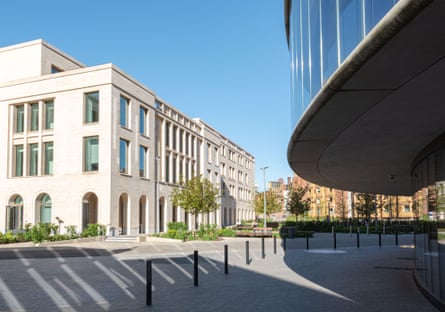
Schwarzman Centre for the Humanities, Oxford.
Polished, refined … Schwarzman Centre for the Humanities, Oxford. Photograph: Stanislav Halcin/Alamy

Hopkins Architects, who won a design competition in 2020, have a reputation for what might be described as the “Jaguar dashboard” school of architecture: polished, refined, deftly synthesising tradition and modernity, always impeccably constructed. Yet here, for all its carefully composed detailing and incorporation of high-end materials, the stripped classicism of the Schwarzman comes across as somewhat bland and bloodless.

The idea of a humanities super-building has been at least 50 years in gestation, periodically foundering for lack of land and funding until Schwarzman rode to the rescue. The site lies in what has been rebadged as the Radcliffe Observatory Quarter, formerly the gardens between the old Radcliffe Infirmary and the eccentric period piece of the Radcliffe Observatory, James Wyatt’s 18th-century reboot of the Tower of the Winds in Athens’ Roman agora.

With the gardens lost over time to a low-quality hospital expansion, the university acquired the entire infirmary site in 2007 and cleared it for development. Over time, it has been populated by a clutch of statement buildings, all resolutely ignoring each other. A case in point is the Blavatnik School of Government, designed by the Swiss partnership of Herzog & de Meuron, which resembles a tottering pile of CDs, and is now ageing like milk. Enter the Schwarzman, as the largest and latest interloper, coolly aloof with its rational geometry, deeply incised windows and modest arched loggia. Yet while there is probably something to be said for a strategy of formal reticence – the Schwarzman as the calm eye of a hectic architectural storm – there’s a fine line between formal reticence and milchwasser insipidness.

It has a big job to do, bringing together people and facilities previously dispersed in an array of accommodation, not always in the most salubrious locales. “History of Art was in rented offices above a Pure Gym round the back of Sainsbury’s,” recalls Prof William Whyte, who project-managed the scheme for the university. Not exactly dreaming spires. “And because all these buildings were horrible, they were always empty.”

Combining academic and civic functions, performance spaces do double duty as faculty lecture halls. The building welcomed students and staff last September and has had a chance to bed in before now being formally opened to the public. “Our great fear was we’d build this and it would be empty,” says Whyte. “And what was glorious was that when we opened it, it was full.”
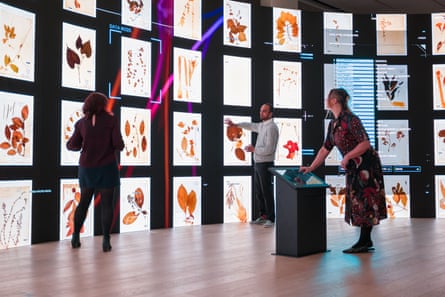
Refik Anadol’s “AI data sculpture” Archive Dreaming at the Schwarzman Centre for the Humanities, Oxford.
‘What was glorious was that when we opened it, it was full’ … Refik Anadol’s “AI data sculpture” Archive Dreaming. Photograph: Richard Dawson/PA

In some ways, this is hardly surprising, as at its heart is the set-piece space of the Great Hall, a four-storey atrium crowned by a triple-glazed polyhedral dome. Light percolates through a secondary octagonal construction of giant slatted oak “petals” which flare out like an exploding timber artichoke. In experimental terms, it certainly beats offices above a Pure Gym.

With its lashings of spatial drama, the Great Hall is the centrifugal force around which the groves of academe whirl, with the libraries and seminar rooms, staff offices and study spaces. Students throng its galleries, glued to laptops or quietly conversing. But at ground level, it also forms a new public room, likened to an Oxford quad reconceptualised for the modern era without the arcane prohibitions. Anyone can wander through, sit and grab a coffee, under the beatific gaze of Mr Schwarzman.
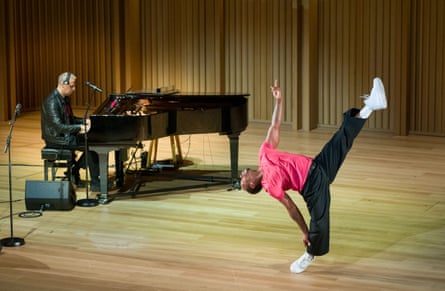
Musician Nitin Sawhney (left) and dancer Lil Buck perform in the Sohmen Concert Hall.
Cultural heavy hitter … Musician Nitin Sawhney (left) and dancer Lil Buck perform in the Sohmen Concert Hall. Photograph: Richard Dawson/PA

Below ground is the subterranean labyrinth of assorted performance spaces, each with a distinct character, from intimate black box to the more regal confines of the 500-seat concert hall, a heroically proportioned space lined with oak panels. The effect is rather like being inside a musical instrument, with shades of the statement auditorium that Hopkins designed for Glyndebourne, now over 30 years ago.

It’s also the world’s first concert hall to attain Passivhaus certification, a feat that extends to the rest of the building. Essentially, the Schwarzman has been designed to achieve an exacting level of low-energy construction, which will reduce its future energy consumption. Performance monitoring over the winter showed that the building’s heating system requires around half the energy of a similar non-Passivhaus structure.

Beyond the imperative to reduce energy, there is a broader civic ambition to dissolve boundaries between town and gown through an extensive public programme of culture, from classical concerts to theatre, dance, talks and art. Inaugural events will feature Cynthia Erivo, Nitin Sawhney, Brian Eno and Kae Tempest, among others, and two major themed seasons will explore the legacy of the 1776 US Declaration of Independence and aspects of utopian thinking. The expectation is that the Schwarzman will evolve into a cultural heavy hitter and add lustre to Oxford’s already pretty lustrous milieu.

Where Enrico Scrovegni offered up a chapel 700 years ago, Stephen Schwarzman has sought to propitiate more worldly and more fickle deities, bringing the saga of Oxford University’s humanities building to a long-awaited conclusion. But in their respective acts of patronage, separated by centuries, both men could be said to have had an eye on immortality.