







A trim caravan sits in an idyllic garden in the grounds of a former gatehouse. Its cosy interior is decked with a cornucopia of crafts: pastel-coloured bunting, felt embroidery, a bright rag rug, plumply immaculate cushions. On the sideboard is a small display of pristine china. It feels like a glamping retreat or a chi-chi refuge from the Chelsea flower show.
But look more closely at the china, and you’ll see that it’s decorated with Sun newspaper headlines venomously fulminating against Gypsy and Traveller encampments. “STAMP ON THE CAMPS” screams one. Another depicts a blazing caravan from the infamous 2011 Dale Farm eviction, which ended a 10-year standoff between Basildon council and Traveller families, who had bought a former scrap yard on green belt land and set up their caravans on it.
The installation (by Romany Gypsy poet, performance artist and journalist Gemma Lees) forms part of Criminal: An Untold Story of Homelessness, Resistance and Survival, a compact yet punchy assemblage of installations, collaborations and infographics that hits you in the gut like a nimble flyweight boxer. Set largely alfresco in the garden of London’s Museum of Homelessness, it explores how homeless people and nomadic communities have been criminalised and marginalised over the last 400 years.
The festive bunting here is delicately printed with extracts of state proscriptions relating to nomadic communities, beginning with the Egyptians Act of 1530 (Romany people, who originally migrated from the Indian subcontinent, were mistaken for “Egyptians”, the etymological origin of the word “Gypsy”) and ending with the 2022 Police, Crime, Sentencing and Courts Act, which strengthened police powers to deal with public order and trespass offences regarding “unauthorised” encampments. Hand-stitched felt embroidery extends the theme, with charming naïf tableaux of caravans through the ages. There are cushions spelling out “Home Sweet Home”, overlaid with yet more febrile Sun headlines: “CARAVAN CHAOS” and “Want to buy my dog for 250 pounds”.
The Museum of Homelessness was established 11 years ago, but for most of its life lacked a bricks and mortar home. That changed in 2023, when it found a base at Finsbury Park’s Manor House Lodge, an old gatekeeper’s cottage. In many ways, Criminal is timely. In London, homelessness is at a new record high. According to the Combined Homelessness and Information Network, commissioned and funded by the Greater London Authority, outreach teams recorded more than 13,000 people sleeping rough in London in 2024-2025, an increase of 10% on the previous year and a 63% rise compared with a decade ago. This does not include the “hidden homeless”, such as those sofa surfing or living in squats. So the Museum of Homelessness is not just a museum; it also provides community support of various kinds and doubles as a cold weather shelter in winter.
Originating in Georgian England to combat the rising number of people forced to live on the streets in the aftermath of the Napoleonic wars and Industrial Revolution, the Vagrancy Act of 1824 is an archaic statute that makes it a criminal offence to sleep rough or beg in England and Wales. It also underpinned the notorious “sus” (or “suspected person”) stop and search law of the 1970s and 80s, which disproportionately targeted black people and ethnic minorities. Despite promises by previous administrations to scrap it, the act remains in force, though the current government has committed to its repeal.
Yet, even before the act, being seen as a vagrant could consign people to the abjection of forced labour, imprisonment and transportation. Today, binary notions of the deserving (hard working families, “local” people, householders) and the undeserving (idlers, aliens, wanderers) still shape public and political attitudes in an unedifying race to the bottom.
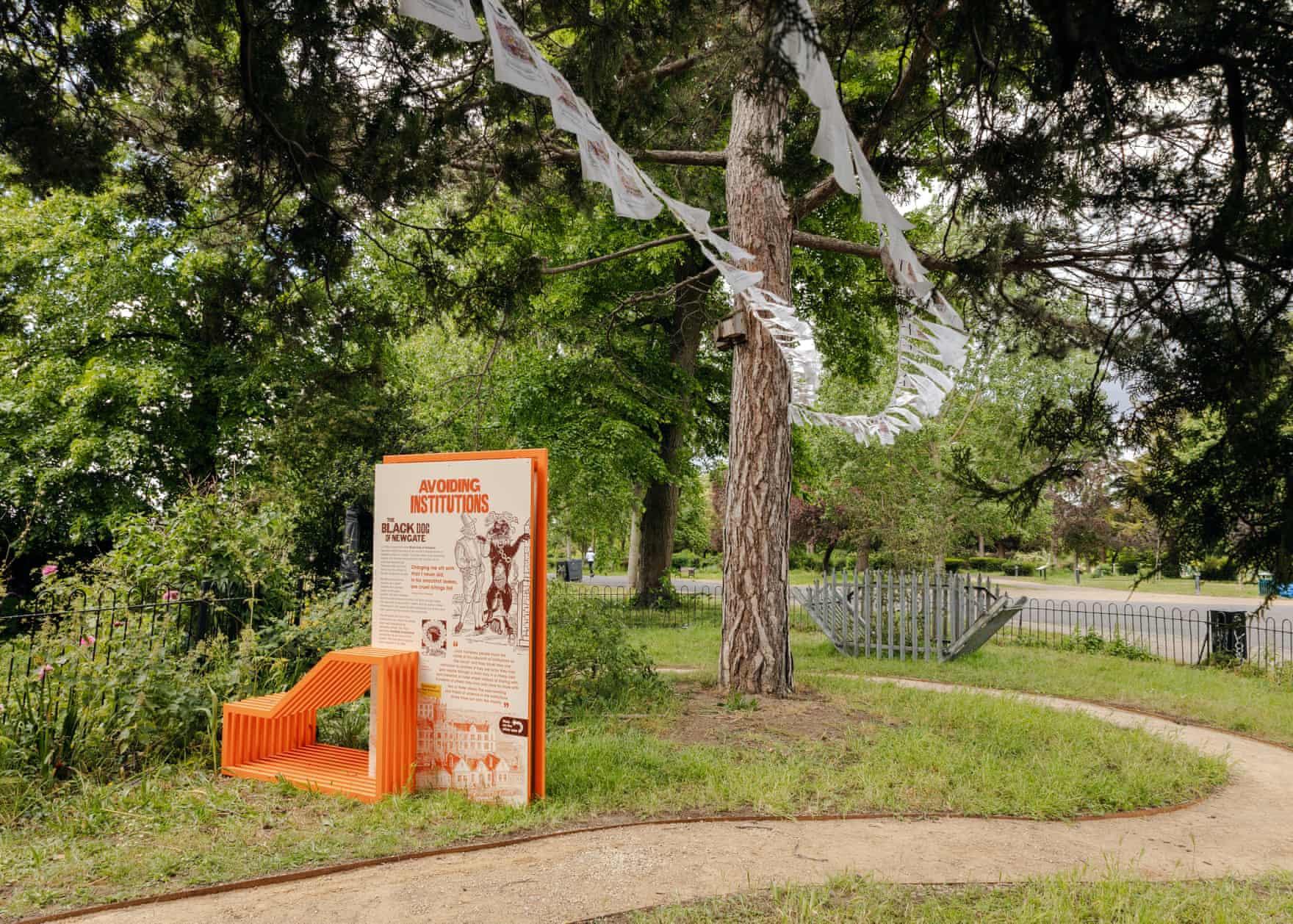
As you perambulate the garden, Criminal’s chronological trajectory encompasses land enclosure, rebellions in the American and Caribbean colonies, and the phenomenon of Elizabethan “rogue” literature – pamphlets itemising “undesirable” human qualities that seeded and legitimised antisemitic, anti-Gypsy and racist tropes. The narrative thread takes in Victorian institutions, poverty maps, soup kitchens and modern-day disinformation, whereby homeless people have become props in the performative politics of “cleaning up city centres”, their lives unthinkingly co-opted for clicks and notoriety. Graphic designer Matt Bonner and Dutch-Polish design company Studio Boloz collaborated on the panels of boldly coloured infographics that slot into seating structures, encouraging people to linger.

Throughout, there’s an exquisite tension between the tranquil, bucolic setting and the often stark subject matter. There are many artful and gentle subversions: a sign that counterintuitively proclaims “Yes loitering”, a hawthorn tree enclosed in a spiky metal palisade, contrived by graffiti artist 10Foot, and strings of Tibetan Buddhist “air horse” flags printed with ASBIs (antisocial behaviour injunctions – 306 in all, the number issued by councils between 2021 and 2025).
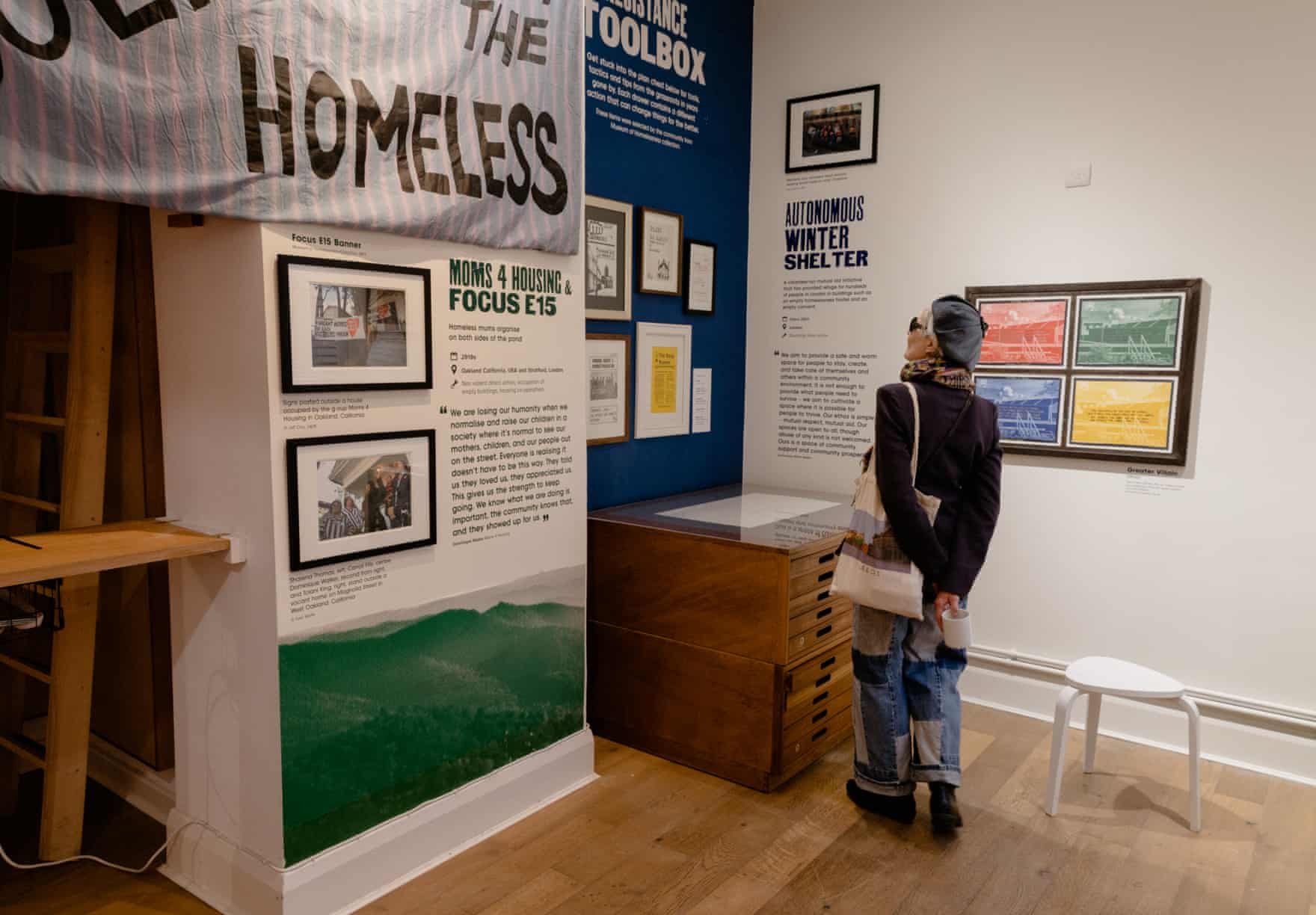
Inside the museum, displays featuring campaigners and groups aim to give a sense of future possibilities, of turning things on their head. They include the Greater Manchester Law Centre, which offers advice for resisting evictions, and Tokyo’s Nora collective, a group of homeless women occupying a “village” of blue plastic tents, who collaborate to humanise their surroundings and how the world sees them.
“We hope it will reframe people’s opinions and perceptions of homeless people,” says Museum of Homelessness cofounder and director Jess Turtle. “At best, they are thought of as victims; at worst, as a sort of menace to society. So we wanted to show the creativity and ingenuity that exists in the community. We want people to go away knowing that there are better solutions to homelessness than law enforcement.”