



Myanmar’s military regime is expanding its ban on the distribution of period products, claiming they are being used to treat wounded resistance fighters, according to local activists.
The south-east Asian country has been locked in civil war since 2021, when the military usurped the democratic government and launched a violent crackdown on dissidents. Artillery fire, the burning of townships and arbitrary arrests have become common in the years since then.
Thinzar Shunlei Yi, a director at Sisters2Sisters, a women’s rights collective that supports fighters, said: “The [military is] saying menstrual products are used by the People’s Defence Force for medical reasons and as support for their feet and boots to absorb sweat and blood.”
There has been no official communication from the military government on this, but the blockade – thought to be part of a broader effort known as “four cuts”, which is designed to deprive insurgents of basic supplies – began in August in certain areas where opposition forces have control. Transporting pads across the bridge that connects Sagaing with Mandalay, Myanmar’s second-largest city, is completely prohibited.
The ban has been expanded this year and was likely to be more widespread than many people thought, said Thinzar Shunlei Yi, because of the taboo around talking about menstruation.
Meredith Bunn, founder of the medical aid charity Skills for Humanity (SFH), said anyone who had ever worked in combat medicine knew that sanitary towels could not be used to treat gunshot wounds or even lacerations.
“A sanitary pad wouldn’t stay in place, wouldn’t soak enough blood and wouldn’t keep the area [clean],” she said, blaming the ban on “completely uneducated, misogynistic fools within the military”.
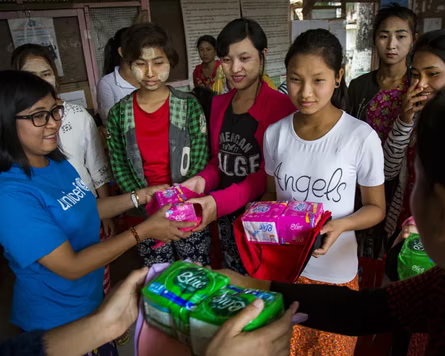
Henriette Ceyrac, who founded a period education organisation, Pan Ka Lay, in Myanmar before it was forced to close a few years ago, said women were having to use unsafe alternatives such as rags, leaves or newspaper, which exposed them to illness.
“It can cause urinary tract infections [UTIs], reproductive tract infections; just a lot of discomfort and pain,” she said.
Alternatively, they turn to the hidden market where prices have tripled from 3,000 kyat (£1) a pack to 9,000 kyat, said Thinzar Shunlei Yi. The minimum daily wage in Myanmar is 7,800 kyat.
In a country where the health system has collapsed, medical attention is hard to find. Thinzar Shunlei Yi said Sisters2Sisters regularly received requests for antibiotics to treat UTIs. The women were uncomfortable, distressed and sometimes opting to stay indoors during their period rather than taking part in “political activities”, she added.
That was likely to be the regime’s intention, said Ceyrac. “It makes sense actually that [the military] wants to restrict women’s movement even more. It’s basically gender-based violence,” she said.
Bunn believes it is a military tactic designed to target female fighters, control civilians and victimise those in displacement camps. More than 3.5 million people have been forced to find shelter in temporary camps since 2021.
Organisations on the ground are working to distribute reusable pads, but without access to washing water, even these can cause health issues. “A lack of menstrual equipment and areas to wash them properly can cause infections, irritation, UTIs and worse, which is why, until it became absolutely necessary, disposable [menstrual products] were preferable,” Bunn said.
Alternative menstrual products such as cups and tampons are rare in Myanmar. Ceyrac said: “It is frowned upon as a woman to seek information and to be knowledgable about these things.” The whole process of menstruation is considered shameful, she said, and women were encouraged to hide any evidence of it.
Thinzar Shunlei Yi said local groups had alerted the UN on the situation in Myanmar, calling the ban of such a basic commodity “a human rights violation”.