






I, for one, am partial to a bath: what’s not to love about a dim room, candles and nary an electronic device in sight?
But a wellness trend that has emerged in recent years makes soaking in tepid water seem quaint: increasingly, people are paying to be “bathed” in sound.
Social media is awash with clips of sound baths, where participants – for a fee – lie on yoga mats, hang in cocoons or float on inflatable pool loungers while berobed practitioners gently ring chimes and bang gongs for relaxation.
Online interest in these experiences has risen exponentially in the last decade. Some are available outside in places like Sydney Harbour, where you can be “rocked gently by the tide” while blindfolded. High-end wellness clubs, meanwhile, boast of surround-sound chambers complete with subwoofers.
The purpose, according to the marketing copy for such classes, is to “soothe and calm your nervous system” with sounds that will “penetrate every cell in your body”, while specific frequencies are purported to promote “healing”.
Singing bowls – metal or crystal bells that produce a shimmering timbre when struck or brushed – produce “cosmic sound” claimed to improve “chronic symptoms like pain, fatigue, anxiety, or emotional overwhelm”. But do any of these claims ring true?
Can sound baths really relax us?
“There’s a rich field of music psychology that’s all about the impacts of different types of sounds on human psychology and human physiology,” says Dr Vince Polito, a senior lecturer in the school of psychological sciences at Macquarie University.
It’s plausible that sound baths can affect mood, he says.
In a 2016 study, people who participated in a meditation session involving Tibetan singing bowls reported feeling less tension, anger and fatigue afterwards. The study was an observational one, without a control group, which means it is at risk of bias and can’t establish causation. Another study, a randomised controlled trial in breast cancer patients, linked Tibetan sound meditation to improved cognitive function and mental health.
Mindfulness meditation itself has been linked to improvements in anxiety, depression and insomnia.
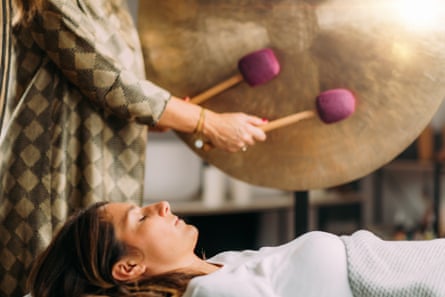
The effects of sound or music on wellbeing largely relates to how we perceive and interpret those sounds, rather than specific types or frequencies, according to Dr Sandra Garrido, a senior research fellow at the University of Sydney’s school of psychology.
“Like anything in the wellness space, its benefits can definitely be talked up,” she says.
Research suggests that our breathing can synchronise without conscious effort to beats we hear – a phenomenon known as “rhythmic entrainment” – and that music can induce different emotions such as happiness, sadness and fear.
That’s why we might prefer slower, calmer music for relaxation, Garrido points out. “A lot of meditation-type music focuses on long tones and not too much in the way of melody or rhythmic patterns that could end up being distracting,” she says, citing the ringing tones of Tibetan singing bowls as an example.
But, she adds: “It’s not so much the music itself in this process as … focusing your attention on one thing, and trying to quiet the mind.”
“Any kind of music that you are focusing on can be a meditative experience.”
Garrido says people often “want something that has this mystical connotation to it”. Of sound baths, she says: “It can be helpful as part of a general wellbeing practice, but it’s not this miracle cure.”
A ‘nice’ experience or music therapy?
“There are long histories of using music and sound in therapeutic ways,” says Dr Amanda Krause, a senior lecturer in psychology at James Cook University and the president of the Australian Music and Psychology Society.
Both listening to and producing music have been linked to more than 500 benefits, she says, including promoting social, cognitive, physical and emotional wellbeing.
This research forms the basis of music therapy, in which music listening or production is used to improve psychological and physical health.
“Music therapists are registered in their profession [in Australia],” Krause says. Music therapists work with a range of clients, including in schools and hospitals. There is no single equivalent regulatory body for sound bath practitioners.
“So often, most of the music listening that we’re doing is accompanying something else,” Krause says. “Maybe we are exercising or commuting to work or working.”
Focused music listening is linked to wellbeing benefits, she says. “People can really use that music listening to amplify emotional responses, and often it might be quite a journey.
“It might not just be a very happy, positive listening experience, but we can see a catharsis through an emotional journey from the listening.”
Garrido says that communally listening to music in the experience of a sound bath can be a “helpful, healthy thing”.
“Historically, throughout most of human history … music has been about social connection,” Garrido says. “It’s only in the last 100 years or so that we’ve had the capacity to go home and listen to music on our own in an isolating kind of way.”
“I’ve been to them myself,” Garrido says, of sound baths. “I enjoy them, they can be relaxing, it’s a nice experience – but I wouldn’t pay too much money for it.”
-
Donna Lu is an assistant editor, climate, environment and science at Guardian Australia
-
Antiviral is a fortnightly column that interrogates the evidence behind the health headlines and factchecks popular wellness claims