








EU officials have arrived in Budapest for high-stakes talks aimed at reshaping the bloc’s strained relationship with Hungary, weeks before the new government takes office, as the country’s departing prime minister, Viktor Orbán, admitted a “political era has ended” and suggested he would stay on as leader of his party in his first interview since the election.
Speaking to the pro-government outlet Patrióta, Orbán described Sunday’s election as an “emotional rollercoaster” after the opposition Tisza party won a landslide victory, bringing an end to his 16 years in power.
Péter Magyar’s party won a supermajority, giving it the power to amend the constitution and potentially roll back key pillars of Orbán’s foray into “illiberal democracy”.
The scope of the loss has prompted questions over what lies ahead for Orbán, whose decades-long political career has been marked by his efforts since 2010 to steadily whittle away at the checks and balances that constrained his government’s power: rewriting election laws to its own benefit, manoeuvring to put loyalists in control of an estimated 80% of Hungary’s media and retooling the country’s judiciary.
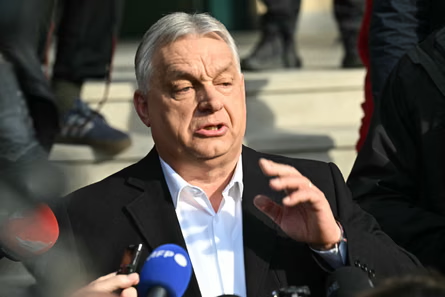
Speaking late on Thursday, Orbán said the results had laid bare that his rightwing populist Fidesz party was in need of a “complete renewal”. Asked who was responsible for the defeat, Orbán said he had no one to blame but himself. “Well, as I am the president of the party … I must take 100% of this responsibility upon myself,” he said.
He added that Fidesz would vote on new leadership in June. “It will not be me who decides what I should do,” he said. “If they say that I need to take the team out into the field, then I will take them to the next match.”
His comments came hours before a delegation from the EU was due to arrive in Budapest, in what is widely being seen as a critical reset for both sides. For the bloc, the visit marks a chance to turn the page on Orbán’s tempestuous tenure and persuade Hungary to lift its veto on a €90bn (£78bn) loan to Ukraine. Magyar, meanwhile, is scrambling to unlock about €17bn in frozen EU funds.
Looming over the talks is a time crunch. “The clock is ticking for a number of topics,” the EU commission’s chief spokesperson, Paula Pinho, told reporters on Thursday, as she explained why officials were travelling to Budapest before Magyar takes office in early May. “Obviously it is in the interest of Hungary, it is in the interest of the EU that we make progress as soon as possible … and that we do not waste any time.”
The frozen funds include nearly €17bn from the EU budget – €10bn of which will expire at the end of August – that require Hungary to implement conditions such as checks on corruption, the right to asylum and academic freedom. More than €16bn in low-interest defence loans could also be on offer.
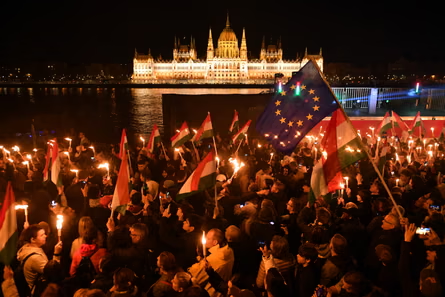
Orbán’s government said the ousted leader would not attend his final EU summit next week, sparing EU officials a potential showdown over his continued veto of the €90bn loan for Ukraine.
During the talks on Friday, Magyar and Tisza would probably be pulled between campaign promises, the demands of the EU and the institutional constraints created by Fidesz’s 16 years in power, said Péter Krekó, the director of the Budapest-based Political Capital thinktank. “Tisza has to cut this Gordian knot somehow, which will not necessarily be very easy,” he said.
Since taking power in 2010, Orbán and his party have stacked the Hungarian state, media and judiciary with loyalists, and it remains unclear how they will react to changes made by a Tisza-led government.
Even so, there was plenty of will among the EU and Tisza to hash out solutions, said Krekó. “The EU funds will be desperately needed so that Tisza can deliver at least on some of their promises,” he said, while the EU was aware that the alternative could see a return to the “obstructive and destructive” relationship it had with Orbán. “I think the political will is definitely there to have the new government deliver so that Orbán does not return to power.”
In the days since Sunday’s election, Magyar has sought to reinforce his message of “regime change” with a series of actions and statements making clear his intent to break from Hungary’s recent past. He has called for the resignation of the country’s two highest courts, audit office and competition and media authorities, as well as the chief prosecutor and Hungary’s president, describing them as “puppets” of the former regime.
In a Wednesday interview with state-run news outlets, he vowed to suspend their news coverage, accusing them of spreading fear, lies and propaganda befitting North Korea and Nazi-era Germany.
The following day, he said on social media that he would not move into Orbán’s office in the historic Castle Quarter, which towers over Budapest and overlooks the Danube River, but instead set up shop in a ministry building near Hungary’s parliament.
He also reiterated a campaign pledge to impose term limits on prime ministers – a move that could block Orbán from returning to power – while pledging to pursue those who had “plundered, looted, betrayed, indebted and ruined” the country.
On Thursday, Orbán said he had been filled with “pain and emptiness” as the results of the election became clear. “Even I thought we were going to win. There were so many of us everywhere.”
He emphasised, however, that the party continued to have a wide voter base, winning nearly 2.4m votes in a country of 9.5 million people. “Let’s not act like the whole country rejected our government,” Orbán said.