


惯性聚合 高效追踪和阅读你感兴趣的博客、新闻、科技资讯
阅读原文 在惯性聚合中打开

推荐订阅源

S
Securelist
C
Cybersecurity and Infrastructure Security Agency CISA
cs.AI updates on arXiv.org
S
Security Affairs
Hacker News: Ask HN
Hacker News: Ask HN
L
Lohrmann on Cybersecurity
PCI Perspectives
PCI Perspectives
Threat Intelligence Blog | Flashpoint
C
Cyber Attacks, Cyber Crime and Cyber Security
Recent Commits to openclaw:main
OSCHINA 社区最新新闻
OSCHINA 社区最新新闻
MyScale Blog
MyScale Blog
月光博客
月光博客
W
WeLiveSecurity
T
Threat Research - Cisco Blogs
Martin Fowler
Martin Fowler
CTFtime.org: upcoming CTF events
Recorded Future
Recorded Future
The GitHub Blog
The GitHub Blog
Webroot Blog
Webroot Blog
Security Archives - TechRepublic
TaoSecurity Blog
TaoSecurity Blog
P
Proofpoint News Feed
Google DeepMind News
F
Full Disclosure
U
Unit 42
Jina AI
Jina AI
博客园 - 司徒正美
阮一峰的网络日志
阮一峰的网络日志
L
LINUX DO - 最新话题
宝玉的分享
宝玉的分享
大猫的无限游戏
大猫的无限游戏
The Hacker News
The Hacker News
The Last Watchdog
The Last Watchdog
T
Troy Hunt's Blog
腾讯CDC
T
Threatpost
H
Hacker News: Front Page
P
Palo Alto Networks Blog
博客园 - 聂微东
Last Week in AI
Last Week in AI
有赞技术团队
有赞技术团队
Help Net Security
Help Net Security
L
LINUX DO - 热门话题
N
News and Events Feed by Topic
人人都是产品经理
人人都是产品经理
让小产品的独立变现更简单 - ezindie.com
奇客Solidot–传递最新科技情报
奇客Solidot–传递最新科技情报
Application and Cybersecurity Blog
Spread Privacy
Spread Privacy

Asia Times

Taiwan’s KMT offers US an off-ramp from war with China F/A-XX fighter tests future of US carrier power against China US, China forge rival fusion chains as Europe weighs role Who is calling the shots in Iran? Large Hadron Collider results hint at undiscovered physics The US counterterrorism czar without a counterterrorism plan Japan’s Takaichi chooses guns over butter — at her peril Iran war leaves Asian nations weighing their nuclear options Southeast Asia holds the key to unlocking Korean impasse In jab at Taiwan, China ramps up military support for Somalia Iran war is turbocharging China’s Africa pivot China’s drone-laid mines aim to trap US in a Taiwan war AI and robots can’t fill bellies – so, capitalism’s end? Next, an Iran nuclear deal with Chinese characteristics Iran, not US, cancels Hormuz blockade after Israel-Lebanon truce Israel-Lebanon ceasefire no tidy end to fighting, Hormuz shutdown Congressional Dems probe envoy Jared Kushner’s Arab money ties Manacled Manus: the limits of ‘Singapore washing’ for China AI China Shock 2.0 jolts global economy as Trump does Xi’s work Disrupted supply chains, divided politics Will Russia attack Ukraine’s European drone suppliers? AI shrinking the margin for nuclear error in South Asia Iran's low-cost drones democratizing precision warfare - Asia Times Israel-Lebanon ceasefire won’t end the death and suffering Don’t hold your breath on a truly European NATO AI boom’s real profits are being made in Asia Hong Kong banks dependent on SWIFT are warned of new US sanctions US starting to respond to challenge of massive drone incursions - Asia Times Trans-Himalayan net zero is a strategic necessity for Asia Alarm bells follow new report of looming US plan to attack Cuba Trump says Israel and Lebanon have agreed to 10-day ceasefire Cuba: the Bay of Pigs invasion 65 years later The legendary cyberpunk anime ‘Akira’ demands a rewatch China’s satellite boost gives Iran a US targeting edge Indonesia losing its sovereign way between US and China Taiwan’s opposition courting China as faith in US fades China carefully navigating Iran’s tighter Hormuz grip Will oil prices ever truly return to ‘normal’? Russia’s war on Telegram may ignite the very fire it fears US Big Oil earning $30 million per hour from Iran war Sending combat troops to exercise, Japan leaves WWII ghosts behind - Asia Times Trump budget director defends 43% military spending boost Don’t believe claims Southeast Asia scam schemes were shut down Blockade v blockade fallout may be not just a world energy crisis Iran war putting China’s economy in a tight spot New resistance alliance built to win Myanmar's civil war - Asia Times US Navy leaning on AI to sweep Iran’s Hormuz mines Trump vs Pope: A US-Vatican rift centuries in the making - Asia Times US Hormuz blockade may not survive a Chinese standoff - Asia Times Iran war inflicting losses that will never be recovered Did Trump just light the match for World War III? Allied shipyards key to closing US naval gap with China Russia’s navy deterred Estonia from boarding its ‘shadow fleet’ In Hormuz war of words, US illustrates threat with ‘drug boat’ hit China faces Trump’s Iran offensive in the Hormuz Strait Medieval Christian tropes inflaming Islamophobic Iran war debate EU loan aims to keep Ukraine war going until 2029 Third China Shock exposing US’s broken defense economics Who should speak for Myanmar? Not Min Aung Hlaing - Asia Times Humanity isn’t ready for AI’s biological threat Quad needs to break China’s rare earth hold on Myanmar Iran war threatening to shatter the global economy - Asia Times US Air Force unready for a prolonged war with China US Hormuz blockade, tariffs jolt China - Asia Times Trump needs A-10s to go after Iranian speedboats and patrol ships NATO allies bash Trump’s Hormuz blockade as oil passes $100 a bbl Trump: with God on his side?  - Asia Times Top Iran diplomat: Deal ‘inches away,’ Trump team sabotaged talks Iran war as a cage Trump can't escape - Asia Times Dueling Hormuz blockades push world to the brink China tech companies going gangbusters in the Gulf Quantum computers to break our codes faster than expected To Lam’s Vietnam drifting perceptibly closer to China Hungarian voters end 16 straight years of Orban’s far-right rule Five emerging themes for the Indo-Pacific from Trump's Iran war - Asia Times Trump announces closure of Hormuz Strait as Iran talks falter - Asia Times Iran has weakened US in the great power game Time to give the Trump-Putin-Orban axis a slap in the face China’s Middle East billions still woefully reliant on US gunboats Indonesia can’t stay silent on China’s UUV incursion Too many players, too many grievances for one ceasefire to hold Japan’s unsustainable pacifist delusion US lawmakers seek to block China’s DUV lithography access For South Korea, an alliance in question Trump aides caught with pants down as Iran war gooses inflation Non-rich Asian states, hit hardest by Iran crisis, ration energy Structural strains grip Tokyo and Seoul US isn’t losing soft power in SE Asia — it’s ceding it to China KMT’s ‘imperialist’ rhetoric shifts Taiwan’s democratic fault line The deal to reopen Hormuz is nowhere near done Iran ceasefire: too many brokers, too little leverage Ending Israel’s war on peace Iran ceasefire won’t easily ease emerging Asia’s pain N Korea building a new war playbook from Iran and Ukraine America’s Soviet moment: Why Trump is looking like Yeltsin Can Pakistan deliver as Washington’s go-to mediator with Iran? CNBC anchor mulls investor ‘upside’ of Trump civilizational threat With Middle East in flames, Trump eyes ‘next conquest’ Vietnam: all the power in To Lam’s grasping hands Mooted South China Sea oil deal with China draws fire in Manila
China has played key role in Iran war and will continue to do so
Tom Harper · 2026-05-07 · via Asia Times
An Iranian walks next to an anti-US mural in a street in Tehran on May 4. Photo: Abedin Taherkenareh / EPA

Donald Trump has paused “Project Freedom”, the US operation aimed at restoring commercial shipping through the Strait of Hormuz. In a post on social media just days after the operation was first announced, Trump said he had made the decision to give US negotiators time to reach an agreement with Iran to end the war.

Iranian state media framed the suspension as a US failure. Iran had warned that it would target vessels attempting to enter the waterway and subsequently launched missiles and drones at civilian ships and the United Arab Emirates. It is unclear where the conflict will go from here. But whatever happens next, the role of China will be crucial.

China has kept Iran’s economy afloat in the first two months of the war. Before the war, China accounted for up to 90% of Iran’s oil exports, importing over a million barrels each day. Iran continued to send large amounts of crude to China during the war’s early stages, with CNBC reporting that at least 11.7 million barrels were shipped between February 28 and March 10.

Payments for Iranian oil have been processed by institutions such as China’s Bank of Kunlun and the Cross-border Interbank Payment System. These are alternatives to the US-dominated Swift global payment system that enable oil trades to be settled in yuan. This has helped Iran bypass western sanctions by putting oil revenues out of the reach of the US Treasury.

The flow of oil from Iran to China has dropped since mid-April, when the US imposed a naval blockade of Iranian ports. But China remains able to provide Iran with a revenue lifeline – albeit a more limited one – moving forward.

On May 2, China’s Ministry of Commerce ordered firms not to comply with US sanctions on five Chinese refiners linked to the Iranian oil trade. This enables the refiners to continue processing Iranian crude that arrives by train or is already outside the blockade area. Roughly 160 million barrels of Iranian crude were in transit or in floating storage at sea as of April 21.

China’s economic support for Iran is emerging as a source of friction between Washington and Beijing ahead of Trump’s upcoming summit with Chinese leader Xi Jinping. In an interview with Fox News on May 4, the US treasury secretary, Scott Bessent, said China’s continued purchases of Iranian oil amounted to funding global terrorism.

However, the influence of China over Iran’s economy gives it leverage over Tehran. And it does appear to be in the interests of China for the war to end. Rising prices are beginning to affect the Chinese economy, and helping the conflict come to an end would also assist the Chinese government in its push to present itself as the responsible global power.

China has already played an important diplomatic role in the conflict. While Pakistan has served as one of the key mediators between the US and Iran, many analysts have credited China as being the key driving force behind the April ceasefire. At that time, Iranian officials said China had asked them to show flexibility and defuse tensions.

China seems to have continued pressing Iran to negotiate with the US since then. Hours after Trump announced he was pausing the US effort to guide vessels out of the Strait of Hormuz, Iran’s foreign minister, Abbas Araghchi, met with his Chinese counterpart, Wang Yi, in Beijing. This is the first time Araghchi has travelled to China since the war broke out.
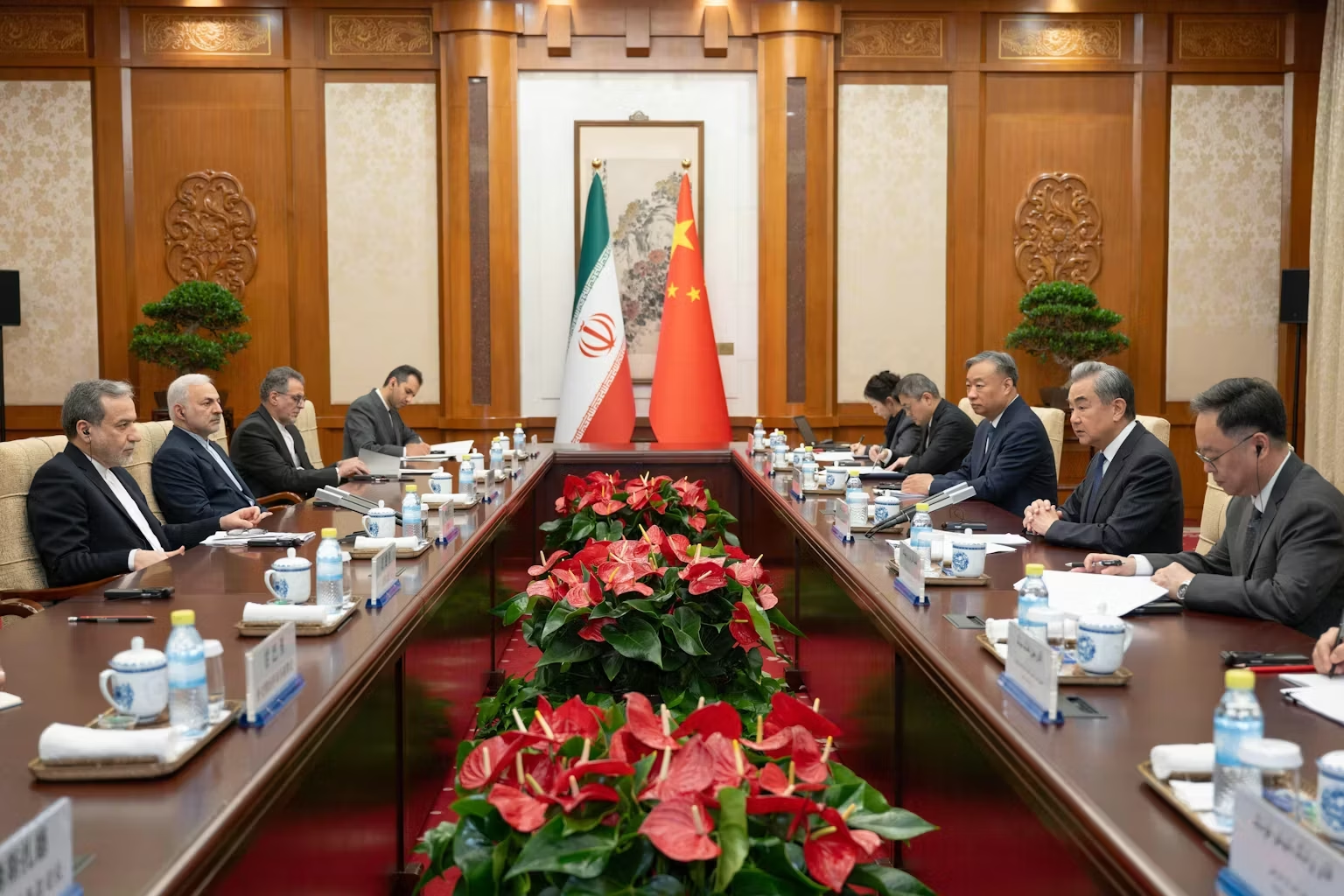
The Chinese foreign minister, Wang Yi, holds talks with his Iranian counterpart, Abbas Araghchi, in Beijing on May 6. Photo: Cai Yang / Xinhua

In a statement released after the meeting, the Chinese foreign ministry said: “China considers that a complete cessation of fighting must be achieved without delay … and that continuing to negotiate remains essential.” Also after the meeting Araghchi said Iran would protect its “legitimate rights and interests in the negotiations” but will “accept a fair and comprehensive agreement.”

Chinese military support

At the same time, there are some signs that China is hedging its bets. A protracted war involving the US in the Middle East has advantages for China too, primarily because it would divert US attention from the Asia-Pacific region. Reports suggest that China is considering taking steps that would help Iran militarily if a full-blown conflict returns.

According to US intelligence, Beijing has weighed transferring air defense systems to Iran, possibly routing the shipments through other countries to mask its involvement. CNN reported in April that the defense systems in question were shoulder-fired anti-air missiles known as Manpads. China responded by saying it “has never provided weapons to any party to the conflict.”

Chinese technical assistance also enhanced the effectiveness of Iran’s military earlier in the war. Since 2021, Iran has been implementing BeiDou, a Chinese satellite navigation system. As an alternative to the US-run Global Positioning System (GPS), BeiDou has helped guide Iranian missile strikes in the conflict and has enabled more effective monitoring of US military deployments.

China has played a key role in how the conflict has played out so far. And given its position of influence over Iran, it will be a leading factor in whether the war reaches a negotiated end or spills back into open conflict.

Tom Harper is a lecturer in international relations, University of East London.

This article is republished from The Conversation under a Creative Commons license. Read the original article.