


The US is starting to respond to drone incursions on US territory, but the response does not match the growing threats from drones, which are likely to get worse.
In 2025, the US tracked 34,000 drones along the southern border, a significant increase over 2024.
Late in 2024 there were reports of mass sightings of drones across New Jersey, New York and Pennsylvania. The government argued that some of these sightings were caused by public misidentifications of authorized flights but military officials said there was a concurrent pattern of unauthorized incursions over sensitive sites such as the Picatinny Arsenal.
The DEVCOM Armaments Center at Picatinny is a lead collaborator on projects like Project Golden Shields where the Army is developing autonomous counter drone systems and sensors. Golden Shield is designed to solve the problem of “drone swarms” and high-volume aerial threats by automating the response chain. This is a very active program which was recently tested at Ft. Hood, Texas by the 1st Cavalry Division. Golden Shields would be a high priority target of America’s top adversaries.

There have been persistent drone threats at US strategic military bases including Barksdale AFB, Langley AF base and Ft. McNair in Washington DC where Secretary of War Pete Hegseth and Secretary of State Marco Rubio reside.
In March the Pentagon urgently deployed a “Fly Away” counter-drone kit at an undisclosed strategic location.
Cartels
The southern border drone incursion and operations within 500 meters (1,600 feet) of the border are attributed to Mexican cartels, mainly to the Sinaloa Cartel and the Jalisco New Generation Cartel (CJNG).

Mexican cartels are heavily involved in the drug trade, in human smuggling across the border, in other scams including “shadow taxes” on avocado farming and lime production and in cargo theft. While technically non-state actors, the cartels have gross incomes exceeding that of many a country. The combined revenues of the cartels are greater than the Kingdom of Jordan or Tunisia. Cartel revenues combined are estimated between $40 and $50 billion annually.
The cartels are using drones primarily for surveillance and for smuggling, and more recently for military strike operations. The cartels have full access to Chinese drone technology and “adapt” commercial drones for high value operations, adding secure communications.
Using 3D-printing, cartels have modified larger commercial platforms (like agricultural sprayers or heavy-lift hex copters) to carry and drop multiple IEDs or mortar rounds in a single flight. Inspired by tactics learned in Ukraine, cartels now use high-speed First-Person View (FPV) drones equipped with contact-fused explosives. These are highly maneuverable and can be flown into specific targets.
There are reports that cartel-trained soldiers were sent to Ukraine where they were tasked with learning how Ukraine is managing its drone war and what technologies are needed for cartel operations. For example, to counter the signal jammers used by Mexican security forces, there have been reports of cartels experimenting with fiber-optic tethered drones. These are immune to electronic jamming.
Cartel attack or suicide drones have not yet appeared over US territory. However, because cartels track law enforcement and border patrol activities, it is only a matter of time before the cartels use them on US targets.
Cartels and Hezbollah
The cartels also partner with other dangerous state and non-state actors, most importantly Hezbollah. Hezbollah operatives, long active in the tri-border area (Argentina, Brazil, Paraguay), provide cartels with access to global trafficking routes and specialized money-laundering channels.

Hezbollah generates nearly 30% of its operating budget through criminal partnerships, including drug and arms trafficking in collaboration with Mexican cartels.
Because Hezbollah is an Iran-controlled proxy, its presence with the drug cartels in Mexico assists them in potential operations in the United States that can include kinetic operations against military sites and infrastructure (such as nuclear power plants) and surveillance to support Iran’s declared effort to kill top American officials. The Ft. McNair intrusion was regarded by experts as part of Iran’s attempt on the lives of Hegseth and Rubio.

Ft. McNair
The US has not said, and may not know, where the Ft. McNair drones came from or, for that matter, where they went. The drones operated in a swarm. They were small or medium-sized drones. According to reports from The Washington Post and WTOP, they exhibited high-level maneuverability that bypassed standard ground-level perimeter security. They appeared to operate as a “swarm,” suggesting advanced software control rather than individual manual pilots. They remained over the base for an extended period during a single night, indicating specialized or modified battery systems for long-endurance flight.
Washington, DC, is situated at the convergence of the Anacostia and Potomac rivers and is around 35 to 40 miles from the Chesapeake Bay. Drones can be launched by small water draft, or even from larger vessels in the Chesapeake.
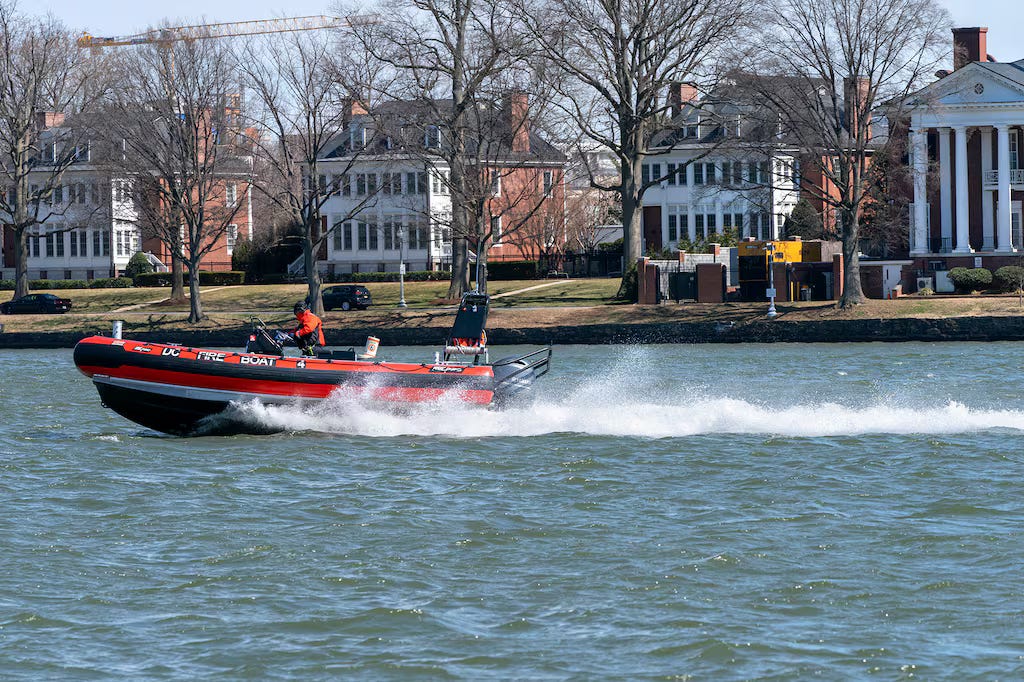
Defenders at Ft. McNair tried to jam the intruders but, similarly to what happened at Barksdale, the jammers failed to stop the drones.
There was no effort to shoot them down and attack jets from nearby air bases were not summoned. The 113th Wing (District of Columbia Air National Guard), specifically the 121st Fighter Squadron, which flies F-16s, is at Joint Base Andrews, less than two minutes by air away from Ft. McNair.
Fighter jets operating a stone’s throw from the White House and firing missiles would be a reckless action.
Use of lasers at Ft. McNair is probably not possible because Ft. McNair is located very close to Reagan National Airport, about 5.1 miles. When planes from Reagan National take off in a westerly direction or when aircraft land using the “river approach,” passengers can see key landmarks including Ft. McNair. The risk of hitting a commercial airliner is too great.
The Pentagon FAA controversy
On February 11 the War Department deployed a laser system at Fort Bliss near El Paso, Texas, to neutralize cartel drones. Because the FAA was not notified of the “live fire” operation in advance, it immediately closed the airspace over El Paso International Airport for several hours. A 10-day closure was initially announced but it was lifted after an urgent interagency standoff.
On February 26 military units reportedly used a laser to shoot down a drone that appeared threatening. It was later revealed that the drone actually belonged to US Customs and Border Protection (CBP). This prompted a second, more localized airspace closure near Fort Hancock, which is across from El Porvenir, Chihuahua, Mexico.
After these events in February the FAA stopped any use of anti-drone lasers. The FAA complained that the military was acting without coordinating with the FAA and risked interfering with commercial aviation. The War Department and the FAA, however, negotiated and reached a deal in April, which is now being implemented.
The FAA, based on tests at White Sands Missile Range in March, agreed that the War Department’s automated safety shut off system, which shuts down a laser if a manned aircraft (or other object) enters the laser’s operating airspace, was satisfactory.

The War Department also agreed to provide mandatory advanced notification before activating high-energy laser systems. The deal has allowed the War Department to start installing laser defense systems on the southern border.
Locust laser on border
The US has started installing a 20 to 35 kw Locust laser system on the border close to where the cartel’s drone activity has been most intense.

These Locust lasers are built by the US company AeroVironment (NASDAQ: AVAV), which develops and deploys autonomous systems, loitering munitions, counter-UAS technologies, space-based platforms, directed energy systems, and cyber and electronic warfare capabilities.
The Locust is palletized and can be truck mounted. It is currently the most combat-proven laser system in the US inventory, having been deployed overseas since 2022. The laser has a range of three to five km (around two to three miles). Reports say that the first Locusts were positioned near the El Paso International Airport and surrounding border zones to mitigate surveillance and smuggling drones.
Lasers have some operating problems that include dealing with bad weather, rain, dust storms, wind and cloud cover. Crews need significant training to keep lasers on targets. Locust uses a commercial X-Box controller.
Last year the government created the Joint Interagency Task Force 401 (JIATF 401). JIATF 401 synchronizes efforts across the Army, Navy, Air Force, Marine Corps, and interagency partners like the Department of Homeland Security (DHS) and US Customs and Border Protection (CBP).
Guidance issued in late 2025 allows base commanders to engage drones beyond the “fence-line” if they are deemed a surveillance or kinetic threat. The task force supports Joint Task Force Southern Border, rapidly deploying sensing and mitigation systems. In early 2026, it oversaw the deployment of 13 advanced sensors and seven mitigation systems (fixed and mobile) to key border sectors.
There is has a long way to go before laser defenses can fully cover the sensitive parts of the US Mexico border.
Fly Away Kits
When you get past the ongoing effort at the southern border, the US response to drone incursions is very sketchy, at best. The government solution is called a Fly Away Kit.
In any intrusion, the plan is to send a kit to the location, such as a military base. The kits and operating teams are airlifted by C-130 turboprop aircraft.
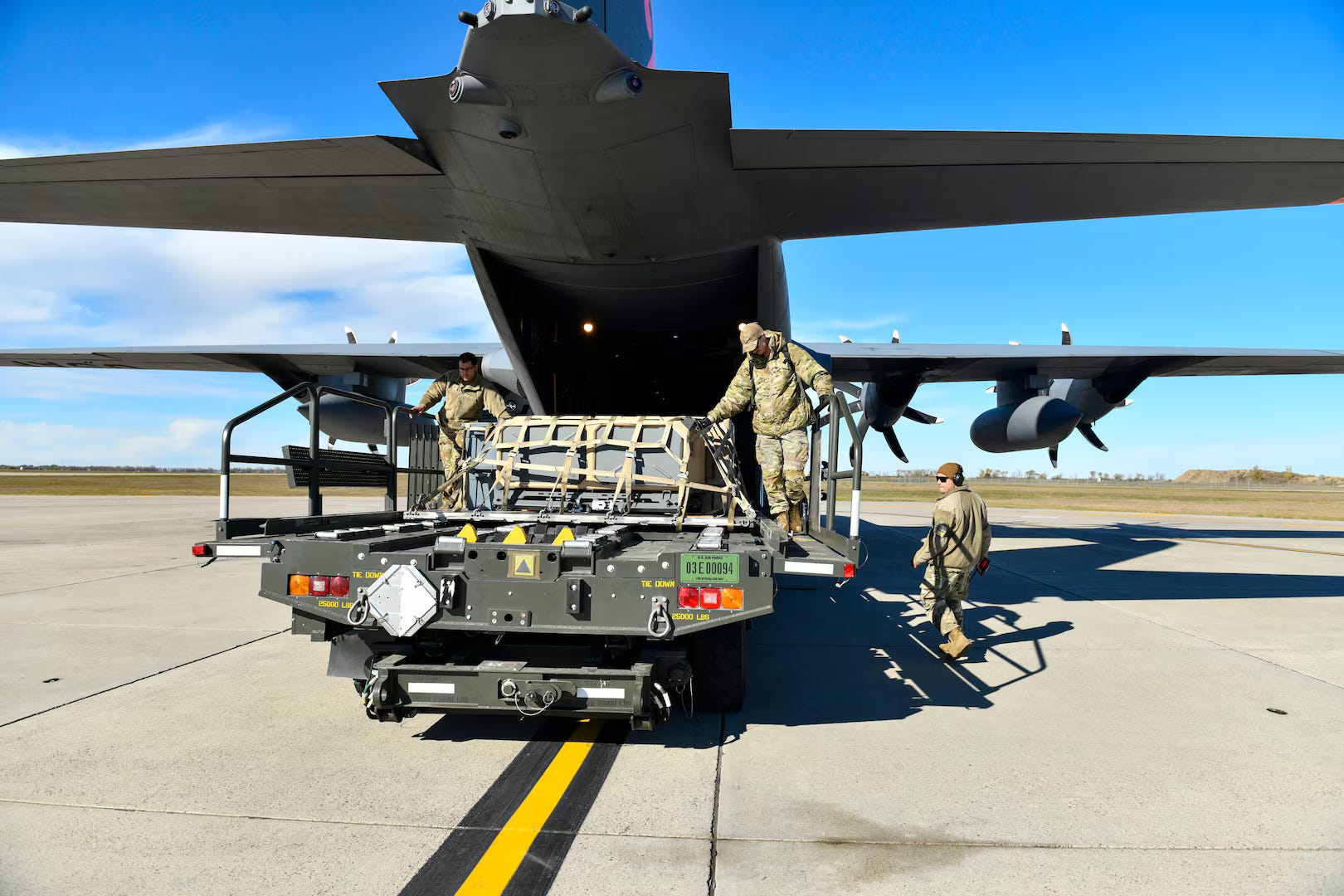
Obviously, this may help if the intrusion happens over a sustained period of time, but isn’t helpful if the Fly Away Kit arrives after the drones have left.
The Fly Away Kit includes sensors, both radar and infrared, an electronic jamming system called Pulsar and a hit-to-kill autonomous drone called Anvil designed to crash into a drone intruder.
It takes around 24 hours once a C-130 has arrived to set up a Fly Away Kit and make it operational.
Each Fly Away Kit has two drone boxes, each holding two Anvil or Anvil-M drones. The Anvil is a hit-to-kill drone that smashes into the intruder. The Anvil-M carries an explosive munition and is typed to destroy more agile drones that a simple hit-to-kill drone can’t catch.
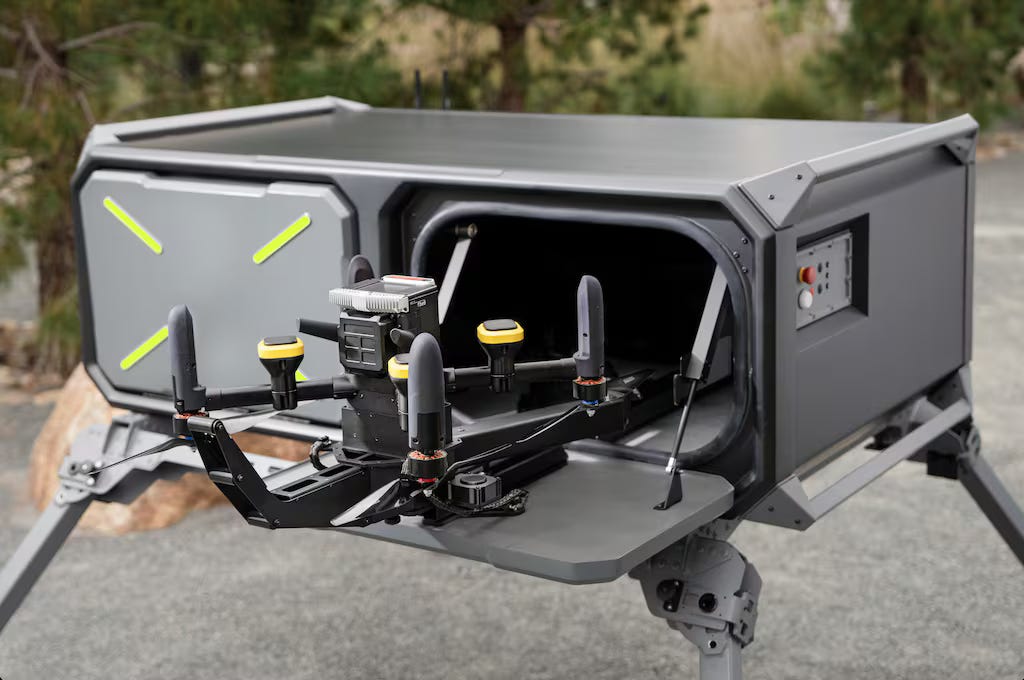
Anvil M with an explosive charge raises other risks around airports, military bases and populated areas.
A Fly Away Kit was likely deployed to Barksdale AFB after the drone intrusion there, but not during it (which took place over a four day period). At Barksdale each intrusion involved 12 to 15 drones, too many for the Fly Away Kit to handle, but a kinetic take down could have provided significant evidence on the origin of the drones. It is reported that the government will soon increase the number of Fly Away kits by 2 or 3, but of course it will need to train crews and arrange transport for the additional kits.
The reality is the Fly Away Kit is an interim solution, at best. Its lack of timeliness renders it ineffective if it has to be delivered in an emergency and takes up to 24 hours to assemble and operate.
The bottom line
The US is moving in the right direction deploying lasers on the southern border, but similar lasers or other kill systems are needed at all sensitive military bases including strategic missile installations and nuclear storage sites.
We don’t know yet if the protocols agreed by the FAA and War Department are really workable. The presumption from the tests is that the automatic shut-down system works, but it can also be fooled or spoofed, so it remains to be seen how the system works as a practical solution to the drone threat.
Stephen Bryen is a former US deputy under secretary of defense. You can read this article and many others on his Substack newsletter Weapons and Strategy.