





惯性聚合 高效追踪和阅读你感兴趣的博客、新闻、科技资讯
阅读原文 在惯性聚合中打开

推荐订阅源

T
Tenable Blog
K
KPMG report finds enterprise disconnect between AI and its ROI | CIO
V
Vulnerabilities – Threatpost
G
GRAHAM CLULEY
Simon Willison's Weblog
C
CXSECURITY Database RSS Feed - CXSecurity.com
P
Privacy International News Feed
H
Heimdal Security Blog
Exploit-DB.com RSS Feed
S
Secure Thoughts
MyScale Blog
MyScale Blog
C
Cyber Attacks, Cyber Crime and Cyber Security
V
Visual Studio Blog
OSCHINA 社区最新新闻
OSCHINA 社区最新新闻
L
LINUX DO - 最新话题
D
Darknet – Hacking Tools, Hacker News & Cyber Security
The Cloudflare Blog
美团技术团队
Recorded Future
Recorded Future
T
Tailwind CSS Blog
Latest news
Latest news
Security Archives - TechRepublic
Security Latest
Security Latest
Know Your Adversary
Know Your Adversary
Cloudbric
Cloudbric
Schneier on Security
I
Intezer
L
LINUX DO - 热门话题
P
Palo Alto Networks Blog
云风的 BLOG
云风的 BLOG
cs.CL updates on arXiv.org
Vercel News
Vercel News
Attack and Defense Labs
人人都是产品经理
人人都是产品经理
L
LangChain Blog
爱范儿
爱范儿
博客园 - 三生石上(FineUI控件)
博客园 - 叶小钗
L
Lohrmann on Cybersecurity
S
SegmentFault 最新的问题
W
WeLiveSecurity
C
Cybersecurity and Infrastructure Security Agency CISA
S
Securelist
SecWiki News
SecWiki News
V2EX - 技术
V2EX - 技术
IT之家
IT之家
Cyberwarzone
Cyberwarzone
F
Full Disclosure
Spread Privacy
Spread Privacy
阮一峰的网络日志
阮一峰的网络日志

Asia Times

Taiwan’s KMT offers US an off-ramp from war with China F/A-XX fighter tests future of US carrier power against China US, China forge rival fusion chains as Europe weighs role Who is calling the shots in Iran? Large Hadron Collider results hint at undiscovered physics The US counterterrorism czar without a counterterrorism plan Japan’s Takaichi chooses guns over butter — at her peril Iran war leaves Asian nations weighing their nuclear options Southeast Asia holds the key to unlocking Korean impasse In jab at Taiwan, China ramps up military support for Somalia Iran war is turbocharging China’s Africa pivot China’s drone-laid mines aim to trap US in a Taiwan war AI and robots can’t fill bellies – so, capitalism’s end? Next, an Iran nuclear deal with Chinese characteristics Iran top diplomat says country may rejoin Islamabad peace talks Iran, not US, cancels Hormuz blockade after Israel-Lebanon truce Israel-Lebanon ceasefire no tidy end to fighting, Hormuz shutdown Congressional Dems probe envoy Jared Kushner’s Arab money ties Manacled Manus: the limits of ‘Singapore washing’ for China AI China Shock 2.0 jolts global economy as Trump does Xi’s work Disrupted supply chains, divided politics Will Russia attack Ukraine’s European drone suppliers? AI shrinking the margin for nuclear error in South Asia Iran's low-cost drones democratizing precision warfare - Asia Times Israel-Lebanon ceasefire won’t end the death and suffering Don’t hold your breath on a truly European NATO AI boom’s real profits are being made in Asia Hong Kong banks dependent on SWIFT are warned of new US sanctions US starting to respond to challenge of massive drone incursions - Asia Times Trans-Himalayan net zero is a strategic necessity for Asia Alarm bells follow new report of looming US plan to attack Cuba Trump says Israel and Lebanon have agreed to 10-day ceasefire Cuba: the Bay of Pigs invasion 65 years later The legendary cyberpunk anime ‘Akira’ demands a rewatch China’s satellite boost gives Iran a US targeting edge Indonesia losing its sovereign way between US and China Taiwan’s opposition courting China as faith in US fades China carefully navigating Iran’s tighter Hormuz grip Will oil prices ever truly return to ‘normal’? Russia’s war on Telegram may ignite the very fire it fears US Big Oil earning $30 million per hour from Iran war Sending combat troops to exercise, Japan leaves WWII ghosts behind - Asia Times Trump budget director defends 43% military spending boost Don’t believe claims Southeast Asia scam schemes were shut down Blockade v blockade fallout may be not just a world energy crisis Iran war putting China’s economy in a tight spot New resistance alliance built to win Myanmar's civil war - Asia Times US Navy leaning on AI to sweep Iran’s Hormuz mines Trump vs Pope: A US-Vatican rift centuries in the making - Asia Times US Hormuz blockade may not survive a Chinese standoff - Asia Times Iran war inflicting losses that will never be recovered Did Trump just light the match for World War III? Allied shipyards key to closing US naval gap with China Russia’s navy deterred Estonia from boarding its ‘shadow fleet’ In Hormuz war of words, US illustrates threat with ‘drug boat’ hit China faces Trump’s Iran offensive in the Hormuz Strait Medieval Christian tropes inflaming Islamophobic Iran war debate EU loan aims to keep Ukraine war going until 2029 Third China Shock exposing US’s broken defense economics Who should speak for Myanmar? Not Min Aung Hlaing - Asia Times Humanity isn’t ready for AI’s biological threat Quad needs to break China’s rare earth hold on Myanmar Iran war threatening to shatter the global economy - Asia Times US Air Force unready for a prolonged war with China US Hormuz blockade, tariffs jolt China - Asia Times Trump needs A-10s to go after Iranian speedboats and patrol ships NATO allies bash Trump’s Hormuz blockade as oil passes $100 a bbl Trump: with God on his side?  - Asia Times Top Iran diplomat: Deal ‘inches away,’ Trump team sabotaged talks Iran war as a cage Trump can't escape - Asia Times Dueling Hormuz blockades push world to the brink China tech companies going gangbusters in the Gulf Quantum computers to break our codes faster than expected To Lam’s Vietnam drifting perceptibly closer to China Hungarian voters end 16 straight years of Orban’s far-right rule Five emerging themes for the Indo-Pacific from Trump's Iran war - Asia Times Trump announces closure of Hormuz Strait as Iran talks falter - Asia Times Iran has weakened US in the great power game Time to give the Trump-Putin-Orban axis a slap in the face China’s Middle East billions still woefully reliant on US gunboats Indonesia can’t stay silent on China’s UUV incursion Too many players, too many grievances for one ceasefire to hold Japan’s unsustainable pacifist delusion US lawmakers seek to block China’s DUV lithography access For South Korea, an alliance in question Trump aides caught with pants down as Iran war gooses inflation Non-rich Asian states, hit hardest by Iran crisis, ration energy Structural strains grip Tokyo and Seoul US isn’t losing soft power in SE Asia — it’s ceding it to China KMT’s ‘imperialist’ rhetoric shifts Taiwan’s democratic fault line The deal to reopen Hormuz is nowhere near done Iran ceasefire: too many brokers, too little leverage Ending Israel’s war on peace Iran ceasefire won’t easily ease emerging Asia’s pain N Korea building a new war playbook from Iran and Ukraine America’s Soviet moment: Why Trump is looking like Yeltsin Can Pakistan deliver as Washington’s go-to mediator with Iran? CNBC anchor mulls investor ‘upside’ of Trump civilizational threat With Middle East in flames, Trump eyes ‘next conquest’ Mooted South China Sea oil deal with China draws fire in Manila
Vietnam: all the power in To Lam’s grasping hands
2026-04-09 · via Asia Times
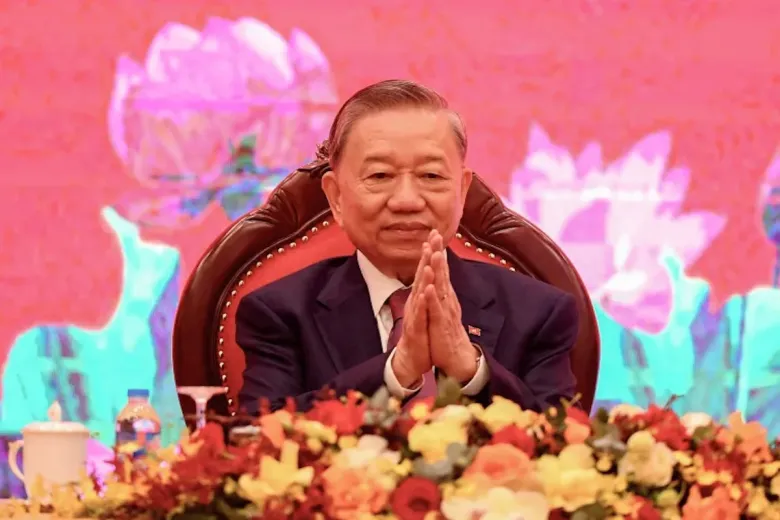
To Lam is consolidating his power in Vietnam. Image: YouTube Screengrab

To Lam’s assumption of the state presidency alongside his position as Communist Party of Vietnam (CPV) general secretary is neither surprising nor unprecedented.

Nguyen Phu Trong held both roles from 2018 to 2021 before relinquishing the presidency. To Lam himself briefly combined them after Trong’s death in mid-2024, before handing the presidency to Luong Cuong.

The difference this time is intent. Previous consolidations were interim or circumstantial arrangements; this one is deliberate, locked in for a full five-year term.

What it reveals about the evolving architecture of Vietnamese politics — and what it implies for the country’s trajectory — deserves closer attention.

It is tempting to frame this consolidation of power as a dismantling of Vietnam’s collective leadership. This may overstate the case.

The CPV formalized a “five pillars” structure in 2024 through Regulation No. 368, elevating the standing member of the secretariat — now Tran Cam Tu — alongside the traditional four: general secretary, state president, prime minister and National Assembly chair.

With To Lam holding two of those five roles, the system has adapted, settling into five pillars held by four people. Yet this adaptation is telling.

Two of the four holders occupy party-internal roles: To Lam as general secretary and Tran Cam Tu as a standing member of the secretariat. Previously, the structure balanced party and state institutions more evenly.

The center of gravity has shifted decisively toward the CPV apparatus, reinforcing a broader trend in which state institutions — the National Assembly in particular — have seen their relative influence diminish.

The consolidation also needs to be understood in precise terms. The state presidency is largely ceremonial, carrying little independent policymaking authority.

The Politburo decides by vote, and To Lam already commands that body as general secretary. Luong Cuong’s brief tenure as president illustrated as much: he held the position without meaningfully shaping Vietnam’s external commitments or domestic direction.

The practical rationale, then, is significant yet narrower than it might appear. The presidency is the constitutionally designated role for receiving foreign credentials, signing treaties and conducting state visits.

Holding both positions allows To Lam to streamline diplomatic mechanics at a moment when Vietnam’s key foreign relationships demand careful management.

The US relationship alone — complicated by trade tensions, including issues of transshipment of de facto made-in-China goods, and Vietnam’s persistent balancing act between Washington and Beijing — benefits from having a single interlocutor who sets both strategic direction and diplomatic protocol.

For foreign counterparts, fewer principals means faster engagement. This efficiency argument extends to To Lam’s economic ambitions. Vietnam’s target of 10% GDP growth requires locking in investment and trade commitments at speed, particularly amid global uncertainty.

A consolidated leadership projects decisiveness to investors and negotiating partners. The party’s dominance over economic policy was already settled; what the presidency adds is smoother execution on the international stage.

The risks are real, though often mischaracterized. The CPV’s internal discipline mechanisms remain intact, and the Politburo still functions as a collective decision-making body.

The deeper concern is institutional narrowing. Each consolidation weakens the informal norms that sustained distributed leadership, making it easier for successors to follow the same path.

And when accountability concentrates alongside authority, setbacks in the growth agenda or a diplomatic misstep fall squarely on one set of shoulders.

Vietnam is aligning its leadership model more closely with China’s, in which Xi Jinping holds both party and state roles. For foreign governments and investors, this simplifies engagement. A single authoritative counterpart reduces ambiguity.

It also means that Vietnam’s political stability is increasingly tied to one figure’s capacity and judgment, in a system designed to distribute precisely those burdens.

For To Lam, the consolidation is a bet that the efficiency gains from centralized authority will outweigh the resilience and inertia that collective leadership provided.

Vietnam’s political architecture has not collapsed. But it is bending toward the party, toward a single leader and toward a model where the margin for error is thinner than it has been in decades.

Lam Duc Vu is a Vietnam-based risk analyst focused on regional trade and geopolitics