
惯性聚合 高效追踪和阅读你感兴趣的博客、新闻、科技资讯
阅读原文 在惯性聚合中打开

推荐订阅源

Threat Intelligence Blog | Flashpoint
Microsoft Azure Blog
Cloudbric
Cloudbric
I
InfoQ
V
V2EX
博客园_首页
The Register - Security
cs.CV updates on arXiv.org
S
Secure Thoughts
Vercel News
Vercel News
Forbes - Security
Forbes - Security
云风的 BLOG
云风的 BLOG
PCI Perspectives
PCI Perspectives
L
LINUX DO - 最新话题
D
DataBreaches.Net
H
Hacker News: Front Page
Application and Cybersecurity Blog
B
Blog RSS Feed
A
About on SuperTechFans
N
News and Events Feed by Topic
Apple Machine Learning Research
Help Net Security
Help Net Security
Attack and Defense Labs
N
Netflix TechBlog - Medium
Spread Privacy
Spread Privacy
F
Full Disclosure
Recorded Future
Recorded Future
AWS News Blog
AWS News Blog
博客园 - 【当耐特】
The Cloudflare Blog
T
Threatpost
T
Tor Project blog
Google DeepMind News
C
CXSECURITY Database RSS Feed - CXSecurity.com
CTFtime.org: upcoming CTF events
Recent Announcements
M
MIT News - Artificial intelligence
A
Arctic Wolf
C
Check Point Blog
Stack Overflow Blog
Stack Overflow Blog
T
Threat Research - Cisco Blogs
Security Archives - TechRepublic
Hacker News - Newest:
Hacker News - Newest: "LLM"
WordPress大学
WordPress大学
Cyberwarzone
Cyberwarzone
小众软件
小众软件
C
Cyber Attacks, Cyber Crime and Cyber Security
P
Proofpoint News Feed
Security Latest
Security Latest
The Last Watchdog
The Last Watchdog

Asia Times

Taiwan’s KMT offers US an off-ramp from war with China F/A-XX fighter tests future of US carrier power against China US, China forge rival fusion chains as Europe weighs role Who is calling the shots in Iran? Large Hadron Collider results hint at undiscovered physics The US counterterrorism czar without a counterterrorism plan Japan’s Takaichi chooses guns over butter — at her peril Iran war leaves Asian nations weighing their nuclear options Southeast Asia holds the key to unlocking Korean impasse In jab at Taiwan, China ramps up military support for Somalia Iran war is turbocharging China’s Africa pivot China’s drone-laid mines aim to trap US in a Taiwan war AI and robots can’t fill bellies – so, capitalism’s end? Next, an Iran nuclear deal with Chinese characteristics Iran, not US, cancels Hormuz blockade after Israel-Lebanon truce Israel-Lebanon ceasefire no tidy end to fighting, Hormuz shutdown Congressional Dems probe envoy Jared Kushner’s Arab money ties Manacled Manus: the limits of ‘Singapore washing’ for China AI China Shock 2.0 jolts global economy as Trump does Xi’s work Disrupted supply chains, divided politics Will Russia attack Ukraine’s European drone suppliers? AI shrinking the margin for nuclear error in South Asia Iran's low-cost drones democratizing precision warfare - Asia Times Israel-Lebanon ceasefire won’t end the death and suffering Don’t hold your breath on a truly European NATO AI boom’s real profits are being made in Asia Hong Kong banks dependent on SWIFT are warned of new US sanctions US starting to respond to challenge of massive drone incursions - Asia Times Trans-Himalayan net zero is a strategic necessity for Asia Alarm bells follow new report of looming US plan to attack Cuba Trump says Israel and Lebanon have agreed to 10-day ceasefire Cuba: the Bay of Pigs invasion 65 years later The legendary cyberpunk anime ‘Akira’ demands a rewatch China’s satellite boost gives Iran a US targeting edge Indonesia losing its sovereign way between US and China Taiwan’s opposition courting China as faith in US fades China carefully navigating Iran’s tighter Hormuz grip Will oil prices ever truly return to ‘normal’? Russia’s war on Telegram may ignite the very fire it fears US Big Oil earning $30 million per hour from Iran war Sending combat troops to exercise, Japan leaves WWII ghosts behind - Asia Times Trump budget director defends 43% military spending boost Don’t believe claims Southeast Asia scam schemes were shut down Blockade v blockade fallout may be not just a world energy crisis Iran war putting China’s economy in a tight spot New resistance alliance built to win Myanmar's civil war - Asia Times US Navy leaning on AI to sweep Iran’s Hormuz mines Trump vs Pope: A US-Vatican rift centuries in the making - Asia Times US Hormuz blockade may not survive a Chinese standoff - Asia Times Iran war inflicting losses that will never be recovered Did Trump just light the match for World War III? Allied shipyards key to closing US naval gap with China Russia’s navy deterred Estonia from boarding its ‘shadow fleet’ In Hormuz war of words, US illustrates threat with ‘drug boat’ hit China faces Trump’s Iran offensive in the Hormuz Strait Medieval Christian tropes inflaming Islamophobic Iran war debate EU loan aims to keep Ukraine war going until 2029 Third China Shock exposing US’s broken defense economics Who should speak for Myanmar? Not Min Aung Hlaing - Asia Times Humanity isn’t ready for AI’s biological threat Quad needs to break China’s rare earth hold on Myanmar Iran war threatening to shatter the global economy - Asia Times US Air Force unready for a prolonged war with China US Hormuz blockade, tariffs jolt China - Asia Times Trump needs A-10s to go after Iranian speedboats and patrol ships NATO allies bash Trump’s Hormuz blockade as oil passes $100 a bbl Trump: with God on his side?  - Asia Times Top Iran diplomat: Deal ‘inches away,’ Trump team sabotaged talks Iran war as a cage Trump can't escape - Asia Times Dueling Hormuz blockades push world to the brink China tech companies going gangbusters in the Gulf Quantum computers to break our codes faster than expected To Lam’s Vietnam drifting perceptibly closer to China Hungarian voters end 16 straight years of Orban’s far-right rule Five emerging themes for the Indo-Pacific from Trump's Iran war - Asia Times Trump announces closure of Hormuz Strait as Iran talks falter - Asia Times Iran has weakened US in the great power game Time to give the Trump-Putin-Orban axis a slap in the face China’s Middle East billions still woefully reliant on US gunboats Indonesia can’t stay silent on China’s UUV incursion Too many players, too many grievances for one ceasefire to hold Japan’s unsustainable pacifist delusion US lawmakers seek to block China’s DUV lithography access For South Korea, an alliance in question Trump aides caught with pants down as Iran war gooses inflation Non-rich Asian states, hit hardest by Iran crisis, ration energy Structural strains grip Tokyo and Seoul US isn’t losing soft power in SE Asia — it’s ceding it to China KMT’s ‘imperialist’ rhetoric shifts Taiwan’s democratic fault line The deal to reopen Hormuz is nowhere near done Iran ceasefire: too many brokers, too little leverage Ending Israel’s war on peace Iran ceasefire won’t easily ease emerging Asia’s pain N Korea building a new war playbook from Iran and Ukraine America’s Soviet moment: Why Trump is looking like Yeltsin Can Pakistan deliver as Washington’s go-to mediator with Iran? CNBC anchor mulls investor ‘upside’ of Trump civilizational threat With Middle East in flames, Trump eyes ‘next conquest’ Vietnam: all the power in To Lam’s grasping hands Mooted South China Sea oil deal with China draws fire in Manila
Strait of Malacca could be next Hormuz-like flashpoint
Gokcay Balci · 2026-04-29 · via Asia Times

While recent global attention has focused on the Strait of Hormuz, which Iran has effectively held closed since late February in a move that has disrupted world energy supplies, a quieter but also important development has been taking shape in south-east Asia.

On April 14, the US and Indonesia announced a “major defense cooperation partnership”, strengthening their military ties. According to reports, the US is also seeking to gain wider access to Indonesian airspace. Several media outlets say Indonesia’s president, Prabowo Subianto, has approved the proposal.

These developments matter because Indonesia’s vast archipelago sits astride some of the most critical sea routes in the world. These include the Strait of Malacca, an important chokepoint for global shipping and trade. The region surrounding Malacca has seen growing military attention from outside powers in recent years.

Both the US and China have been steadily expanding their military presence around the strait and its approaches. The US has largely done so through base access and naval deployments, and China through its port network and naval buildup.

The Andaman and Nicobar Islands, located near the strait’s western approaches, also provide India with a strategic presence in the region.

South-east Asia is becoming more explicitly tied into great-power competition, with the new US-Indonesia defense partnership adding the latest layer. Should this competition intensify – whether through a crisis in Taiwan, a spillover from Hormuz or a shift in alliances – the Strait of Malacca would be at the center of it.

A map showing the Strait of Malacca in south-east Asia.
At its narrowest point, the Strait of Malacca is just 2.8km wide. Peter Hermes Furian / Shutterstock

The Strait is the shortest sea route connecting the Indian Ocean to the South China Sea and Pacific Ocean, making it the default corridor for trade between East Asia and the West. It stretches roughly 900 kilometers from the Malay Peninsula to the Indonesian island of Sumatra. At its narrowest point, the Phillips Channel near Singapore, it is barely 2.8 kilometers wide.

Almost 24% of global seaborne trade by volume flows through the strait. It carries 45% of the world’s seaborne oil, over 25% of all cars traded internationally and 23% of dry bulk cargo including key agricultural commodities like grains and soybeans.

A large portion of European imports of electronics, consumer products like footwear and toys, machinery and industrial goods pass through the strait in sea containers as well.

The strait is also home to some of the world’s most critical port infrastructure. Singapore, located at the strait’s southern entrance, is the second-busiest container port and the busiest container transshipment hub on the planet.

It handles over 40 million containers a year and is the world’s largest ship refuelling hub. Port Klang in Malaysia ranks among the world’s top ten container ports too, handling 14 million containers annually.

Why Malacca is irreplaceable

The most commonly cited detours around the Strait of Malacca, the Sunda and Lombok Straits, both lie within Indonesian territory and neither is a straightforward substitute.

Rerouting through either adds roughly 1,000 to 1,500 nautical miles to the journey – three to five extra days at sea – along with higher fuel costs and the loss of Singapore’s refueling infrastructure.

Beyond Indonesia, the Torres Strait near Papua New Guinea is too shallow for large commercial vessels with a draft of over 12 meters. Ships avoiding all these routes would face a detour around the entire Australian continent, adding another 10 to 15 days of transit time. These geographical features are the reason why the Strait of Malacca is so difficult to bypass.

China understands the risk of relying on Malacca perhaps better than anyone. In 2003, the then-president of China, Hu Jintao, coined the phrase “Malacca dilemma” to describe a strategic exposure that has continued since. Between 75% and 80% of China’s imported oil still passes through the strait.

Beijing has invested heavily in alternatives, but none come close to matching the scale of what transits Malacca. Pipelines running from Kyaukpyu on the Bay of Bengal in Myanmar into Yunnan province in China bypass Malacca entirely.

However, their capacity is only around 440,000 barrels per day, a small fraction of China’s roughly 11 million barrels of daily oil imports.
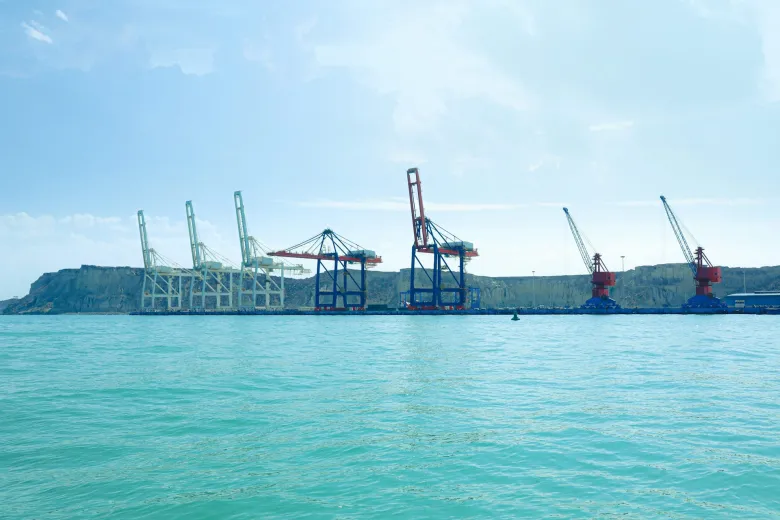
Gwadar Port on the Arabian Sea in Balochistan.
Gwadar Port on the Arabian Sea in Balochistan, Pakistan, which was developed largely with Chinese investment as part of the China-Pakistan Economic Corridor. Photo: victor yankee / Shutterstock via The Conversation

The China-Pakistan Economic Corridor plans to link Gwadar Port on the Arabian Sea to Xinjiang in north-west China through road, rail and energy infrastructure.

But it remains only partially developed, with its completion affected by difficult terrain and security challenges in parts of Pakistan. China has also diversified through Central Asian oil and gas pipelines, which provide about 10% of its total imported oil.

There are rail freight corridors connecting China to Europe, which avoid maritime chokepoints entirely and are faster than shipping. However, they are far more expensive and very limited in capacity.

Arctic shipping routes along Russia’s northern coast offer a longer-term hedge, cutting the distance between Asia and Europe, but remain seasonal and marginal in global trade terms.

For now, there is no clear indication that the growing military presence around the Strait of Malacca will have any impact on commercial shipping. But if a conflict does arise in the future, it will be trade-dependent economies like China that will suffer.

Gokcay Balci is lecturer in sustainable freight transport and logistics, University of Leeds and Ebru Surucu-Balci is assistant professor in circular supply chains, University of Bradford

This article is republished from The Conversation under a Creative Commons license. Read the original article.