
惯性聚合 高效追踪和阅读你感兴趣的博客、新闻、科技资讯
阅读原文 在惯性聚合中打开

推荐订阅源

Microsoft Azure Blog
V
V2EX
博客园 - 【当耐特】
WordPress大学
WordPress大学
爱范儿
爱范儿
美团技术团队
宝玉的分享
宝玉的分享
钛媒体:引领未来商业与生活新知
钛媒体:引领未来商业与生活新知
小众软件
小众软件
量子位
Hugging Face - Blog
Hugging Face - Blog
B
Blog RSS Feed
Recorded Future
Recorded Future
Engineering at Meta
Engineering at Meta
雷峰网
雷峰网
CTFtime.org: upcoming CTF events
M
MIT News - Artificial intelligence
freeCodeCamp Programming Tutorials: Python, JavaScript, Git & More
博客园 - 聂微东
H
Hackread – Cybersecurity News, Data Breaches, AI and More
腾讯CDC
大猫的无限游戏
大猫的无限游戏
Jina AI
Jina AI
博客园 - 叶小钗
GbyAI
GbyAI
Y
Y Combinator Blog
Cyber Security Advisories - MS-ISAC
F
Full Disclosure
G
Google Developers Blog
D
Docker
T
Tailwind CSS Blog
C
Check Point Blog
Last Week in AI
Last Week in AI
人人都是产品经理
人人都是产品经理
T
The Blog of Author Tim Ferriss
B
Blog
博客园 - 三生石上(FineUI控件)
博客园 - Franky
H
Help Net Security
MyScale Blog
MyScale Blog
U
Unit 42
D
DataBreaches.Net
奇客Solidot–传递最新科技情报
奇客Solidot–传递最新科技情报
I
InfoQ
阮一峰的网络日志
阮一峰的网络日志
The GitHub Blog
The GitHub Blog
L
LangChain Blog
有赞技术团队
有赞技术团队
Martin Fowler
Martin Fowler
Microsoft Security Blog

Asia Times

Taiwan’s KMT offers US an off-ramp from war with China F/A-XX fighter tests future of US carrier power against China US, China forge rival fusion chains as Europe weighs role Who is calling the shots in Iran? Large Hadron Collider results hint at undiscovered physics The US counterterrorism czar without a counterterrorism plan Japan’s Takaichi chooses guns over butter — at her peril Iran war leaves Asian nations weighing their nuclear options Southeast Asia holds the key to unlocking Korean impasse In jab at Taiwan, China ramps up military support for Somalia Iran war is turbocharging China’s Africa pivot China’s drone-laid mines aim to trap US in a Taiwan war AI and robots can’t fill bellies – so, capitalism’s end? Next, an Iran nuclear deal with Chinese characteristics Iran top diplomat says country may rejoin Islamabad peace talks Iran, not US, cancels Hormuz blockade after Israel-Lebanon truce Israel-Lebanon ceasefire no tidy end to fighting, Hormuz shutdown Congressional Dems probe envoy Jared Kushner’s Arab money ties Manacled Manus: the limits of ‘Singapore washing’ for China AI China Shock 2.0 jolts global economy as Trump does Xi’s work Disrupted supply chains, divided politics Will Russia attack Ukraine’s European drone suppliers? AI shrinking the margin for nuclear error in South Asia Iran's low-cost drones democratizing precision warfare - Asia Times Israel-Lebanon ceasefire won’t end the death and suffering Don’t hold your breath on a truly European NATO AI boom’s real profits are being made in Asia Hong Kong banks dependent on SWIFT are warned of new US sanctions US starting to respond to challenge of massive drone incursions - Asia Times Trans-Himalayan net zero is a strategic necessity for Asia Alarm bells follow new report of looming US plan to attack Cuba Trump says Israel and Lebanon have agreed to 10-day ceasefire Cuba: the Bay of Pigs invasion 65 years later China’s satellite boost gives Iran a US targeting edge Indonesia losing its sovereign way between US and China Taiwan’s opposition courting China as faith in US fades China carefully navigating Iran’s tighter Hormuz grip Will oil prices ever truly return to ‘normal’? Russia’s war on Telegram may ignite the very fire it fears US Big Oil earning $30 million per hour from Iran war Sending combat troops to exercise, Japan leaves WWII ghosts behind - Asia Times Trump budget director defends 43% military spending boost Don’t believe claims Southeast Asia scam schemes were shut down Blockade v blockade fallout may be not just a world energy crisis Iran war putting China’s economy in a tight spot New resistance alliance built to win Myanmar's civil war - Asia Times US Navy leaning on AI to sweep Iran’s Hormuz mines Trump vs Pope: A US-Vatican rift centuries in the making - Asia Times US Hormuz blockade may not survive a Chinese standoff - Asia Times Iran war inflicting losses that will never be recovered Did Trump just light the match for World War III? Allied shipyards key to closing US naval gap with China Russia’s navy deterred Estonia from boarding its ‘shadow fleet’ In Hormuz war of words, US illustrates threat with ‘drug boat’ hit China faces Trump’s Iran offensive in the Hormuz Strait Medieval Christian tropes inflaming Islamophobic Iran war debate EU loan aims to keep Ukraine war going until 2029 Third China Shock exposing US’s broken defense economics Who should speak for Myanmar? Not Min Aung Hlaing - Asia Times Humanity isn’t ready for AI’s biological threat Quad needs to break China’s rare earth hold on Myanmar Iran war threatening to shatter the global economy - Asia Times US Air Force unready for a prolonged war with China US Hormuz blockade, tariffs jolt China - Asia Times Trump needs A-10s to go after Iranian speedboats and patrol ships NATO allies bash Trump’s Hormuz blockade as oil passes $100 a bbl Trump: with God on his side?  - Asia Times Top Iran diplomat: Deal ‘inches away,’ Trump team sabotaged talks Iran war as a cage Trump can't escape - Asia Times Dueling Hormuz blockades push world to the brink China tech companies going gangbusters in the Gulf Quantum computers to break our codes faster than expected To Lam’s Vietnam drifting perceptibly closer to China Hungarian voters end 16 straight years of Orban’s far-right rule Five emerging themes for the Indo-Pacific from Trump's Iran war - Asia Times Trump announces closure of Hormuz Strait as Iran talks falter - Asia Times Iran has weakened US in the great power game Time to give the Trump-Putin-Orban axis a slap in the face China’s Middle East billions still woefully reliant on US gunboats Indonesia can’t stay silent on China’s UUV incursion Too many players, too many grievances for one ceasefire to hold Japan’s unsustainable pacifist delusion US lawmakers seek to block China’s DUV lithography access For South Korea, an alliance in question Trump aides caught with pants down as Iran war gooses inflation Non-rich Asian states, hit hardest by Iran crisis, ration energy Structural strains grip Tokyo and Seoul US isn’t losing soft power in SE Asia — it’s ceding it to China KMT’s ‘imperialist’ rhetoric shifts Taiwan’s democratic fault line The deal to reopen Hormuz is nowhere near done Iran ceasefire: too many brokers, too little leverage Ending Israel’s war on peace Iran ceasefire won’t easily ease emerging Asia’s pain N Korea building a new war playbook from Iran and Ukraine America’s Soviet moment: Why Trump is looking like Yeltsin Can Pakistan deliver as Washington’s go-to mediator with Iran? CNBC anchor mulls investor ‘upside’ of Trump civilizational threat With Middle East in flames, Trump eyes ‘next conquest’ Vietnam: all the power in To Lam’s grasping hands Mooted South China Sea oil deal with China draws fire in Manila
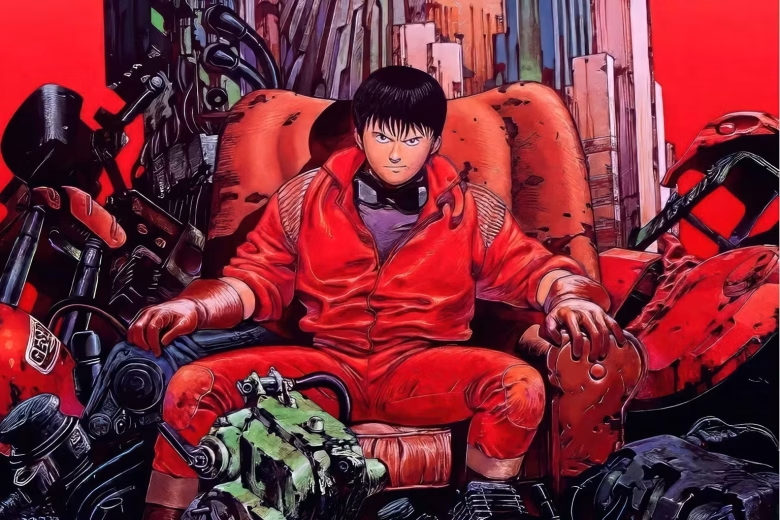
The legendary cyberpunk anime ‘Akira’ demands a rewatch
Tony Milligan · 2026-04-16 · via Asia Times
Image: Kira Committee / Kodansha / MBS / Bandai Co

The classic 1988 anime Akira returns to UK, Irish, French and Spanish cinema screens on April 17, with Australia and New Zealand following in early May. Set in a dystopian neo-Tokyo, it is one of the few pieces of cyberpunk manga that have translated well onto the screen.

Its ultimate message is disturbing: we are no better or worse than the elites who are using technology to dominate us. All of us are just part of a bigger game. A game involving power and our limited ability to wield it.

Directed by the original manga creator, Katsuhiro Otomo, the hand-drawn animation is incredible, the storyline complex and the violence relentless. Along with Blade Runner (1982) and William Gibson’s novel Neuromancer (1984), Akira is considered one of the big-three classics of cyberpunk – a genre defined by high tech and low life.

They’re all centered around rogue loners who investigate mysteries, only to be accidentally drawn into conflict with powerful elites. And each is set in an imagined near future where bodies are replicated, modified and occasionally rendered monstrous.

Akira goes for the monstrous option, driven by a relentless pursuit of power that is simultaneously natural to humans and destructive of our humanity. Otomo’s anti-hero, Kaneda, is a biker drawn from the subculture of real tribal bozozuku biker gangs, which had tens of thousands of members in early 1980s Japan.

Otomo’s tale shows a deep familiarity with Japanese sub-cultures and societal unease about the legacy of the atomic bomb and aversion to mutation.

Youtube video

In the film, Kaneda tries to rescue his friend Tetsuo but stumbles into a conflict between hardened idealistic terrorists and a top-secret military project. The latter is trying to accelerate the drug-induced development of telepathic powers that are wielded by a group of captive children. Tetsuo has become part of the program and shows incredible power, but he cannot contain it within his body.

The emphasis on power is welcome. Tetsuo has always been relegated to second place in the biker gang to Kaneda and cannot bear it. The other effects are less welcome. As with the faltering Japanese economy, artificially accelerated development spirals out of control, eventually forcing military forces and terrorists to collaborate to contain Tetsuo and the mysterious Akira. Much of neo-Tokyo is destroyed in the process. Once again, the narrative strongly echoes the legacy of the atomic bomb.

Akira and cyberpunk

Akira is a good watch and, if you have the patience, a good read.

Patience is certainly a important virtue for Akira fans. They have been waiting decades to see a live action version. The latest collapse of attempts to bring it to the screen in 2025 helped to prompt this year’s return of the anime.

But how accurately does cyberpunk’s vision of the future align with the real history that unfolded after the genre’s golden age in film and literature? Though it got plenty wrong, cyberpunk did anticipate some defining features of contemporary life – most notably anti-elite populism and political protest.

Cyberpunk, including Akira, is broadly anti-authoritarian, yet it is often set in worlds where no viable alternative appears to exist.

As a result, dissent in cyberpunk tends to be more expressive than goal-oriented, with violence frequently emerging as one of its most potent forms of articulation.

This is, arguably, a reasonable anticipation of a long-term trend within political dissent – particularly where (as in cyberpunk) an association is drawn between technology and elite control. It is worth noting that driverless Waymo taxis were a popular target for protesters during the 2025 riots in Los Angeles.

So there is a similarity up to a point. But cyberpunks like Kaneda and Tetsuo, and their counterparts in the other genre classics, faced off against power more than wealth. Today’s left and left-right crossover dissent focuses upon bankers and it trades upon an idea of finance capital in which banking dominates industry. Cyberpunk was anti-authority, but had a better idea of who was actually in charge – elites for whom wealth was primarily corporate and only a means to advancing power.

In our world – the actual world of advancing technology – nobody really knows how much is owned by the wealthiest corporate tech figures such as Elon Musk (Tesla and Space-X), Larry Ellison (Oracle), Mark Zuckerberg (Meta) and Jeff Bezos (Amazon). But we do know that none of them are bankers. Their wealth underpins their power, and as in cyberpunk they seek broader forms of social and political influence.

Unlike cyberpunk elites, they face limits to their ability to wield such influence. The brief Musk team-up with Donald Trump was a marriage made in the divorce courts, with little prospect of lasting the course. In Akira, elites are far less constrained, particularly in the military.

Akira focuses upon power, as opposed to mere wealth, by using a secretive military program as the driver of the plot. But it does so with moral ambiguity. There are no monsters in charge. The military is under the command of The Colonel, who is not a particularly bad or unsympathetic character. He just happens to be someone on a different side from Kaneda and the terrorist underground that Kaneda has fallen in with for reasons more to do with assertive sexual attraction rather than politics.

Ultimately, Tetsuo and Kaneda cannot come up against The Colonel as good guys versus the bad guy, or as friends to the many set against the enemy elite. Kaneda wields power ruthlessly within his biker gang and Tetsuo desperately wants power. Both are constrained only by their attraction to the (secondary) female characters. The desire for power is represented as natural and, by the end, as a cosmic urge which is slowly making its way into consciousness through humans – albeit at the expense of our small and vulnerable bodies.

Within this narrative there is a longing for power inside all of humanity. A longing that is both constructive and destructive. To renounce it would be to renounce our humanity. To imagine that we can wield it indefinitely is the great illusion. Eventually the temple bell rings and it is over. This makes power-wielding elites no better or worse than the rest of us. The distinction between the experimenters and those of us experimented upon ceases to matter.

Tony Milligan is a teaching associate in philosophy, School of History, Philosophy and Digital Humanities, University of Sheffield.

This article is republished from The Conversation under a Creative Commons license. Read the original article.