







Is US President Donald Trump closer to Boris Yeltsin or Vladimir Putin? The question is less about personality than about historical function: what kind of leader emerges when a system begins to lose its internal balance.
For much of the 20th century, the world was defined by an ideological divide. The United States and the Soviet Union were not merely rival powers; they embodied competing answers to the same question: how should a modern society organize its economy and its people?
On one side stood capitalism: decentralized, market-driven and adaptive. On the other stood communism: centralized, planned and state-directed. Each claimed to correct the excesses of the other. Each ultimately revealed its own contradictions.
The Soviet Union did not collapse because it lacked power. At its peak, it commanded vast natural resources, a formidable industrial base and one of the most powerful militaries in the world. It collapsed because of structural flaws embedded in its own design.
By sidelining the merchant (the entrepreneurial engine of exchange and innovation), the Soviet system removed the incentives that sustain economic vitality. Production became rigid, allocation became political and shortages coexisted with waste.
Over time, the deeper failure was psychological: citizens no longer believed the system worked for them. When reform finally came, it came too late. The system had become too rigid to adapt.
The US today faces a different—but structurally comparable—challenge.
Where the Soviet system sidelined the merchant, the American system has increasingly sidelined the worker, the wage-earner who underpins the material economy. Since the late 20th century, globalization, outsourcing and financialization have reshaped the US economy. Capital has become highly mobile; labor has not. Manufacturing has shifted offshore, while the financial sector has expanded in scale and influence.
The result is not economic collapse, but structural imbalance. The US continues to generate enormous wealth, but that wealth has become increasingly concentrated. The link between productivity and wages has weakened. For many Americans, economic growth no longer translates into improved living standards.
Data from the Federal Reserve underscores this shift. The top 1% of households now control roughly one-third of total US wealth, levels not seen in decades. Under President Trump, wealth inequality has continued to rise, with the top 1% owning 31.7% of all household wealth, the highest share on record. Meanwhile, wage growth for large segments of the population has stagnated while economic insecurity remains widespread.
This is not merely an economic imbalance. It is a legitimacy problem. As in the late Soviet period, the issue is not only material but psychological.
Polling data confirms this erosion of faith: approximately 60% of Americans believe the country is heading in the wrong direction, while in Russia — despite the war and sanctions— roughly 61% still believe their country is on the right track. A growing share of Americans no longer believes the system operates in their interests.
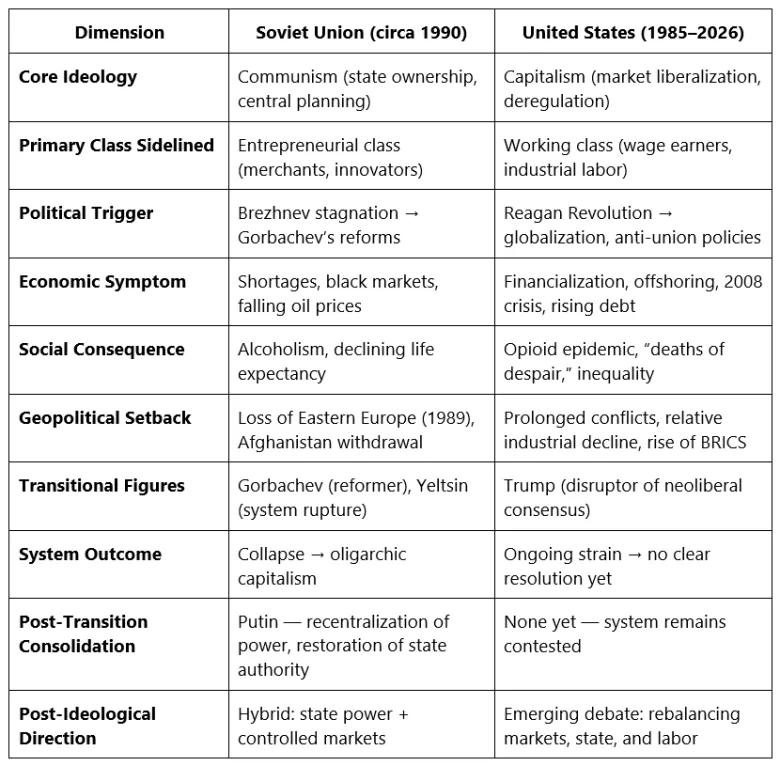
Political figures often emerge not as architects of systemic change, but as expressions of underlying strain.
In the Soviet Union, Boris Yeltsin rose at a moment when the system had already lost coherence. He did not create the crisis; he embodied it. His tenure accelerated the collapse of the old order, but it also unleashed a chaotic transition.
State assets were privatized rapidly, often at a fraction of their value, giving rise to an oligarchic class. For many Russians, the 1990s were not liberation but dislocation.
Putin’s rise marked a different phase. He reasserted state authority, recentralized power and restored a degree of stability. Russia’s economy recovered, unemployment fell, and the state regained control over strategic sectors. Whatever the long-term implications of that model, it addressed the immediate crisis of systemic breakdown.
Trump’s political trajectory reflects a different context but a comparable structural moment. His support has come disproportionately from constituencies that feel economically and culturally displaced. His rhetoric challenges trade frameworks, alliances, and domestic governance structures that many perceive as distant or unresponsive.
The comparison is not about equivalence. It is about sequence. Trump resembles less a stable endpoint than a transitional figure, closer to Yeltsin than to Putin. He is the kind of leader who emerges when a system begins to break its own rules.
For decades, the US has been insulated from the full consequences of its internal imbalances by a unique global advantage: the dollar’s central role.
Since the 1970s, the global oil trade has been largely denominated in US dollars, creating sustained demand for dollar assets. Today, the dollar still accounts for roughly 60% of global foreign exchange reserves, and US financial markets remain the deepest and most liquid in the world.
This system has allowed the US to run persistent fiscal deficits while maintaining relatively low borrowing costs. It has functioned as a financial cushion, absorbing pressures that might otherwise have forced earlier structural adjustment. But cushions, like empires, are not permanent.
In recent years, a gradual shift has begun. China has expanded the use of its yuan in energy transactions. Russia has reduced its reliance on the dollar following sanctions. Other countries are exploring alternative settlement mechanisms. These developments remain incremental, but they point toward a more diversified global monetary environment.
Yet unlike Putin, who reduced Russia’s debt to 20% of GDP and restored fiscal discipline, Trump has proposed no serious plan to reduce the national debt, which is now approaching $40 trillion and with interest payments rising as a share of federal spending.
Instead of addressing this burden, Trump has pushed for expanding the defense budget—adding to the fiscal strain at precisely the moment when the petrodollar cushion is thinning. The combination of rising debt, higher military spending and a lack of structural adjustment makes the US more vulnerable to a financial shock than at any point since the 2008 crisis.
Political polarization further complicates any sustained, long-term policy coordination, leaving the country exposed should global demand for dollar assets decline more rapidly than expected.
The lesson of the Soviet experience is not that great powers collapse suddenly. It is that they weaken when their systems cease to align with their own foundations.
The Yeltsin analogy, if it holds, carries a sobering implication: transitional figures do not resolve the crises they express. They clear the ground. What follows depends on whether the successor moment brings genuine rebalancing — a serious reckoning with the divergence between capital and labor, between growth and shared prosperity — or merely a harder reassertion of the existing order.
The Soviet precedent suggests that systems rarely reform themselves from within until the cost of not doing so becomes undeniable. For the US, that threshold has not yet been reached.
But the distance to it is shorter than it once appeared. That reckoning would require rebalancing capital and labor, restoring wage-linked prosperity and stabilizing a debt trajectory that neither party has yet confronted seriously.
The question is not whether America will face its reckoning. It is whether it will recognize it in time to choose its own terms.
此内容由惯性聚合(RSS阅读器)自动聚合整理,仅供阅读参考。 原文来自 — 版权归原作者所有。