
惯性聚合 高效追踪和阅读你感兴趣的博客、新闻、科技资讯
阅读原文 在惯性聚合中打开

推荐订阅源

C
CXSECURITY Database RSS Feed - CXSecurity.com
K
Kaspersky official blog
A
Arctic Wolf
Attack and Defense Labs
L
LINUX DO - 热门话题
N
News | PayPal Newsroom
cs.CV updates on arXiv.org
L
Lohrmann on Cybersecurity
PCI Perspectives
PCI Perspectives
cs.AI updates on arXiv.org
The Last Watchdog
The Last Watchdog
B
Blog RSS Feed
让小产品的独立变现更简单 - ezindie.com
W
WeLiveSecurity
Know Your Adversary
Know Your Adversary
博客园 - Franky
T
Tenable Blog
T
Tailwind CSS Blog
钛媒体:引领未来商业与生活新知
钛媒体:引领未来商业与生活新知
Help Net Security
Help Net Security
WordPress大学
WordPress大学
T
The Exploit Database - CXSecurity.com
www.infosecurity-magazine.com
博客园 - 司徒正美
阮一峰的网络日志
阮一峰的网络日志
D
Darknet – Hacking Tools, Hacker News & Cyber Security
H
Heimdal Security Blog
TaoSecurity Blog
TaoSecurity Blog
S
Security Affairs
J
Java Code Geeks
小众软件
小众软件
freeCodeCamp Programming Tutorials: Python, JavaScript, Git & More
Apple Machine Learning Research
NISL@THU
NISL@THU
O
OpenAI News
The Cloudflare Blog
月光博客
月光博客
Google Online Security Blog
V
V2EX
罗磊的独立博客
美团技术团队
博客园 - 三生石上(FineUI控件)
Security Latest
Security Latest
奇客Solidot–传递最新科技情报
奇客Solidot–传递最新科技情报
C
Cyber Attacks, Cyber Crime and Cyber Security
cs.CL updates on arXiv.org
Cyberwarzone
Cyberwarzone
L
LINUX DO - 最新话题
Hacker News - Newest:
Hacker News - Newest: "LLM"
大猫的无限游戏
大猫的无限游戏

The New Stack | DevOps, Open Source, and Cloud Native News

Agentic development hinges on verification. For cloud-native software, that is a runtime problem. AI agents need infrastructure: Why Europe’s regional cloud strategy matters Transform your AI coding agent into a deterministic Java Spring expert WeAreDevelopers is coming to the US to give unsung developers a bigger voice Cleaner AI training data, fewer bugs: Sonar’s SonarSweep explained Observability overload is drowning engineers Google’s DiffusionGemma is 4x faster than its other Gemma models Fable 5: Guardrails and burn rate are annoying users, who say it’s still better than Opus 4.8 The Anthropic leader who built Claude Code says he ditched prompting — now he just writes loops. AWS can now mathematically prove your VMs are isolated Microsoft pulled 73 GitHub repos after malware attack — but still won’t say who’s compromised Databricks wants to kill the “email me a file” problem for AI agent skills Ramp bets forward deployed engineers can do what off-the-shelf finance AI can’t Git real: AI agents aren’t just for solo developers anymore Anthropic launches Claude Mythos/Fable 5, but you better try it soon Spring is 23 years old. AI just made it a security emergency. This AI agent startup ditched Anthropic for DeepSeek — and says it’s saving millions When your data model is the bottleneck: lessons from Medium’s feature store How long before we stop reading the code? The tokenmaxxing party is over, and Revenium is mopping up How AI is solving the memory crunch it created Microsoft’s pitch to enterprises: Ditch Azure Repos for GitHub, despite its rocky reliability record Claude Code’s biggest upgrade yet ran 5 agents at once — here’s what happened Why Anthropic just doubled Claude Cowork limits at no charge For years, Apache Cassandra handed this work to your team — 6.0 takes it back “A dangerous combination”: The 2 factors that can “corrupt” AI agent workflows With Foundry, Microsoft bets the enterprise AI battle is about reliability, not capability Microsoft unlocks Visual Studio for developers left behind by its own AI AI teams now deploy 1,000 times a month. Your pipeline wasn’t built for that. Microsoft just made the agent runtime free — and kept everything around it “Whoever builds the most joyous product wins”: The agent war begins Netlify CTO Dana Lawson: Writing code is no longer the job From Jupyter Notebook to production: How to ship AI systems that actually work OpenClaw used Gavriel Cohen’s code and exposed the AI Agent accountability problem Replit shows how vibe coding is getting its own financial stack — and a path to profit Cloudflare aqui-hires VoidZero: Did a piece of the open web just stabilize, or become more brittle? Cursor cuts prices and adds enterprise spend controls amid “tokenomics” reckoning Google Gemma 4 12B nearly matches 26B benchmarks — and runs on your laptop Snowflake thinks it knows what’s really slowing developers down Autonomous agents have met their biggest challenge yet: The database. Why agentic AI makes the ops platform the most important layer in the enterprise How to dramatically improve enterprise security alert tuning to battle cyberattacks Why the need for humans won’t disappear in the age of autonomous databases How to secure Kubernetes in the age of AI workloads Asana says its new AI “chief of staff” turns your Slack chaos into trackable work Nvidia’s best model is now live Mate Security’s Asaf Wiener made every backend engineer a model router. He’s right to. The AI cost crisis finally has a watchdog — just not the companies causing it How to get operational data off the factory floor without creating an IT breach Why CPUs still matter in the age of AI agents Rayfin: Microsoft’s answer to the gap between vibe coding and enterprise production Microsoft bets the enterprise AI race will be won on data context, not model power “A successful attack could be catastrophic”: Anthropic gives more groups access to Claude Mythos How GitHub plans to win developers back Microsoft really, really, really wants developers to love Windows again With Intelligent Terminal, Microsoft is reinventing the Windows terminal Microsoft debuts “Scout” at Build, a new personal agent for work OpenAI’s Codex adds new tools — Sites, Annotations, more plugins — for knowledge workers GitHub Copilot’s usage-based billing is live: Here’s what you need to know OpenAI, Anthropic, Google, Amazon, and xAI all fail on type of attack, study finds JetBrains open-sources Mellum2 to go where Claude Code can’t Claude Code vs. Cursor vs. Codex vs. Antigravity — six months in This coding agent doesn’t want your feedback — it ships without it “Blowing things up”: The one move vendors got wrong on AI agents At Sapphire, SAP makes the case that enterprise AI is a context problem Gavriel Cohen found his own code inside OpenClaw, so he walked away AI retrieval at scale is becoming a systems problem, not a tooling problem The DIY platform trap that’s burning out engineering teams I tested Cursor’s new Jira integration and it’s 5 stars, no notes. Here’s why. Why GPT-5.4, Claude, and Gemini can’t agree on basic, real-world facts Replit’s vibe coding platform just got a Visa-backed identity layer for AI agents — and it changes how agents spend money Opus 4.8 Made Claude Smarter. Token Discipline Got Urgent. Why Linux creator Linus Torvalds gets angry hearing “99% of code is AI” Vendor neutrality isn’t magic: A hard look at the OpenTelemetry ecosystem “The AI did it” won’t save you when EU regulators come knocking The fix for soaring AI cloud bills exists — so why won’t we trust it? AI is shipping code faster than security was built to handle Why AWS scrapped OpenSearch’s architecture to chase agent workloads Claude Opus 4.8 is here: effort controls, dynamic workflows, cheaper fast mode, better honesty, less deception Percona celebrates 20th birthday with new foundation — and a goat cake Claw-style AI agents are coming to the enterprise. The governance infrastructure is still catching up. The agentic identity crisis: Why your security isn’t ready for the AI revolution Debugging the undebuggable: building observability into probabilistic AI systems Snowflake commits $6B to AWS as it pushes deeper into AI Why MotherDuck refuses to fork DuckDB Researcher “gave Claude Code ‘ADHD’… and it thinks 2x better now.” Outside experts want more proof. “There is no accountability”: AI coding agents are installing packages no one owns “Tokenmaxxing is real, expensive & it’s spreading”: AI budgets are exploding With Google’s debut, the most important AI agent feature is now the most boring one Why AI agents need a Context Lake Google ranks the best AI for building Android apps, and the winner isn’t Gemini Google pushes Pro, Ultra, and free users from open-source Gemini CLI to closed-source Antigravity CLI The reason enterprise outages almost never start where ops teams think Taming the agentic influx: a blueprint for AI business observability How the AC/DC framework helps teams govern AI coding agents GitLab 19.0 trades its string section for a full DevSecOps orchestra Who’s monitoring the agents? How Jaeger hit 8.6× compression on 10 million spans with ClickHouse What ClickHouse learned from a year of coding with AI agents OpenClaw passed 300,000 GitHub stars. Then Google launched Spark.
Why OpenAI and Anthropic are hiring forward deployed engineer teams
Oluwadamilola Oshungboye · 2026-05-29 · via The New Stack | DevOps, Open Source, and Cloud Native News

Companies adding AI to their products often think that a powerful model is the key to successful integration. This assumption holds for early-stage use cases, where using an API can quickly demonstrate value. However, it stops working once AI becomes part of larger systems that different teams depend on.

At that point, the biggest challenge is making the model work reliably within existing infrastructure alongside internal data, legacy software, compliance rules and workflows that were never designed for AI. MIT’s NANDA Initiative studied 300 public AI projects and found that 95 percent of enterprise AI pilots produced little or no measurable impact on profit and loss. The problem was not the models, but how they were put into use.

When AI companies like OpenAI and Anthropic began rolling out their models to large enterprises, they encountered the same implementation challenges. To solve this, they began placing engineers directly with clients. These engineers work with the company’s teams to integrate the system, launch it in production and improve it as issues appear. This close collaboration shortened feedback loops, accelerated deployment and increased the chances that systems actually worked in production. This approach is now known as forward deployed engineering (FDE).

This shift is getting harder to overlook. OpenAI set up its forward deployed engineering team in 2024 and quickly grew it. Anthropic also announced plans to grow its Applied AI group to meet rising demand. Across the industry, job postings for forward deployed engineers jumped by more than 800 percent between January and September 2025. AI labs seem to agree that the future of AI adoption relies on deployment, not just improving model quality.

The origin of forward-deployed engineering

The concept of forward deployed engineering started well before AI companies became popular. It actually began around twenty years ago at Palantir.

Palantir develops data intelligence software for government agencies and large financial firms. These organizations operate in environments with complicated infrastructure, strict compliance requirements and operational complexity that off-the-shelf software cannot easily solve. The usual approach of shipping the product, providing documentation and letting the customer handle the rest did not work in these cases.

So Palantir introduced a new role called “Deltas.” Deltas are software engineers who work directly with customers and build solutions within the client’s environment, focusing on what is needed to make the system work in real-world situations. While traditional software engineers design features for many customers at once, Deltas take a different approach. They concentrate on one organization at a time, learning its infrastructure, data and workflows, then adapting the system to fit how that organization actually works.

This approach was so effective that until 2016, Palantir had more Deltas than software engineers. For a software company, this was unusual. More than half of the engineers worked directly with clients instead of building the core product. 

This same idea is still at the heart of forward deployed engineering today. To see why this model is effective, it helps to look at what forward deployed engineers actually do.

What FDEs actually do

Forward deployed engineers work directly within a client’s environment with a clear goal: get the system running in production and keep it running smoothly.

In practice, this means becoming part of the client’s technical team. A forward deployed engineer joins the company’s communication channels, works closely with product and engineering teams and builds directly with the client’s data and systems. They help decide what to build and they also take responsibility for building, integrating and ensuring it works well after launch. This role combines software engineering, product insight and operational know-how, and success is measured by how well the system is used and performs, not by time spent.

A typical engagement starts by learning how the organization really works. This involves mapping data flows, identifying where AI can help or automate tasks and determining how teams will use the results. Afterward, the forward deployed engineer builds and integrates systems to meet these needs. Once the system is live, the engineer stays involved, making adjustments, improving reliability and responding to feedback as people use the system.

As one FDE put it, “The model is usually the cleanest part. The hard part is finding the workflow nobody documented, the data source people actually trust, and the person who knows why the process works that way.”
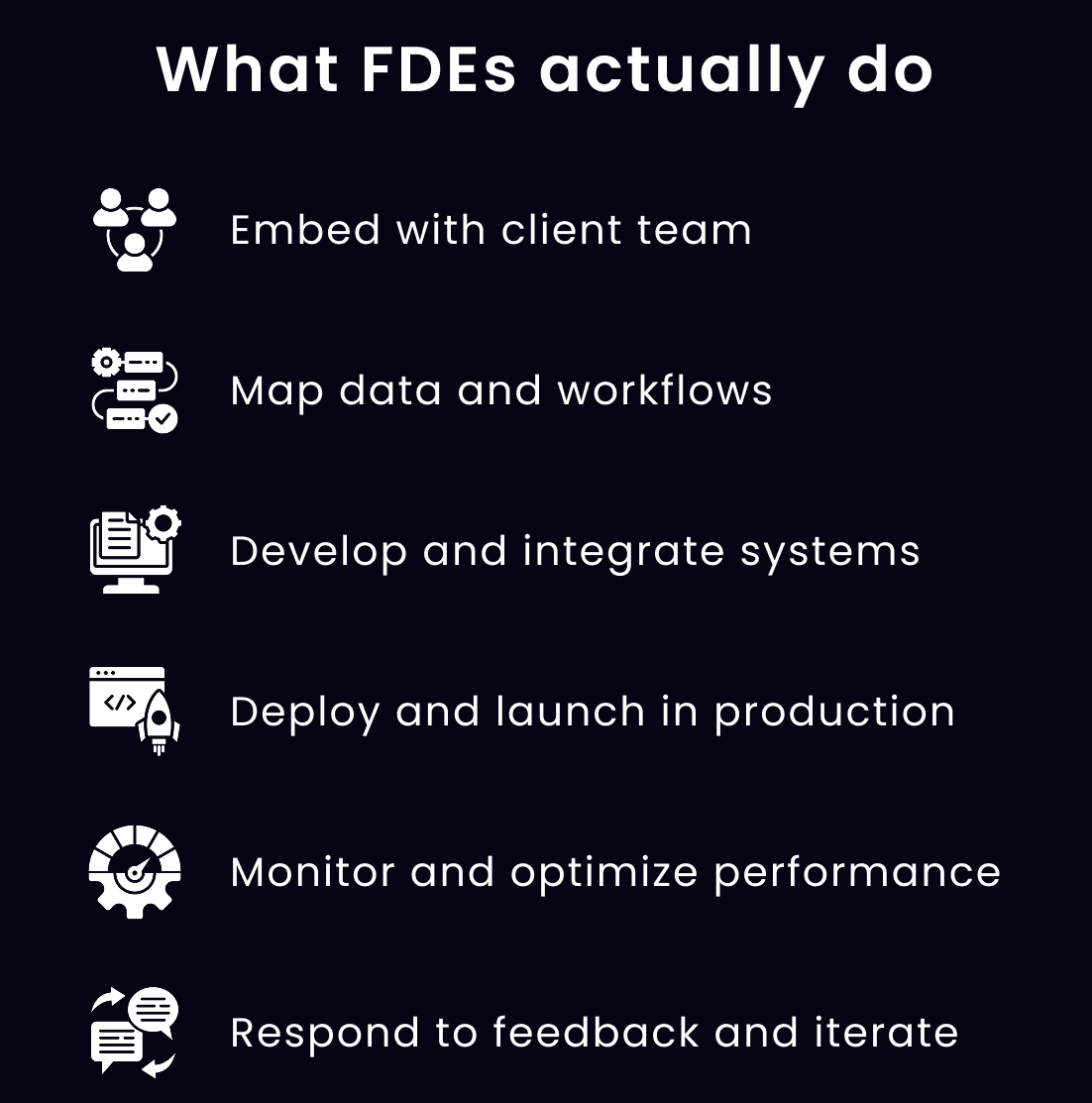
What FDEs do

That is what separates the role from traditional consulting. Consultants usually work for a set time and are judged by what they deliver. Forward deployed engineers, on the other hand, are measured by whether the system continues to run well and continues to add value after it goes live. Their job does not end at handoff, because they stay involved until the system becomes part of daily operations and the client’s own team can manage it.

Knowing what this work looks like day-to-day helps explain why companies building advanced AI systems have invested so much in this approach. But it still leaves the question: Why does AI need this model when traditional software didn’t?

Why AI needs FDE more than traditional SWE

In traditional software, most of the risk comes at the beginning. You design, integrate and test, and once everything works, it usually keeps working. If something breaks, it’s easy to find and fix the problem.

AI systems introduce a different kind of risk because they are probabilistic. A model may perform well in testing yet degrade once exposed to production data and real users. Instead of failing outright, the system can become unreliable, returning inconsistent or irrelevant results that slowly erode user trust.
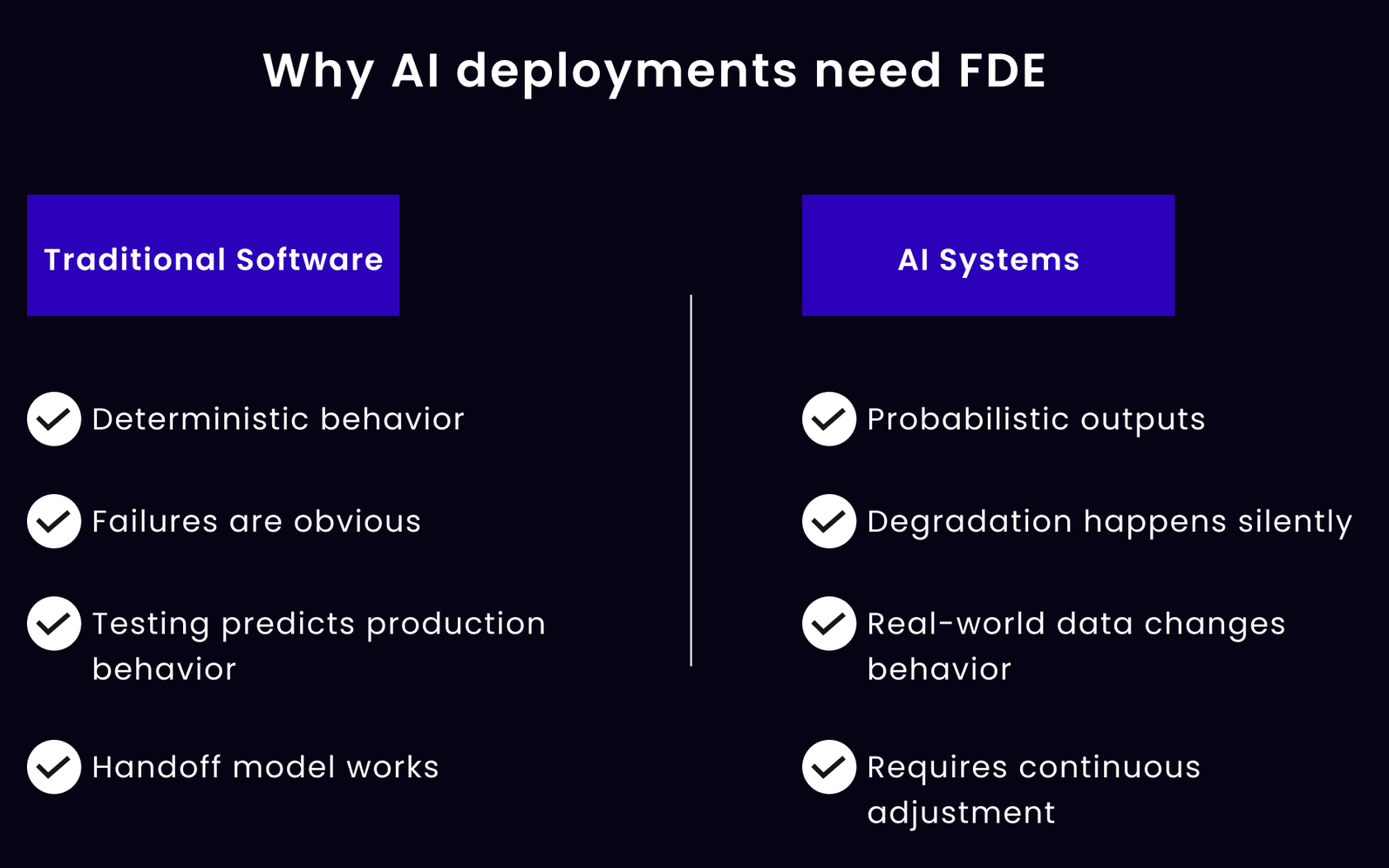
Why AI Deployments need FDE

The typical software delivery model isn’t built to handle this type of failure because internal teams are set up to deliver features, not to remain involved long enough to stabilize a system that evolves over time. Consultants, on the other hand, usually work within fixed scopes and deadlines and once their job is done, they move on. In both cases, ownership fades at the moment an AI system needs the most hands-on attention.

Forward deployed engineers help solve this problem. By working within the customer’s environment, they spot issues as they arise, make quick adjustments and improve the system in real time. That proximity is what turns a promising model into something reliable enough to depend on.

How the FDE model is becoming more accessible

The FDE model used by leading AI companies is typically inaccessible to smaller organizations due to the cost of sustaining it. Companies with large budgets can assign multiple engineers, sometimes entire teams, to a single client deployment. Smaller organizations face the same implementation challenges but don’t have the engineering capacity to dedicate teams to open-ended integration work.

To close that gap, a few different approaches are now emerging. AI labs are expanding deployment support around their models, with OpenAI launching a dedicated deployment company and Anthropic, OpenAI, and Cohere all increasing investment in forward-deployed or applied AI roles. Large consulting firms are also filling the gap through partnerships designed to help enterprises take AI beyond pilots. At the same time, platform companies, such as Bit Cloud, are pairing forward-deployed engineers with tooling so a single engineer can bring a production-ready starting point into a customer’s environment rather than building each integration from zero.

These approaches all share the idea that the main bottleneck has changed. Now, the challenge is not the model itself, but finding engineers who can work within a customer’s systems, understand real workflows, and deliver solutions that work in production.

Wrapping up

Forward deployed engineering began in response to a real-world problem. Organizations had access to more powerful software but often struggled to make these systems work in their day-to-day operations. The main issue was not the technology, but the gap between what the software offered and what organizations actually needed for their own infrastructure, data and workflows.

AI labs ran into the same problem Palantir faced twenty years ago. The most reliable way to make complex systems work was to put engineers close to the people using them, the data they depended on and the problems they were meant to solve.

As AI becomes part of core business systems, the advantage will go to teams that can move beyond prototypes and make deployment repeatable. Whether that support comes from an internal team, an AI lab or a platform, the companies that get this right will be the ones whose AI investments actually work in production.

Bit Cloud is the complete platform for building professional software: AI, design systems, components, CI, testing, and deployment, all in one place. Your AI gets smarter with every build. Start for free.

YOUTUBE.COM/THENEWSTACK

Tech moves fast, don't miss an episode. Subscribe to our YouTube channel to stream all our podcasts, interviews, demos, and more.

Created with Sketch.