




Editor’s note: Zaur Nurmamedov is a journalist and a graduate of the Faculty of Political Science at the Academy of Public Administration under the President of the Republic of Azerbaijan (1993–1999). He previously served as first deputy editor-in-chief of the Vesti.Az news portal (2009–2023). The views expressed in this article are his own and do not necessarily reflect the position of News.Az.
Armenia has entered the final hours before the parliamentary elections scheduled for Sunday, 7 June. The campaign has ended, political agitation has ceased, and the country now finds itself in a state of tense anticipation. Tomorrow’s vote will determine not only the composition of the new National Assembly and the identity of the next head of government, but also the direction Armenia will take in the years ahead.
Formally, citizens are being asked to choose between political parties and electoral blocs. In reality, however, the election has turned into a referendum on Prime Minister Nikol Pashinyan’s rule, his policy towards Azerbaijan, his attempts to normalise relations with Türkiye, and Armenia’s gradual distancing from Russia.
The main favourite remains Pashinyan’s Civil Contract party. Most recent opinion polls indicate that it is the force most likely to finish first. Yet this does not necessarily mean that the ruling party will secure the same level of dominance it enjoyed after the 2021 election.
Polls published in recent months have generally placed Civil Contract between 27% and 33%. Some surveys have shown stronger support among respondents who say they are certain to vote. International news agencies also describe Pashinyan as the most likely winner, while stressing that he may fall short of the level of support needed to form a government as strong as the one he previously led.
 Source: Euractiv
The main question, therefore, is no longer simply whether Pashinyan will win, but how convincing that victory will be. If Civil Contract secures enough seats to form a government on its own, the incumbent prime minister will be able to claim that Armenian society has once again endorsed his political course. If the party finishes first but becomes dependent on coalition partners, negotiations or complex parliamentary arithmetic, the country’s political system will become considerably less stable.
The main new challenger to the government is the Strong Armenia movement, associated with Russian-Armenian businessman Samvel Karapetyan. Its emergence has altered the traditional structure of the opposition. Until recently, former President Robert Kocharyan and the political forces aligned with him were regarded as Pashinyan’s principal rivals. The opposition landscape is now divided among several centres of power, each claiming to represent the main alternative to the current government.
Karapetyan has built his campaign around criticism of Pashinyan’s foreign policy, promises to improve relations with Russia and accusations that the government has made excessive concessions to Azerbaijan. His supporters portray him as an effective manager capable of attracting investment, restoring economic ties with Moscow and defending national interests more firmly.
Karapetyan’s position, however, remains complicated. He is under house arrest and faces serious accusations from Armenian law enforcement agencies. The businessman and his team describe the case as politically motivated, while the authorities reject that claim and insist that the proceedings are purely legal in nature.
Despite an active campaign, most surveys do not suggest that Strong Armenia is capable of overtaking Civil Contract on its own. Different polls have placed its support at roughly 10% to 14%. At the same time, several studies have shown a much narrower gap between Pashinyan and Karapetyan. Such discrepancies make it necessary to treat polling data with caution.
Polling itself has become a separate source of controversy in Armenia ahead of the election. Some little-known organisations have published results that differ sharply from those produced by more established research centres. Political forces have accused one another of using opinion polls not to measure public sentiment, but to influence it.
The most reliable conclusion that can be drawn from the available data is that Pashinyan remains the favourite, but a substantial share of the electorate is still undecided. These voters, together with the eventual turnout, could significantly alter the final balance.
Another major contender is the Armenia Alliance led by former President Robert Kocharyan. It is campaigning on experience, national security and the restoration of close strategic cooperation with Russia. Yet the opposition has failed to unite behind a single leader. Karapetyan, Kocharyan, Gagik Tsarukyan and other opponents of Pashinyan are running separately, competing not only with the government but also with one another.
This fragmentation objectively benefits Civil Contract. Even if the ruling party’s support declines, its rivals may split the protest vote among themselves. Some ballots cast for smaller parties may also be excluded from the parliamentary seat distribution if those forces fail to clear the legal threshold.
A large number of political groups are taking part in the election, but only a limited number have a realistic chance of entering parliament. As a result, the new National Assembly could either be divided among several major players or once again be shaped around Pashinyan’s dominant party and a small number of opposition factions.
The peace process with Azerbaijan has become the central issue of the campaign. Pashinyan argues that Armenia must abandon a policy of permanent confrontation, recognise existing international borders and move towards peaceful development. His vision includes reopening transport links, normalising relations with Azerbaijan and Türkiye, and transforming Armenia into a regional transit hub.
The prime minister presents peace as the only realistic guarantee of preserving Armenian statehood. In his view, continuing the Karabakh movement and attempting to reverse current realities could lead the country into new wars, further loss of life and even greater dependence on external powers.
The opposition accuses Pashinyan of accepting Baku’s demands under the guise of pursuing peace, weakening Armenia’s negotiating position and failing to obtain sufficient security guarantees. Questions surrounding possible constitutional amendments, border delimitation and the opening of regional transport routes have become some of the most contentious issues of the campaign.
The future of Armenian-Azerbaijani normalisation therefore depends directly on the outcome of the vote. A Pashinyan victory backed by a stable majority would allow him to present his peace policy as having received a renewed popular mandate. This could accelerate further negotiations with Baku, discussions on constitutional amendments and the practical implementation of transport projects.
A weak result for the ruling party, by contrast, would complicate the process. Even if Pashinyan remained prime minister, he would be forced to take a stronger opposition in parliament and society into account. A victory or major breakthrough by pro-Russian and national-conservative forces could lead to a review of some of the agreements already reached.
Armenia’s geopolitical orientation is equally important. During Pashinyan’s years in power, relations between Yerevan and Moscow have deteriorated sharply. Armenia has frozen its participation in the Collective Security Treaty Organization, expanded cooperation with the European Union and the United States, and begun discussing European integration.
At the same time, Armenia remains heavily dependent on Russia economically. Russia is still one of the country’s largest trading partners, controls important elements of its energy infrastructure and remains a key market for Armenian goods and migrant labour.
Moscow has warned that Yerevan’s continued movement towards the European Union may be incompatible with full participation in the Eurasian Economic Union. In the run-up to the election, mutual accusations, trade restrictions and warnings about possible revisions to existing energy and economic arrangements have intensified.
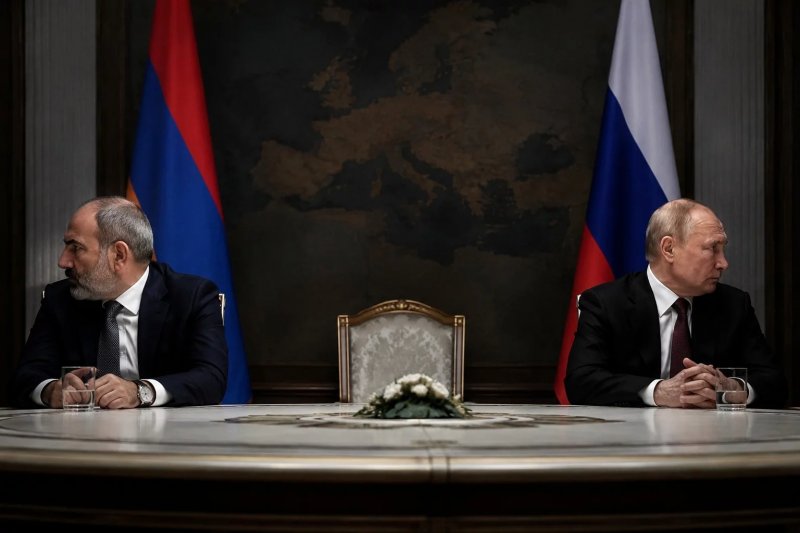
The 7 June vote is therefore being viewed not only as a domestic political event, but also as a contest between two foreign-policy models. Pashinyan proposes reducing dependence on Moscow, deepening ties with the West and building peaceful relations with neighbouring states. His main opponents advocate restoring ties with Russia, taking a more cautious approach towards Western initiatives and adopting a tougher line in negotiations with Azerbaijan.
The European Union and the United States are closely watching the election. For Western countries, Pashinyan’s continued rule would mean the preservation of a course aimed at gradually reducing Russian influence in the South Caucasus. For Moscow, his defeat or a significant strengthening of his pro-Russian opponents would offer an opportunity to regain some of the positions it has lost.
 Source: AI-generated
At the same time, reducing the choice facing Armenian society to a simple confrontation between Russia and the West would be an oversimplification. Voters are also concerned about prices, jobs, road conditions, corruption, social protection, the quality of public services and security.
In rural areas, Pashinyan has benefited from infrastructure projects, road improvements and a more visible state presence. In Yerevan, the government’s position appears less secure, and criticism is more pronounced.
Growing fatigue with Pashinyan’s rule remains a serious problem for the prime minister. He has been in power since 2018, and many citizens, even those who do not support the former elites, are dissatisfied with the concentration of power, the government’s conflict with the Armenian Apostolic Church, the prosecution of political opponents and the absence of a final peace agreement.
Yet the opposition has so far failed to demonstrate convincingly that it represents a united and credible alternative capable of governing. The possible return of politicians associated with the former system also fails to inspire enthusiasm among a substantial part of the public. This dual reality — disappointment with Pashinyan combined with a lack of trust in his rivals — remains the government’s principal advantage.
The most likely outcome is a first-place finish for Civil Contract and Nikol Pashinyan’s continuation as prime minister. The question of a parliamentary majority, however, remains open. A convincing victory would allow him to continue his peace-oriented and pro-Western course. A narrow victory could lead to coalition negotiations, political instability and stronger pressure from the opposition.
An unexpected result cannot be ruled out entirely. The large number of undecided voters, the possibility of low turnout, protest voting and widespread distrust of polling all preserve an element of unpredictability. Armenia has previously experienced moments when public sentiment shifted more quickly than opinion surveys were able to capture.
Today, the country is genuinely holding its breath. For one part of society, tomorrow’s vote represents an opportunity to break out of a long cycle of conflict and open a new chapter in relations with neighbouring states. For another, it is the last chance to halt a political course they regard as dangerous to the country’s national interests.
Whatever the result, one thing is clear: the 7 June election will be among the most important in Armenia’s modern history. It will determine not only the political future of Pashinyan and his government, but also the prospects for peace with Azerbaijan, relations with Russia, closer ties with Europe and the broader balance of power in the South Caucasus.
(If you possess specialized knowledge and wish to contribute, please reach out to us at opinions@news.az).
此内容由惯性聚合(RSS阅读器)自动聚合整理,仅供阅读参考。 原文来自 — 版权归原作者所有。