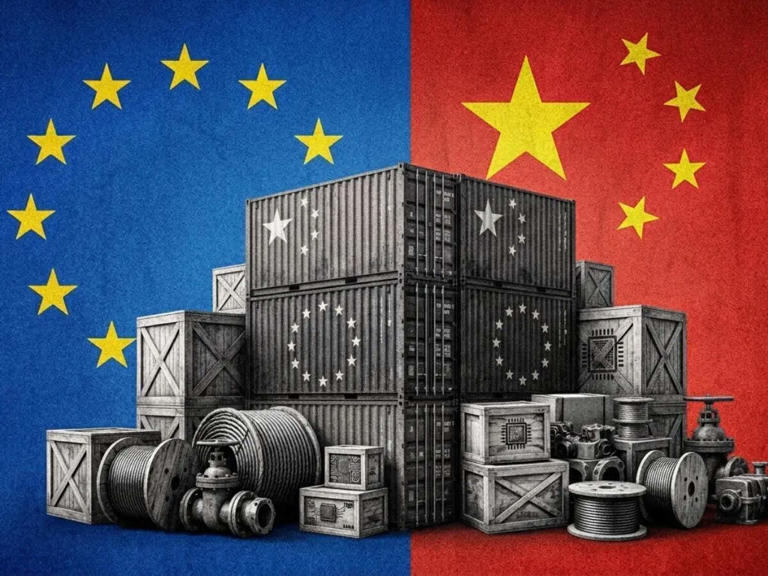
China has warned the European Union of possible retaliatory measures if the new European “Made in Europe” law harms Chinese companies, Xinhua news agency reported, citing China’s Ministry of Commerce.
“Made in Europe” (Made in Europe/EU) is an EU initiative aimed at labelling and supporting goods produced within the bloc in order to strengthen its industrial base and reduce dependence on imports, particularly in the technology sector. The new draft law envisages giving priority to European products in public procurement.
Beijing has stated that the EU’s industrial acceleration law creates serious barriers to investment and constitutes institutional discrimination. “If China’s position is ignored, the country will be forced to take countermeasures,” the ministry said.
China has reason for concern. The European Union is one of its largest trading partners, consistently ranking among the top three destinations for its foreign trade. By the end of 2025, trade turnover between China and the EU had increased by 5.4 percent, reaching $828.11 billion. The EU is a key market for Chinese exports, while China is one of the main sources of imports for the bloc. In the first quarter of 2026, trade between China and the EU grew by 17.6 percent. Exports from China to the EU rose to $147.76 billion, while imports from the EU reached $64.64 billion.
Source: MSN
In March, the European Commission presented a strategy to enhance economic competitiveness amid China’s growing influence in several sectors. This regulation, known as the Industrial Accelerator Act, aims to increase the share of manufacturing in the EU’s GDP to 20 percent by 2035, up from about 14 percent in 2024. The document will enter into force after approval by the European Parliament, after which it will become binding on all EU member states.
The Act covers industries such as automotive manufacturing, battery production, construction, the chemical sector, steelmaking and transport — sectors in which China is actively investing.
France is the main proponent of the new measures. European media report that the scope of the document was somewhat scaled back to secure support from Germany and Northern European countries.
Beijing’s statement on potential countermeasures in response to the “Made in Europe” bill reflects not just another trade dispute, but a deeper global shift. It signals the gradual breakdown of the previous model of open interdependence between China and the European Union and a transition towards competition between industrial blocs.
“Made in Europe” implies that companies receiving state support in strategic EU sectors must comply with requirements to localise production and components within Europe. From Brussels’ perspective, such a policy is a tool to strengthen industrial sovereignty, especially amid competition with the United States and China, as well as an attempt to accelerate the green transition and reduce dependence on external supply chains.
However, for Beijing, the measures amount to an attempt to limit Chinese companies’ access to European subsidies and strategic markets.
Analysts note that China is employing both diplomatic and deterrent approaches. On the one hand, Beijing has expressed readiness for dialogue with the EU on the issue. On the other, it has warned of possible countermeasures. Experts believe China has the means to respond to the marginalisation of its interests in Europe, but it traditionally favours soft power and will try to resolve the issue diplomatically. If the situation escalates, it may reveal the real cost of the emerging conflict.
Who is right and who is wrong in this dispute? Each side has its own rationale.
The EU seeks to reduce the vulnerability of its supply chains, especially in critical sectors. China, in turn, views the European market as a key destination for expanding its high-tech exports. In essence, two positions are clashing: the European logic of security, focused on protecting strategic industries and subsidies, and the Chinese logic of open markets, which emphasises access to EU-supported programmes and infrastructure.
The EU’s move at this particular moment is no coincidence. Against the backdrop of a slowing global economy and ongoing tariff tensions with the United States, Europe is being forced to seriously consider protecting its own industrial interests. A period is emerging in which domestic production capabilities are becoming increasingly important and require stronger support, including limits on access for external investors.
China, for its part, does not face constraints in domestic production. On the contrary, it is dealing with overcapacity in certain sectors, the need to diversify export markets and restrictions from the West that exacerbate these challenges. China is interested in expanding into Western markets, while those markets are increasingly showing a tendency to contract in an effort to shield themselves from Chinese expansion.
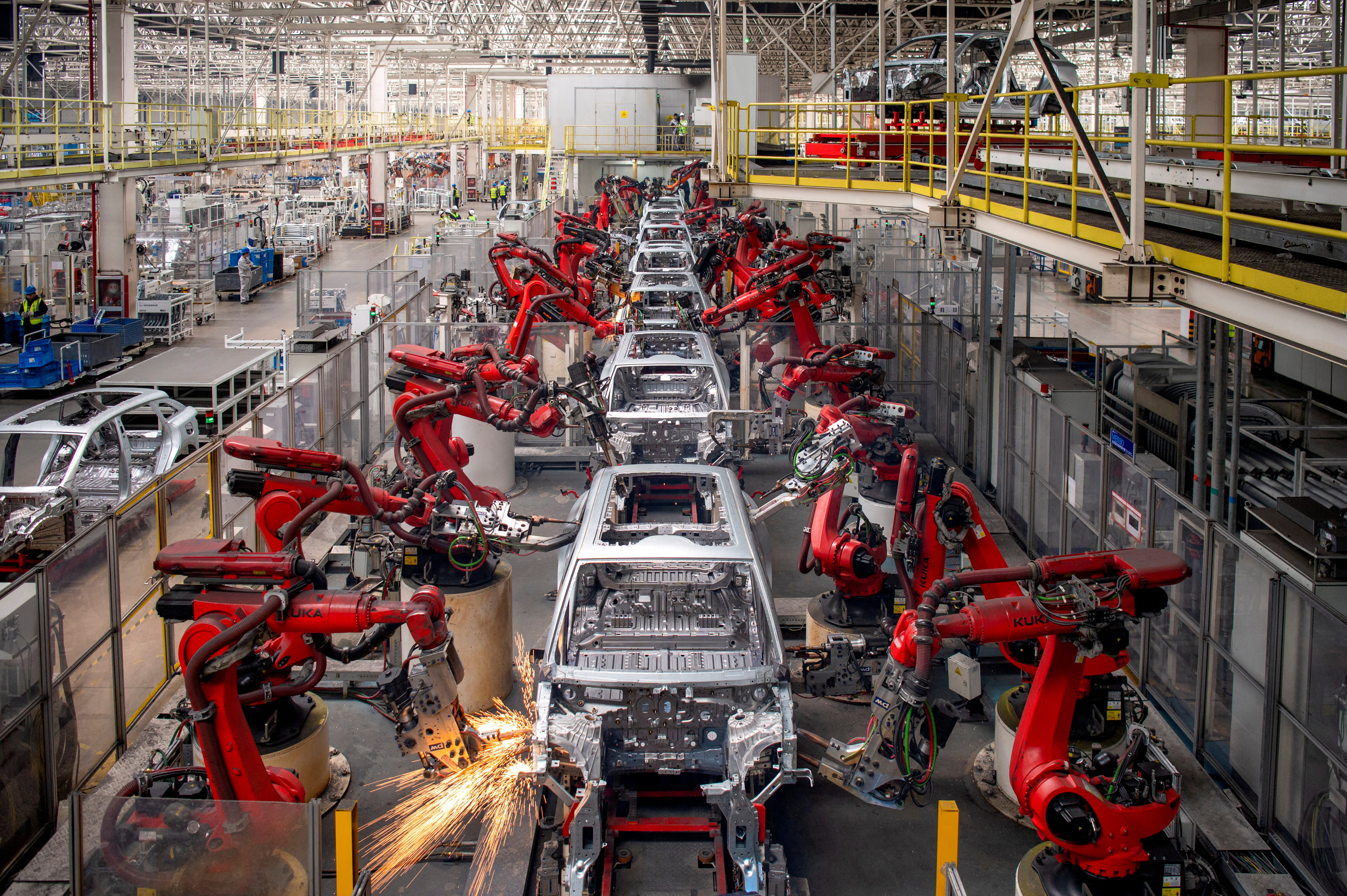
Source: Reuters
The adoption of the Act is only a matter of time. The European Parliament is expected to vote in favour. If it is adopted in its current form, without any softening of the EU’s position, consequences are likely.
According to experts, China may introduce targeted restrictions against European companies operating in China, particularly in the automotive, chemical and engineering sectors. Chinese companies may reduce their participation in European projects and redirect investments to countries in Asia, the Middle East and Latin America. The formation of separate technological ecosystems — European and Chinese — will accelerate, with limited compatibility between them.
More optimistic analysts expect that China may succeed in softening the law through negotiations and securing certain adjustments. However, this scenario appears less likely given the growing misunderstandings in the dialogue between Brussels and Beijing.
In these conditions, Beijing’s statement is not just a reaction to a single draft law, but a signal that economic relations between China and the European Union are entering a phase of structural reassessment. Even if the current dispute is resolved, the trend towards separation is likely to persist.
By Trural Heybatov
此内容由惯性聚合(RSS阅读器)自动聚合整理,仅供阅读参考。 原文来自 — 版权归原作者所有。