








Editor’s note: Moses Becker is a special political commentator for News.Az. He holds a PhD in political science and specialises in inter-ethnic and inter-religious relations. The views expressed in this article are those of the author and do not necessarily reflect the position of News.Az.
Formally, a state of war has existed between Lebanon and Israel since 1948, when the newly established Jewish state appeared on the world map and was opposed by almost all Arab countries. Owing to its military weakness, however, the Lebanese army did not engage in active military operations, although the state of war with Israel has continued to this day.
The first major war took place in 1982, when units of the Palestine Liberation Organization (PLO), led by Yasser Arafat, established a presence in Lebanon. In effect, the republic became an arena of confrontation between Israel and the Palestinians, while its own army remained largely on the sidelines. During the fighting, the Israel Defense Forces (IDF) advanced all the way to Beirut and ultimately forced Arafat's militants to relocate to Tunisia.
The Second Lebanon War began with an incursion into Israeli territory by Hezbollah militants, carried out at Iran's instigation. On 12 July 2006, at 9:00 a.m., Hezbollah units launched a rocket and mortar attack on the Israeli town of Shlomi and the fortified military position of Nurit. Later that same day, a Hezbollah squad crossed the border and attacked an Israeli patrol travelling in Humvee vehicles. Eight Israeli soldiers were killed in the attack, while two others were captured and taken into Lebanon.
Immediately afterwards, Hezbollah proposed exchanging the captured soldiers for Lebanese and Palestinian prisoners held in Israeli jails. Israel refused. In response to what it regarded as unprovoked aggression, the Israeli army immediately launched military operations, entering border areas of Lebanon in an effort to recover its soldiers. At the same time, Israeli aircraft and helicopters struck Hezbollah positions from which attacks were being launched.
Source: CNN
On the evening of 13 July, the Israeli military imposed a blockade on Lebanon's airspace and seaports. Israeli aircraft attacked Beirut International Airport, rendering its runways inoperable. On 14 July, a new wave of large-scale bombardments began in southern Lebanon. In response, Hezbollah's leader officially declared war on Israel. The following day, Israeli air strikes expanded into central Lebanon. Hezbollah, in turn, intensified rocket attacks on northern Israeli cities and military installations, further escalating the conflict.
On 15 July 2006, Israeli Prime Minister Ehud Olmert stated that Israel was prepared to cease military operations provided that the captured soldiers were released and rocket attacks against Israeli territory stopped. Israel also demanded the implementation of a United Nations resolution calling for the disarmament of all armed groups in Lebanon and the transfer of control over southern Lebanon to the Lebanese government. Hostilities ended on 14 August.
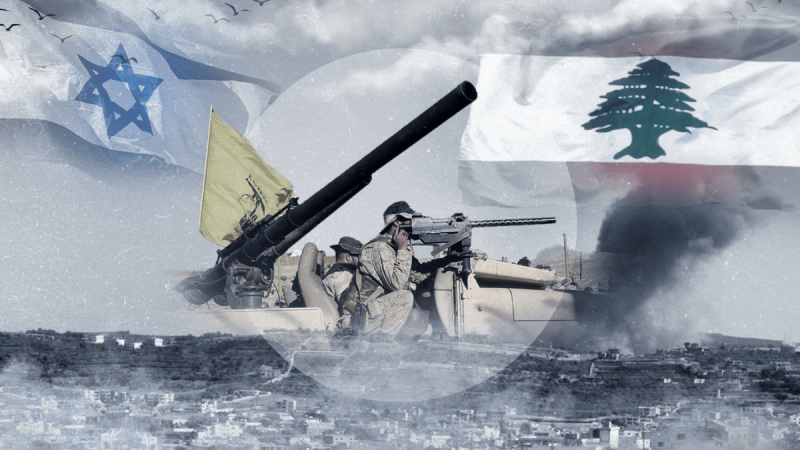
The Third Lebanon War began on 8 October 2023, after the Lebanese Shiite organisation Hezbollah declared its support for Hamas following the latter's attack on Israel. Acting in accordance with the wishes of its patrons in Tehran, the organisation entered the Israeli-Palestinian conflict despite what the author describes as Lebanon's national interests.
On the morning of 8 October, Hezbollah began attacking the Israeli border with armed units and shelling communities in northern Israel. The IDF responded with air strikes against concentrations of Hezbollah members, as well as the group's military equipment and weapons stockpiles. By January 2024, approximately 96,000 residents of northern Israel had been evacuated.
Initially, the two sides exchanged rocket and aerial strikes. Israel then launched a ground operation, which began on 22 July, and by August the IDF had occupied a number of settlements. A low-intensity conflict continued throughout 2024 and 2025.
In the spring of 2026, during its ground operation, the IDF established a new line of control that in some places extends up to 10 kilometres into Lebanese territory, reaching the Litani River. According to Israeli military sources and Channel 12 television, Israel applied a model previously used in Gaza: the area between the international border and the so-called "yellow line" was declared a closed military zone.
More than 50 Lebanese villages fell within this perimeter. Residents of these communities have been prohibited from returning to their homes even during temporary ceasefires.
The Israeli military has shown no intention of stopping there. On 31 May 2026, Prime Minister Benjamin Netanyahu ordered the IDF to further expand its ground operation in Lebanon.
"My instruction now is to deepen and expand our control over territories that were previously under Hezbollah's control," Netanyahu said.
According to him, these actions are intended to create security zones beyond Israel's borders and protect Israeli cities and communities.
The prime minister noted that Israeli forces had eliminated 700 Hezbollah militants in a single month. Since the launch of Operation Lion's Roar in February 2026, the number had reached 3,000.
"The campaign is not over yet. We are fully determined to crush Hezbollah's rule," Israeli Defence Minister Israel Katz added.
Meanwhile, rocket attacks against Israel have declined sharply, although drone attacks have increased. The IDF continues advancing in Lebanon despite a 45-day ceasefire announced on 16 April.
According to The Jerusalem Post, citing senior Israeli officials, Israel has asked the United States for authorisation to conduct expanded air strikes against Beirut.
On 31 May, Defence Minister Israel Katz reported that Israeli forces had taken control of the strategically important medieval Beaufort Castle in southern Lebanon.
Despite Iranian attempts to link negotiations with the United States to an end to the war in Lebanon, Israel continues advancing deeper into the country.
According to the author's assessment, Hezbollah's setbacks have increased its isolation within Lebanese society. The article states that more than 90 per cent of Christians, Druze and Sunnis currently oppose the organisation. The author further argues that many moderate Shiites share this view, believing Hezbollah is jeopardising their future in Lebanon.
The number of internally displaced persons, primarily Shiites from southern Lebanon, has reportedly reached 1.2 million. According to the author, attitudes towards these displaced populations among other religious communities are largely negative.

Source: AP
Against this backdrop, the first direct talks between Lebanon and Israel at ambassadorial level took place in Washington on 16 April. These discussions are continuing, reflecting what the author describes as growing Lebanese dissatisfaction with being in the position of an Iranian proxy.
In addition, the weakening of Iran and the reduction in financial support from the Islamic Revolutionary Guard Corps have, according to the author, undermined morale among Hezbollah fighters, many of whom are increasingly questioning their future.
The author concludes that Iranian policy has contributed to the isolation of Shiite communities within the Arab world, where they are increasingly viewed not as an integral part of the Islamic community but as representatives of foreign interests.
Perhaps this is why US President Donald Trump has intensified efforts to expand the Abraham Accords, a development that could fundamentally reshape the geopolitical landscape of the Middle East. Should this initiative succeed, Iran could find itself in the position of a besieged fortress.
In any case, the war between the United States and the Islamic Republic has already left a deep mark on history.
(If you possess specialized knowledge and wish to contribute, please reach out to us at opinions@news.az).
此内容由惯性聚合(RSS阅读器)自动聚合整理,仅供阅读参考。 原文来自 — 版权归原作者所有。