





Editor’s note: Zaur Nurmamedov is a journalist and a graduate of the Faculty of Political Science at the Academy of Public Administration under the President of the Republic of Azerbaijan (1993–1999). He previously served as first deputy editor-in-chief of the Vesti.Az news portal (2009–2023). The views expressed in this article are his own and do not necessarily reflect the position of News.Az.
China has once again found itself at the centre of the global diplomatic agenda this week. Several high-ranking foreign leaders are arriving in Beijing or have already begun official engagements there, while Chinese President Xi Jinping is holding a series of talks highlighting China’s growing role as one of the key centres of international politics.
The most closely watched event of the week is expected to be US President Donald Trump’s visit to China. According to Reuters, Trump and Xi are expected to meet in Beijing on 14–15 May. The agenda is likely to include trade, energy, artificial intelligence, sanctions, Iran, nuclear security and the broader strategic competition between the world’s two largest economies. Washington is reportedly seeking new Chinese purchases of US agricultural products, energy resources and Boeing aircraft. For China, the summit is important not only as an opportunity to reduce tensions with the United States, but also as a way to demonstrate that Beijing remains a platform without which key global issues cannot be resolved.
The significance of these talks is reinforced by the scale of US-China economic ties. The United States and China remain the world’s two largest economies, and their trade disputes in recent years have directly affected global markets, supply chains, commodity prices, food security, technology flows and logistics. According to Reuters, energy may also form part of a possible economic package: before the latest round of trade restrictions, China’s imports of US crude oil and liquefied natural gas were estimated at about $8.4 billion in 2024. This shows that even limited agreements between Beijing and Washington can have consequences far beyond the two countries.
For Central Asia, the main event of the week is Tajik President Emomali Rahmon’s state visit to China, taking place from 11 to 14 May at the invitation of Xi Jinping. On 12 May, the two leaders held talks at the Great Hall of the People in Beijing and attended a signing ceremony for cooperation documents. The Chinese side emphasised its support for Tajikistan’s development, as well as for protecting the country’s independence, sovereignty and security.
Source: globaltimes
The economic background to Rahmon’s visit makes it particularly important. According to Chinese data, trade turnover between China and Tajikistan reached $4.31 billion in 2025, an increase of 11.7% compared with the previous year. Chinese exports to Tajikistan amounted to $3.75 billion. Other data indicate that China’s share of Tajikistan’s foreign trade reached 26.4% in 2025, while Tajik exports to China exceeded $523.8 million and imports from China amounted to $2.33 billion. These figures show that China has effectively become one of Dushanbe’s most important foreign economic partners.
Investment is another key part of the relationship. According to regional media reports citing Tajik sources, more than 700 enterprises with Chinese capital operate in Tajikistan. It has also been reported that from 2007 to 2024, Chinese investment in Tajikistan’s economy approached $6 billion. Given Dushanbe’s limited domestic resources, these investments are of strategic importance and are linked to infrastructure, industry, energy, transport, mining and agriculture.
Another important development is that during Rahmon’s current visit, Chinese and Tajik companies reportedly signed contracts worth more than $8 billion. If implemented, these agreements could significantly expand China’s economic presence in Tajikistan and deepen Dushanbe’s reliance on Chinese capital, technology and infrastructure projects.
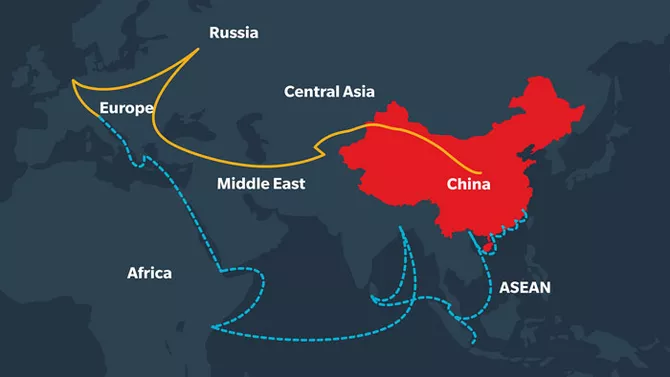
For China, Tajikistan is important not only as an economic partner. The country occupies a strategically significant position, bordering China, Afghanistan, Uzbekistan and Kyrgyzstan. For Beijing, this direction is closely linked to security, the stability of China’s western regions, transport connectivity and the advancement of the Belt and Road Initiative. For Dushanbe, China remains a source of investment, loans, infrastructure projects and political support on the international stage.
At the same time, Beijing is also intensifying its contacts with Southeast Asia. Brunei’s Crown Prince Haji al-Muhtadee Billah is paying an official visit to China from 11 to 15 May. On 12 May, Xi Jinping met him at the Great Hall of the People in Beijing. The Chinese side expressed its readiness to deepen practical cooperation with Brunei.
Although Brunei is a small state, it holds particular importance for China. It is a member of ASEAN, an energy partner and a country located in the sensitive South China Sea region. For Beijing, relations with Brunei form part of a broader policy of strengthening ties with Southeast Asia, where China seeks to combine economic influence, infrastructure projects and diplomatic dialogue.
Taken together, Beijing’s diplomatic activity this week has several dimensions. On the one hand, China is preparing to host the US president and engage in dialogue with its main strategic competitor. On the other, it is strengthening ties with Central Asia through Emomali Rahmon’s visit. At the same time, Beijing is working with Brunei and other partners, demonstrating that its foreign policy is not limited to relations with the West.
Source: TASS
For Central Asia, Rahmon’s visit is especially revealing. It confirms that China continues to view the region as a strategic space linking East Asia, Russia, the Middle East and Europe. Through trade, investment, infrastructure and political support, Beijing is steadily consolidating its influence across the region. Tajikistan, because of its geographical position and economic need for external investment, remains one of the most important directions of China’s policy in Central Asia.
(If you possess specialized knowledge and wish to contribute, please reach out to us at opinions@news.az).
此内容由惯性聚合(RSS阅读器)自动聚合整理,仅供阅读参考。 原文来自 — 版权归原作者所有。