








Editor’s note: Zaur Nurmamedov is a journalist and a graduate of the Faculty of Political Science at the Academy of Public Administration under the President of the Republic of Azerbaijan (1993–1999). He previously served as first deputy editor-in-chief of the Vesti.Az news portal (2009–2023). The views expressed in this article are his own and do not necessarily reflect the position of News.Az.
Russian President Vladimir Putin’s state visit to Kazakhstan should not be viewed as a routine diplomatic trip. Formally, the agenda includes talks with President Kassym-Jomart Tokayev, participation in the Eurasian Economic Forum, and a meeting of the Supreme Eurasian Economic Council. But the real significance of the visit is much broader. Kazakhstan has become one of the key arenas where the interests of Russia, China, the West, Central Asia, and major energy corridors intersect.
Putin’s visit, scheduled for 27–29 May, carries the highest diplomatic status — a state visit. According to Russian media, the programme includes top-level talks, the signing of documents, participation in Eurasian Economic Union events, and separate negotiations between Putin and Tokayev. A joint statement on the “seven foundations of friendship and good-neighbourliness between the peoples of Russia and Kazakhstan” is also expected.
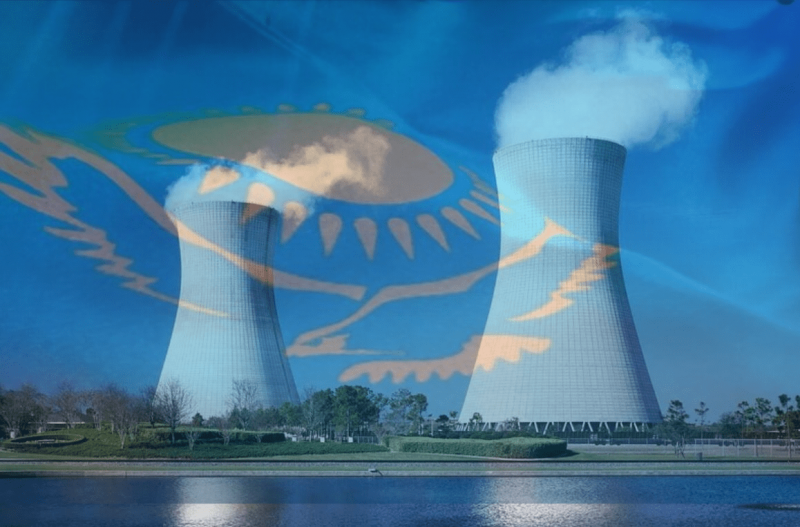
The first and most obvious reason for the visit is energy. Russia wants to consolidate its role as one of Kazakhstan’s key infrastructure partners. One of the central issues is nuclear energy. Moscow and Astana are expected to sign an agreement defining the parameters for the construction of Kazakhstan’s first nuclear power plant. For Kazakhstan, this is a strategic project: the country is one of the world’s largest uranium producers, but it has not had operational nuclear power generation since the BN-350 reactor was shut down in 1999.
Source: Kazinform
For Russia, the project is not only economic but also political. If Moscow secures a leading role in building Kazakhstan’s first nuclear power plant, it will create a long-term technological and financial link between Astana and Russia’s nuclear industry. A nuclear power plant is not a one-time deal. It means decades of maintenance, supplies, personnel training, financing, and political interaction. This is why the nuclear project can be viewed as one of the main reasons behind the current visit.
The second reason is oil transit and energy logistics. During the trip, the two sides are expected to discuss expanding the transit of Russian oil to China through Kazakhstan, including via the Atasu–Alashankou route. The parties had previously discussed increasing supplies, but this expansion has not yet been fully implemented.
For Russia, this issue is especially important amid Western sanctions and the reorientation of export flows towards the East. Kazakhstan is becoming not merely a neighbouring country for Moscow, but an important transit corridor to China. The more complicated Russia’s European direction becomes, the greater the importance of Kazakhstan’s infrastructure. In this sense, Astana is gaining additional weight: routes passing through its territory may become part of the new energy architecture of Eurasia.
The third reason is the Eurasian Economic Union. Putin arrived in Kazakhstan not only for bilateral talks, but also to take part in the Eurasian Economic Forum and the meeting of the Supreme Eurasian Economic Council. For Moscow, this is an opportunity to demonstrate that integration formats in the post-Soviet space still matter despite the war in Ukraine, Western sanctions, pressure from the West, and the growing independence of Central Asian states.
Russia is interested in preventing the EAEU from turning into a purely formal structure. Kazakhstan, meanwhile, seeks to use its participation in the union pragmatically: to gain economic benefits while avoiding political dependence. Therefore, Putin’s visit to Astana is also an attempt to strengthen Russia’s influence within Eurasian institutions, where Kazakhstan plays one of the central roles.
The fourth reason is the struggle for influence in Central Asia. Kazakhstan is pursuing a multi-vector foreign policy. Astana maintains close relations with Russia, actively develops ties with China, and strengthens contacts with the EU, the United States, Türkiye, and the Gulf states. For Moscow, this is a sensitive issue: Kazakhstan remains Russia’s close partner in several formats, but it no longer appears to be a country prepared to automatically follow Russia’s foreign policy line.
This is why Putin came to Astana at a time when Central Asia has become an arena of active diplomatic competition. China is expanding its economic presence, the West is interested in critical minerals, energy, and transport routes, Türkiye is strengthening ties through Turkic formats, while Kazakhstan is seeking to become an independent centre of regional politics. For Russia, it is important not to lose its position within this system.
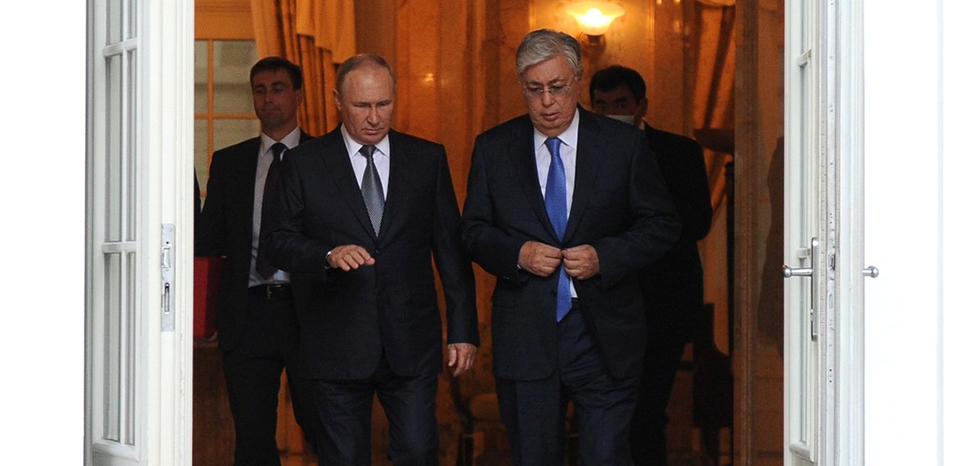
The fifth reason is the personal diplomacy between Putin and Tokayev. Russian media have emphasised the special status of the visit, while the fact that it is another state visit within a relatively short period is being presented as proof of the high level of relations between the two countries. Tokayev personally met Putin in Astana, which also signalled special attention to the visit.
But behind this diplomatic courtesy lies a more complicated reality. Kazakhstan is too important for Russia to limit relations to formal contacts. It is the largest country in Central Asia, the region’s biggest economy, and a crucial partner in terms of borders, transit, energy, security, and trade. Any cooling of relations with Astana would be a serious strategic blow to Moscow.
Source: Kremlin
The sixth reason is symbolic. Ahead of the visit, Putin gifted Kazakhstan four Amur tigers as part of a programme aimed at restoring the tiger population. At first glance, this is soft diplomacy and a symbolic gesture. But such symbols also matter: Moscow wants to demonstrate that relations with Astana are not only about oil, gas, nuclear energy, and geopolitics, but also about humanitarian, environmental, and cultural projects.
At the same time, the main intrigue of the visit lies not in the ceremonies, but in how far Kazakhstan is prepared to go in deepening cooperation with Russia. Astana is interested in partnership with Moscow, but it does not want to become a junior ally. Kazakhstan needs technologies, investment, transit revenues, and stable relations with its northern neighbour. At the same time, it seeks to preserve room for manoeuvre between Russia, China, and the West.
This is why Putin’s visit to Kazakhstan can be described as Moscow’s attempt to secure its place in the new regional reality. Russia can no longer view Central Asia as a space of automatic influence. Now, every major deal, every transport route, every energy project, and every political format requires active competition.
For Kazakhstan, the visit is an opportunity to gain maximum practical benefits while emphasising its own role as an independent Eurasian centre. For Russia, it is a chance to demonstrate that despite international isolation in the Western direction, it still retains strong positions in Eurasia.
Therefore, Putin came to Kazakhstan not only for talks with Tokayev and participation in the EAEU summit. He came for energy, transit, the nuclear project, political influence, and confirmation that Kazakhstan remains one of Moscow’s key partners. But Astana is now playing a far more sophisticated game: it receives Putin, signs documents, discusses major projects, and at the same time continues to build its own multi-vector policy, in which Russia is important but no longer the only centre of gravity.
(If you possess specialized knowledge and wish to contribute, please reach out to us at opinions@news.az).
此内容由惯性聚合(RSS阅读器)自动聚合整理,仅供阅读参考。 原文来自 — 版权归原作者所有。