






Editor's note: Darya Grevtsova is deputy director of the Institute of Political Studies and a Russian political scientist. The article reflects the author's personal opinion and may not coincide with the views of News.Az.
After Armenia’s defeat in the 2020 Karabakh War, Armenian society found itself in a state of deep frustration. The loss of Karabakh was not merely a military or territorial defeat for Armenia; it became a profound psychological trauma, the consequences of which continue to shape the country’s internal political atmosphere. Armenian society faced a difficult question: where should this accumulated anger and disappointment be directed, who should be blamed for what happened, and which path should the country follow next?
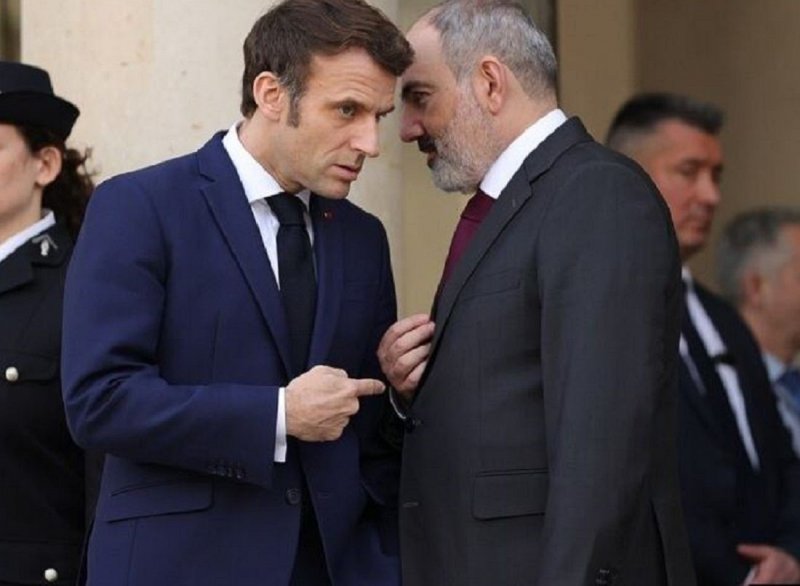
It was at this moment that various political forces began trying to channel this public frustration in a direction that served their own interests. For some, the main culprit was Armenia’s former political elite. For others, it was Prime Minister Nikol Pashinyan and his government. For another group, it was Russia, which, in their view, failed to support Armenia at a critical moment. Against this backdrop, Western politicians, above all French President Emmanuel Macron, became increasingly active, seeking to use Armenian disappointment to advance Yerevan’s Western orientation.
The logic of Macron and his allies is quite clear: they want to convince Armenian society that Russia has allegedly proven to be weak, unreliable, and incapable of protecting Armenia. Therefore, they argue, Yerevan should make a final turn toward the West, the European Union, and France. In this rhetoric, the Karabakh defeat is turned into an argument against Moscow and into a tool for influencing Armenian public opinion.
As is well known, there is indeed a strong sense of resentment toward Russia in Armenian political discourse. A significant part of Armenia’s elite and society believes that during the Karabakh War, Moscow adopted a neutral position instead of standing by Armenia. Russia did not send its troops to fight for Armenian interests and did not directly intervene in the conflict. This argument is now actively used by those forces that want to persuade Armenian society to turn away from Russia.
However, it is important to understand that Western politicians are exploiting this issue not out of sympathy for Armenia, but out of their own geopolitical interests. When Macron says that the South Caucasus should not become an arena for the struggle of empires, these words are not only a call for peace and stability. In reality, they also reflect an attempt to push Russia out of the region and replace it with Western influence.
In this logic, the South Caucasus is not viewed as a space for equal cooperation, but as a zone for a new redistribution of influence. France is increasingly trying to take responsibility for the Armenian direction, seeking to secure the role of Yerevan's main Western patron. Azerbaijan has traditionally been of interest to the United Kingdom, primarily from the standpoint of energy, transport routes, and regional policy. Georgia also remains an important area for Western actors, although the balance of influence there is more complex. Overall, Western countries are trying to reshape the region in line with their own interests.
Source: Public Radio of Armenia
Nikol Pashinyan plays a special role in this process. It must be understood that Pashinyan has always been a politician oriented toward the West. He came to power on the wave of protests and with the support of forces that saw Armenia’s future in gradual distancing from Russia and closer alignment with Western structures. Therefore, pursuing a consistent pro-Russian rhetoric or choosing a Russian course is not only unnatural for him, but also politically disadvantageous.
In his struggle for power, Pashinyan relies precisely on those groups and external centers of influence that link Armenia’s future with the West. His political logic is to present the Western choice as a path toward modernization, security, and liberation from dependence on Moscow. That is why he is consistently promoting the idea of turning Armenia toward the European Union, France, and the United States.
But Pashinyan’s problem is that Armenian society does not support this course unconditionally or unanimously. If we look at the level of trust in him, attitudes toward his policies inside the country, as well as the mood within the Armenian diaspora, it becomes clear that there is no national consensus around his foreign policy course. Moreover, a significant part of the diaspora, which is numerically larger than the population of Armenia itself, is highly critical of Pashinyan.
For many Armenians, especially those living outside Armenia, Pashinyan’s policy is associated with painful defeats, the loss of Karabakh, and the weakening of Armenian positions. Therefore, his attempt to fully reorient the country toward the West is perceived not as a natural historical choice, but as a risky experiment whose consequences may prove extremely painful for Armenia itself.
This is why Yerevan’s current foreign policy course remains the subject of serious internal struggle. Armenian society is effectively facing a choice: to continue cooperation with Russia, taking into account historical ties, economic projects, labor migration, remittances, and security issues, or to move completely toward the West, betting on France, the European Union, and the United States.
At the same time, Europe mainly offers Armenia political promises, attractive statements, and theoretical prospects. Russia, despite all the contradictions, remains a practical factor for Armenia: economic ties, the labor market, financial transfers, energy and infrastructure projects, and a long-standing security framework which, despite the crisis of trust, cannot be destroyed without serious consequences.
That is why, for part of Armenian society, a complete break with Russia looks like an extremely risky step. These people may be dissatisfied with Moscow and may criticize Russian policy, but they also understand that the abrupt destruction of all ties with Russia does not guarantee Armenia security, economic growth, or real support from the West in a critical moment.
This brings us to the main question: is France, which speaks so actively about supporting Armenia, ready to bear real responsibility for it? Macron can deliver bright speeches, promise solidarity, and speak about Armenia’s European future. But are the French really prepared to defend Armenia, fight for it, or assume heavy obligations in the event of a new crisis? So far, there is no convincing evidence of this.
For Macron himself, the victory of Pashinyan and pro-Western forces in Armenia’s elections has not only regional but also personal political significance. In recent years, France has been noticeably losing its position as an independent geopolitical player. If Paris was once perceived as one of the great powers capable of influencing processes in different parts of the world, today its capabilities are becoming increasingly limited.
This has been especially visible in Africa, where France has lost a significant part of its former influence. In several countries, anti-French sentiment has intensified, Paris has faced being pushed out of its traditional zones of influence, and its attempts to restore its position no longer produce the results they once did. Problems also persist in other areas, including overseas territories, where protest sentiment and dissatisfaction with French policy are growing.
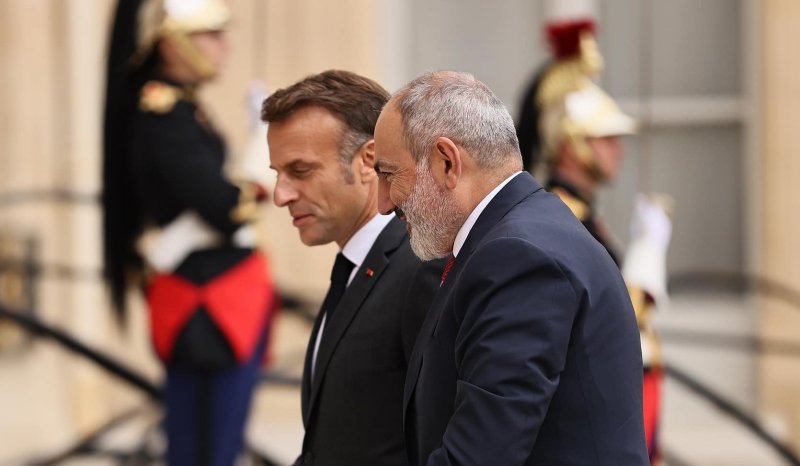
Against this backdrop, Armenia is becoming one of the few directions where Macron can still try to demonstrate France’s geopolitical relevance. If Paris manages to keep Armenia within the Western orbit and secure Pashinyan’s continued rule, this will be presented as a success of French foreign policy. In essence, France is trying to obtain a new zone of influence in Armenia — a political foothold in the South Caucasus.
Source: Public Radio of Armenia
That is why Pashinyan’s victory in the elections is extremely important for Macron. This is not only a matter of Armenian politics, but also a matter of the French president’s personal image as a geopolitical player. At a time when France is losing influence in Africa and facing internal and external crises, Armenia gives Paris an opportunity to demonstrate at least a local geopolitical victory.
It is no coincidence that, ahead of Armenia’s elections, contacts with European leaders have intensified, summits have taken place, and loud statements about the country’s European future have been made. All of this is aimed at showing Armenian society that Armenia will allegedly be better off with Europe than with Russia. In this process, Macron acts as one of the main advocates of the Western choice.
Yet beautiful words do not cancel out reality. Europe can promise Armenia political support, democratic prospects, and European solidarity. But when it comes to security, the economy, and the survival of the state, statements alone are not enough. Armenian society understands this, which is why serious distrust remains both inside the country and within the diaspora toward attempts to abruptly turn Armenia toward the West.
Thus, the struggle over Armenia’s foreign policy course today is not merely a dispute between supporters of Russia and supporters of the West. It is a struggle for the country’s strategic future. On one side stand Pashinyan, Western forces, and Macron, who are trying to anchor Armenia in the Western orbit. On the other side is a significant part of Armenian society and the diaspora, who are not convinced that this choice will bring the country security and stability.
The upcoming elections will show which path Armenia chooses. Will it finally break with Russia and become part of the Western project in the South Caucasus, or will Armenian society prefer a more cautious course that takes into account historical, economic, and political ties with Moscow? In any case, this will not be just an electoral choice. It will be a decision that will largely determine Armenia’s future.
(If you possess specialized knowledge and wish to contribute, please reach out to us at opinions@news.az).
此内容由惯性聚合(RSS阅读器)自动聚合整理,仅供阅读参考。 原文来自 — 版权归原作者所有。