






Will the war resume in the Middle East? This is the question many people ask themselves as they open the morning news.
Judging by the current situation, a full-scale war is unlikely in the immediate future. However, positional moves by the opposing sides will continue. Tensions in the region remain high, and the main theatre of activity has now firmly shifted to the Strait of Hormuz. This vital waterway has become the central arena of confrontation between Iran and the United States, and it appears that future developments will unfold precisely in this geography.
On Tuesday evening, CBS, citing US officials, reported an attack on the CGM San Antonio, a cargo vessel owned by a French company. According to the report, there were casualties.
A day earlier, Iran’s Islamic Revolutionary Guard Corps (IRGC) reportedly attacked a vessel linked to South Korea, South Korean news agency Yonhap reported, citing intelligence sources. The ship was struck while anchored in the Strait of Hormuz. On the same day, the UAE Foreign Ministry condemned what it described as an Iranian drone attack on a tanker belonging to the state-owned oil company ADNOC in the Strait of Hormuz.
There is little reason to expect de-escalation, especially after it became known that Iran has officially launched a new mechanism for managing maritime traffic through the Strait of Hormuz. According to Press TV, under the new system, all vessels intending to pass through the strait will receive an email from an official address setting out the rules and regulations for passage. Iran has required all foreign vessels to adjust their operations accordingly and obtain transit permission before crossing the Strait of Hormuz.
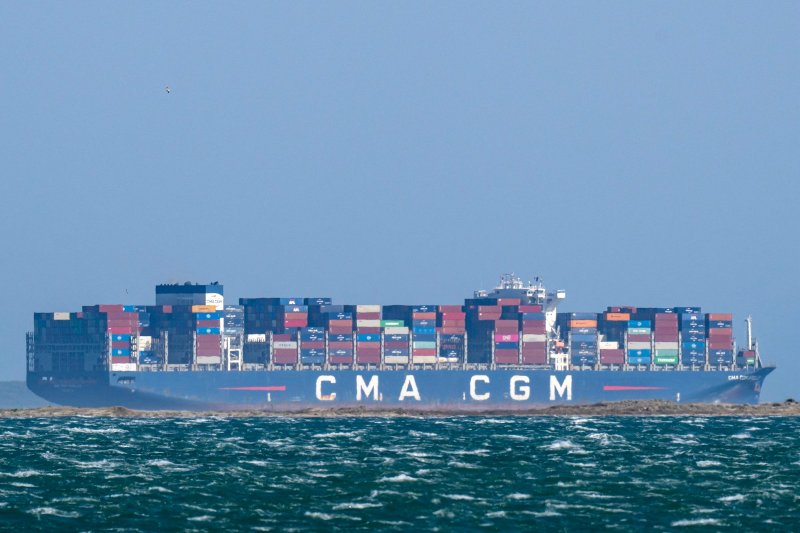
Photo: Getty Images
Against this backdrop, US President Donald Trump’s statement on postponing the operation to escort vessels stranded in the Persian Gulf appears to signal a retreat.
On Sunday, Washington announced it would begin a military operation on Monday named “Freedom.” Pentagon chief Pete Hegseth said at a press conference that Operation Freedom was not part of military operations against Iran and was “temporary in nature.” US Secretary of State Marco Rubio said at a White House briefing that Operation Epic Fury, which began in late February, had achieved its objectives and that Washington was moving to the next stage — namely the Freedom project, which, according to him, was purely defensive in nature. “There will be no shooting unless they shoot at us first,” Rubio said.

Photo: Getty Images
The first day of the operation was relatively successful: under the protection of the US military, a vessel owned by the Danish company Maersk and sailing under the American flag passed through the strait without incident. However, no increase in oil supplies was recorded during that period. Within 24 hours, the US side reported shelling of two IRGC boats, while the IRGC, as expected, claimed that small cargo vessels had been targeted and that its own boats remained intact and unharmed.
Already on Tuesday, it was announced that Freedom would be briefly suspended at the request of Pakistan and other countries. Donald Trump wrote on Truth Social that the decision had been made due to “huge military successes” and “significant progress” towards reaching a peace agreement with Iran. “As long as the blockade remains in force, Project Freedom will be suspended for a short period to see whether the agreement can be finalised and signed,” Trump wrote.
Iran’s reaction was immediate. Iranian state media quickly described Trump’s decision as a “retreat after a series of failures” in efforts to unblock the waterway vital to global shipping.
In any case, after Trump’s announcement suspending Freedom, oil prices edged slightly lower. The oil market reacts very quickly to developments in the Strait of Hormuz.
Global media reported that oil prices declined slightly in early Asian trading on Wednesday following Trump’s remarks. Brent crude fell by 1.7% to $108 per barrel, while WTI (US crude) dropped by 1.6% to $100.60.
For now, this decline looks modest, especially considering that only a couple of days earlier oil prices had surged by more than 6% amid fears of renewed hostilities in the Middle East. Since war has not broken out, prices have begun to ease gradually.
“The key question for oil traders is whether this will lead to real progress in restoring trade through the Strait of Hormuz. At the moment, there are virtually no signs of that,” investment strategist Charu Chanana told the BBC.
What stands out is that the United States is acting far more cautiously in the current confrontation than in many other Middle Eastern situations. This is unlikely to reflect US weakness or Iranian strength. Rather, the fact that the core confrontation is centred on one of the world’s most important maritime chokepoints is forcing Washington to proceed carefully to avoid paralysing global trade. A dramatic surge in oil prices is not in the interests of the United States, nor does Washington need a global crisis.
Iran, unlike the United States, has less to lose and may be prepared to go much further. Yet Tehran also appears to hope the issue can be resolved peacefully and on terms favourable to itself. While Washington announces and then postpones operations, schedules and then delays negotiations, Tehran is moving to secure as much space as possible ahead of a bargaining process that will sooner or later begin. By the time negotiations start, Iran’s establishment of its own regime in the Strait of Hormuz must appear not as a threat, but as a reality.
For its part, the United States is seeking to secure international measures regarding the Strait of Hormuz.
On 5 May, Washington submitted to the UN Security Council a draft resolution on protecting freedom of navigation in the Strait of Hormuz.
According to a statement by US Secretary of State Marco Rubio, distributed by the State Department press service, the United States is demanding that Iran stop attacks, mining activities and the collection of fees. As outlined in the statement, Washington expects Iranian authorities to disclose the number and locations of naval mines, assist in their removal and support the creation of a humanitarian corridor. The UAE, Bahrain, Saudi Arabia, Kuwait and Qatar are co-sponsors of the draft resolution.
By Samir Muradov
此内容由惯性聚合(RSS阅读器)自动聚合整理,仅供阅读参考。 原文来自 — 版权归原作者所有。