








Editor’s note: Zaur Nurmamedov is a journalist and a graduate of the Faculty of Political Science at the Academy of Public Administration under the President of the Republic of Azerbaijan (1993–1999). He previously served as first deputy editor-in-chief of the Vesti.Az news portal (2009–2023). The views expressed in this article are his own and do not necessarily reflect the position of News.Az.
Armenian Prime Minister Nikol Pashinyan’s announcement that the Akhalkalaki–Kars railway is now open for Armenian exports and imports is more than a technical update on regional transport. It is a political signal, an economic breakthrough for Armenia and another indication that the balance of power in the South Caucasus is being reshaped.
Pashinyan described the opening of the route as a major event in Armenia’s economic life. He thanked Türkiye and Georgia, emphasising that Armenia now has access to the Akhalkalaki–Kars railway, as well as Azerbaijan’s railway infrastructure, for import and export operations. In practical terms, this means that, for the first time in decades, Armenia is gaining a more stable railway connection to Türkiye through Georgian territory.
Türkiye’s special representative for the normalisation of relations with Armenia, Serdar Kılıç, also presented the development as a new step towards direct trade between Ankara and Yerevan. His statement was significant not only because it confirmed Turkish political support for the process, but also because it linked the opening of the route to a broader regional framework involving Türkiye, Armenia, Azerbaijan and Georgia.
This is precisely why the development should not be viewed solely through the lens of logistics. The opening of the Akhalkalaki–Kars route for Armenian cargo is a visible part of a much broader geopolitical transformation. It reflects the emergence of a new transport architecture in the South Caucasus, in which Türkiye, Azerbaijan, Georgia and Western actors are playing an increasingly decisive role, while Russia and Iran risk being pushed to the margins of regional connectivity.
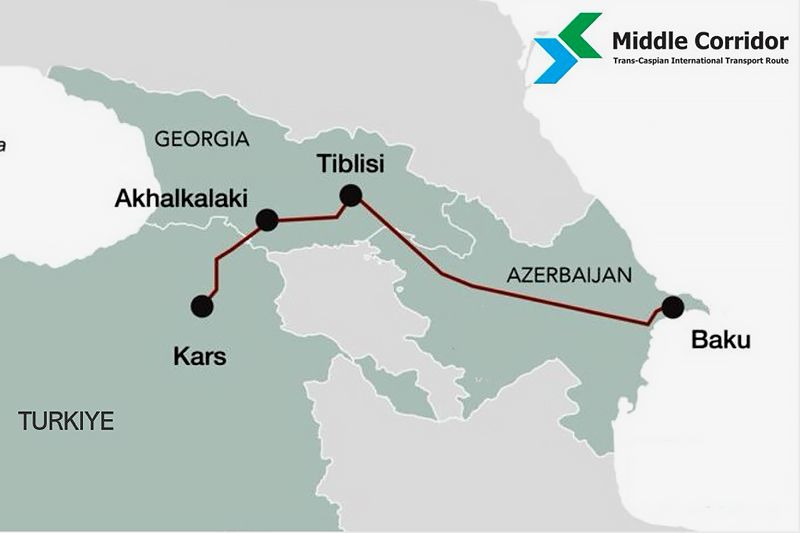
Photo: Getty Images
For Armenia, the decision is potentially historic. The country has long suffered from limited transport options and a sense of economic isolation. Access to Türkiye through Georgia gives Yerevan a route to a market of around 85 million people and, through Türkiye, a gateway to Europe and wider global trade networks. It also reduces Armenia’s dependence on narrow and politically vulnerable routes through Iran and Georgia.
The timing is also important. Although Yerevan and Ankara have been engaged in normalisation talks for some time, the process appears to have gained real momentum after the Washington meeting on 8 August 2025. The opening of the route can be seen as one of the first tangible results of that diplomatic process. It is also a visible political success for Pashinyan ahead of parliamentary elections scheduled for 7 June. Opening a major transport route just two weeks before the vote is not only economically significant, but also politically well-timed.
Georgia is another clear beneficiary. For Tbilisi, the route means additional cargo flows through Akhalkalaki and a stronger role as an indispensable transit hub. Georgia is no longer merely a key link in the Baku–Tbilisi–Kars railway. It is also becoming a more important corridor for Armenian goods moving towards Türkiye and Europe. This gives Tbilisi new leverage in regional diplomacy and strengthens its value in strategic discussions with the United States and European partners.
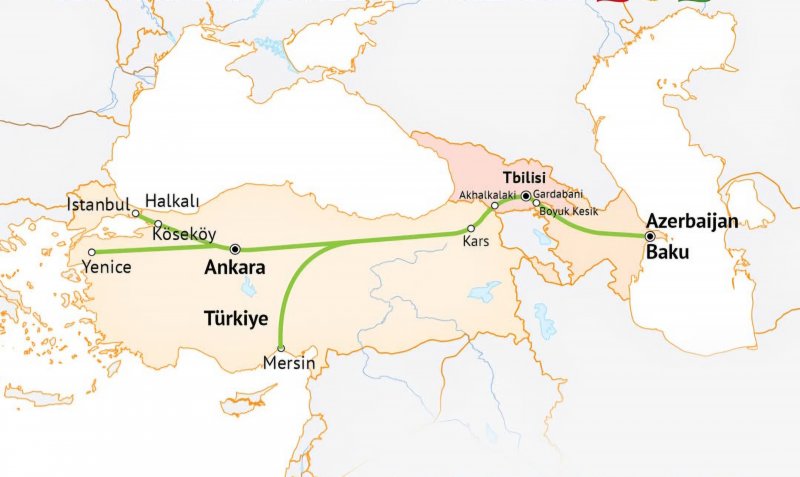
Photo: Getty Images
The broader context makes the development even more significant. The war between Russia and Ukraine has already transformed Eurasian logistics. As routes through Russia have become more politically risky and commercially complicated, many logistics companies have shifted towards the Middle Corridor. The Baku–Tbilisi–Kars railway has benefited from this trend. Now, with the Akhalkalaki–Kars route becoming available for Armenian cargo, Russia’s transit role in the South Caucasus is being weakened even further.
This is where the Abkhazian railway issue becomes especially relevant. For years, one of the main arguments in favour of reopening the railway through Abkhazia was Armenia’s transport isolation. Supporters of the idea argued that Armenia needed such a route to overcome its limited access to regional markets. However, the opening of Akhalkalaki–Kars seriously undermines that argument.
Georgia has always approached the Abkhazian railway with caution, and for understandable reasons. Reopening the route through occupied Abkhazia would create a dangerous political trap for Tbilisi. It could force Georgia, at least in technical and customs terms, to treat the occupation line as a kind of “state” border. For Georgia, this would be unacceptable without the restoration of territorial integrity and de-occupation.
Russia has recently returned to the idea of restoring railway communication with Georgia through Abkhazia, largely because Moscow sees the new regional transport projects as a threat to its influence. Russian Deputy Prime Minister Alexei Overchuk has spoken about the possibility of restoring such a connection. In reality, however, this scenario remains highly unlikely. It would require an end to the war in Ukraine, the lifting of Western sanctions, serious normalisation of Russian-Georgian relations and, most improbably, a political settlement of Abkhazia’s status.
The opening of the Akhalkalaki–Kars route makes the Abkhazian railway even less urgent for all sides except Russia. It deals a double blow to Moscow’s argument. First, it removes the claim that Armenia has no viable alternative. Second, it provides Georgia, Armenia and Azerbaijan with functioning routes that do not depend on Russia. Armenia is now connected to Western markets through Georgia and Türkiye — without Russian participation.
This changes the negotiating balance. If Russia continues to promote the Abkhazian railway as its last instrument for preserving a transit role in the South Caucasus, it will do so from a weaker position. Georgia has no reason to rush into politically risky concessions. Alternative routes are already emerging, and any step towards reopening the Abkhazian railway without strong political guarantees would be seen in Tbilisi as a dangerous indirect concession to Russian occupation.
There is also another important dimension. The opening of the Akhalkalaki–Kars route can be interpreted as the practical launch of the western end of the TRIPP project, even before the eastern section through Syunik is completed. Once the western entry point is opened, political and logistical pressure naturally increases for completion of the eastern exit — the corridor through Syunik.
This is why the development strengthens Pashinyan’s position not only economically, but also politically. If Armenia wants a full peace treaty with Azerbaijan and the complete launch of the new transport architecture, it will eventually need to address sensitive domestic political and constitutional issues. In that sense, the railway opening gives Pashinyan a concrete success that he can present to Armenian society: normalisation is not just a diplomatic slogan, but a path towards trade, markets and connectivity.
The opening of Akhalkalaki–Kars is therefore not merely about trains, cargo or customs procedures. It is about the future direction of the South Caucasus. The region is moving towards a new model of connectivity built around Türkiye, Azerbaijan, Georgia and Western-backed transport initiatives. Russia’s ability to dominate regional routes is shrinking, while Iran’s role is also becoming less central.
For Armenia, this is a chance to move from isolation towards integration. For Georgia, it is an opportunity to strengthen its transit status. For Azerbaijan and Türkiye, it confirms the strategic importance of the transport networks they have spent years developing. For the United States and the West, it is a visible result of efforts to support alternative corridors in Eurasia.
The real question now is whether this momentum will continue. If the western section of the new transport logic is already moving, the next decisive issue will be the eastern connection through Syunik and the broader political settlement between Armenia and Azerbaijan. The opening of Akhalkalaki–Kars shows that the South Caucasus is entering a new stage. The old routes of dependence are losing relevance, and a new geopolitical map is being drawn — one railway line at a time.
(If you possess specialized knowledge and wish to contribute, please reach out to us at opinions@news.az).
此内容由惯性聚合(RSS阅读器)自动聚合整理,仅供阅读参考。 原文来自 — 版权归原作者所有。