





Editor’s note: Abulfaz Babazadeh is a scientist, a scholar of Japanese studies, a political observer, and a member of the Union of Journalists of Azerbaijan. The views expressed in this article are the author’s own and do not necessarily reflect those of News.Az.
In the 21st century, a city is no longer merely the sum of its buildings, roads, squares, and utility networks. It has become a political organism, an economic accelerator, a space of human dignity, and a major test for the state. That is why WUF13, held in Baku with significant international resonance, proved to be an event of far greater scale than just another international forum on urban planning. It was a test of the modern world’s ability to speak about the future in the language of practical solutions, sustainable infrastructure, the safe return of people to their ancestral lands, green transformation, and responsible reconstruction.
Baku hosted WUF13 under the theme “Housing the World: Safe and Resilient Cities and Communities,” placing housing, security, resilience, and urban inclusiveness at the center of the global debate. According to the forum’s official platforms, WUF13, held in Baku on 17–22 May 2026, brought together a record number of participants: more than 58,000 people from 176 countries, making it the largest session of the World Urban Forum in its history.
The main lesson from Baku is that a city of the future cannot be built solely with concrete, glass, and digital platforms. It must be built on trust. Where there is trust, investment follows, and where investment comes, infrastructure emerges. That is precisely where people return. And where people return, genuine recovery begins.
Photo: UN Climate Promise
This matters because international politics has long had too many halls, speeches, and final communiqués quietly gathering dust in archives. The value of WUF13 in Baku lies elsewhere: the forum offered the world a practical transition from discussing problems to designing solutions.
That is why the first-ever Leaders’ Statements Session in the history of the World Urban Forum, held at the initiative of Azerbaijani President Ilham Aliyev, became a political innovation. The participation of 27 heads of state and government took WUF13 beyond the boundaries of a professional urban planning discussion and turned it into a platform for high-level strategic dialogue.
It was a precise political move. Today, cities are on the front line of all global crises, including climate, migration, housing, infrastructure, social, and humanitarian challenges. If global politics once began with borders, armies, and resources, it now increasingly begins with a different question: where and how will people live?
The first lesson: the city as a matter of security
The modern city is vulnerable. It suffers from wars, climate disasters, chaotic migration, housing shortages, pressure on transport systems, energy risks, and social fragmentation. Therefore, urban security can no longer be understood narrowly as the presence of police, surveillance cameras, and control systems. Urban security means clean air, affordable housing, safe drinking water, transport connectivity, digital resilience, an inclusive environment, preparedness for emergencies, and the ability to recover quickly after a crisis.
The Baku forum placed this issue at the centre of the agenda. The Baku Call to Action, adopted following WUF13, linked the global housing crisis to the need for a more coordinated approach to infrastructure, transport, social policy, environmental protection, and economic development.
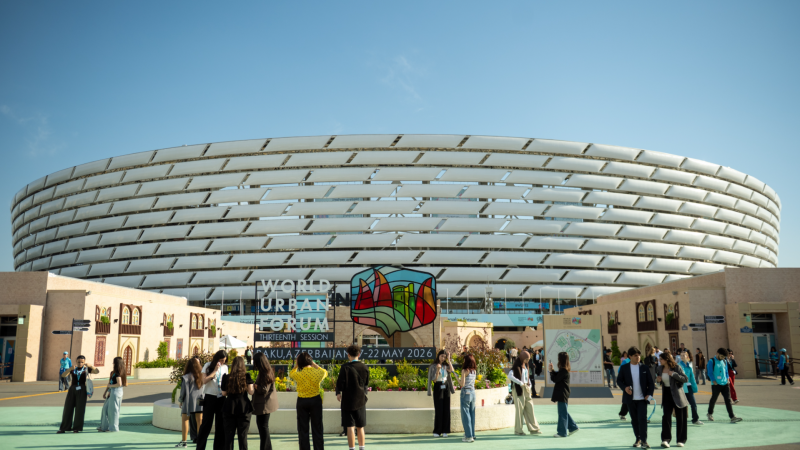
Photo: Azernews
This is the new meaning of urban planning: building a city means managing future risks. Poor urban planning creates social time bombs. Good urban planning reduces the likelihood of crises before they even appear on news screens.
The second lesson: post-war reconstruction must begin with people
At WUF13, Azerbaijan presented an experience whose significance extends far beyond the region. This concerns the restoration of the liberated territories, the return of former internally displaced persons, the reconstruction of destroyed towns and villages, the creation of new infrastructure, the application of “smart city” and “smart village” concepts, and the integration of demining into the urban planning process.
This is the experience of a country that has faced urbicide, culturicide, ecocide, and the need to rebuild and develop entire territories from the ground up. Within WUF13, separate discussions were devoted to post-conflict urban reconstruction, humanitarian demining, sustainable resettlement, and the restoration of the districts of Aghdam, Fuzuli, Khojavend, Jabrayil, Gubadli, and Zangilan. Official WUF13 materials note that since 2020 Azerbaijan has carried out large-scale humanitarian demining operations, clearing more than 270,000 hectares of land and neutralising over 250,000 mines and explosive remnants of war.
Here, Baku’s lesson for the world is absolutely clear: the return of people cannot be measured solely by the number of houses built. Safe return requires roads, schools, hospitals, jobs, energy, water, communications, public spaces, ecology, memory, and trust. A house without a surrounding environment becomes a box. An environment without people becomes decoration. Sustainable recovery begins where the state sees the displaced person as a citizen returning to his or her history.
The third lesson: the city of the future must breathe
One of the strongest conceptual themes of WUF13 was the link between urbanisation and the environment. The initiative by Leyla Aliyeva and IDEA on air quality and green infrastructure brought to the forefront a simple but often underestimated truth: a city where people cannot breathe cannot be considered modern.
The “Baku Call for Breathing Cities” should be seen as one of the forum’s most practical humanitarian messages. Clean air is already a matter of health, productivity, demography, urban justice, and economic competitiveness.
The future will belong to those cities that understand earlier than others that green infrastructure is as strategic as roads, power grids, and water supply systems. A tree in a city is, in a sense, an air conditioner, a filter, psychological therapy, protection from heat, and a contribution to public health. Sometimes the smartest urban solution looks like a properly planted alley.
The fourth lesson: the global agenda needs operational standards
One of the most important outcomes of WUF13 was the signing of a Letter of Intent between Azerbaijan’s State Committee on Urban Planning and Architecture and UN-Habitat on the joint development of an operational guide for future sessions of the World Urban Forum.
This may be one of the forum’s most underestimated outcomes. Many countries know how to host major events. But not every country is able to turn its organisational experience into an international standard.
This is how the Baku model emerges: not simply to host a forum, but to leave behind a methodology, create a governance framework, and offer future host countries a clear system for organisation, logistics, substantive agenda-setting, and institutional legacy.
In global diplomacy, this is called the transition from an event to a standard. And a standard lives longer than any forum.
The fifth lesson: the city must be inclusive
WUF13 addressed housing, women, youth, Indigenous peoples, vulnerable groups, community rights, and social resilience. This reflects the maturity of the modern urban agenda. A city cannot be considered successful if it is convenient only for investors, tourists, and cars. A successful city is convenient for a child, an elderly person, a woman, a person with disabilities, an internally displaced person, a student, a worker, an entrepreneur, an artist, and a family returning to normal life after upheaval.
Official WUF13 materials emphasise that the forum became a platform for discussing women’s rights to housing and land, a safe urban environment, women’s participation in planning and decision-making, as well as issues of cultural memory and the identity of Indigenous peoples.
This is an important signal: the future of the city is decided where society’s voice is heard. Without people’s participation, urban planning turns into a dictatorship of blueprints. With people’s participation, it becomes a social contract.
The sixth lesson: Baku connected heritage and modernisation
At WUF13, Azerbaijan also presented its own urban philosophy: development without abandoning memory. For Baku, this is especially natural. The city where Icherisheher stands alongside modern architecture, where the Caspian Boulevard has become a space of public life, and where new urban solutions seek to combine functionality, aesthetics, and symbolism, is itself an argument.
There are cities in the world that modernise by destroying their memory. There are cities that preserve the past and fear the future. Baku is trying to follow a third path: turning heritage into a resource for development and modernisation into a continuation of historical identity.
This is especially important for the liberated territories. Reconstruction there must not become a mechanical copying of standard urban templates. It must restore life while also respecting the memory of place. A city that has survived destruction needs moral rehabilitation.
The seventh lesson: Azerbaijan offers the world a model of “return as development”
The Great Return programme has significance that goes beyond national borders. Across the world, the number of people forced to leave their homes because of wars, conflicts, climate disasters, and economic shocks is growing. That is why the issue of return is becoming one of the key themes of the 21st century.
The Baku experience shows that return must be safe, dignified, technological, economically meaningful, and environmentally responsible. People cannot be returned to emptiness, danger, and infrastructural poverty. Return must mean the beginning of a new life, not a repetition of old trauma.
That is why the integration of smart solutions, green energy, digital governance, social infrastructure, and sustainable planning into the reconstruction of the liberated territories looks like material for international study. It could become a model for other post-conflict regions of the world, provided that the approach is systematically described, opened for analysis, and incorporated into global practice.
(If you possess specialized knowledge and wish to contribute, please reach out to us at opinions@news.az).
此内容由惯性聚合(RSS阅读器)自动聚合整理,仅供阅读参考。 原文来自 — 版权归原作者所有。