






As the Middle Corridor gains strategic importance across Eurasia, experts are increasingly debating its geopolitical implications. In this interview, we examine Kazakhstan–Azerbaijan cooperation, regional connectivity, and the future of Eurasian trade routes.
News.Az spoke with Dosym Satpayev, PhD, director of the Risk Assessment Group, an Almaty-based consulting organisation.
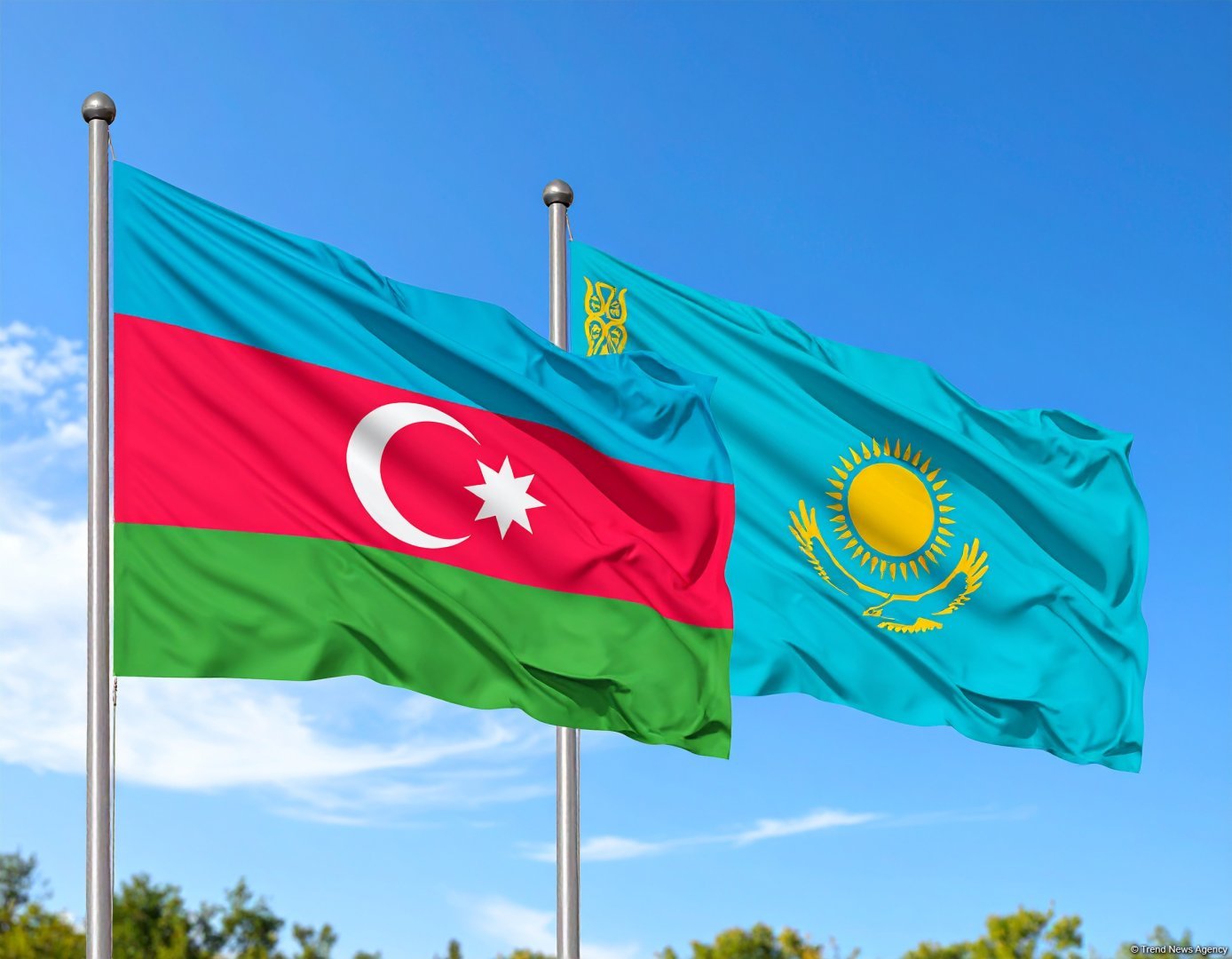
– Mr Satpayev, does the rapid expansion of cooperation between Kazakhstan and Azerbaijan within the Middle Corridor indicate the emergence of a new geopolitical reality in Eurasia?
– The new geopolitical reality in Eurasia is closely linked to several global trends which, on the one hand, undermine predictability as a strategic resource and increase the number of so-called “black swan” events, but on the other hand create new windows of opportunity.
Source: Trend
Among these trends are the fragmentation of the world order, the decline of the post-Cold War global system, and the strengthening of regional blocs. The world is becoming increasingly multipolar, partly due to closer cooperation among states that now have an opportunity to move beyond the semi-periphery of the global economy.
Therefore, cooperation between Azerbaijan and Kazakhstan within the framework of the Middle Corridor confirms the emergence of a new geopolitical reality. Moreover, recent developments in relation to the Strait of Hormuz have highlighted the vulnerability of maritime transport routes, which is likely to further increase international interest in the Trans-Caspian International Transport Route. This, in turn, could strengthen Kazakhstan’s and Azerbaijan’s positions as major transit hubs connecting Asia and Europe.
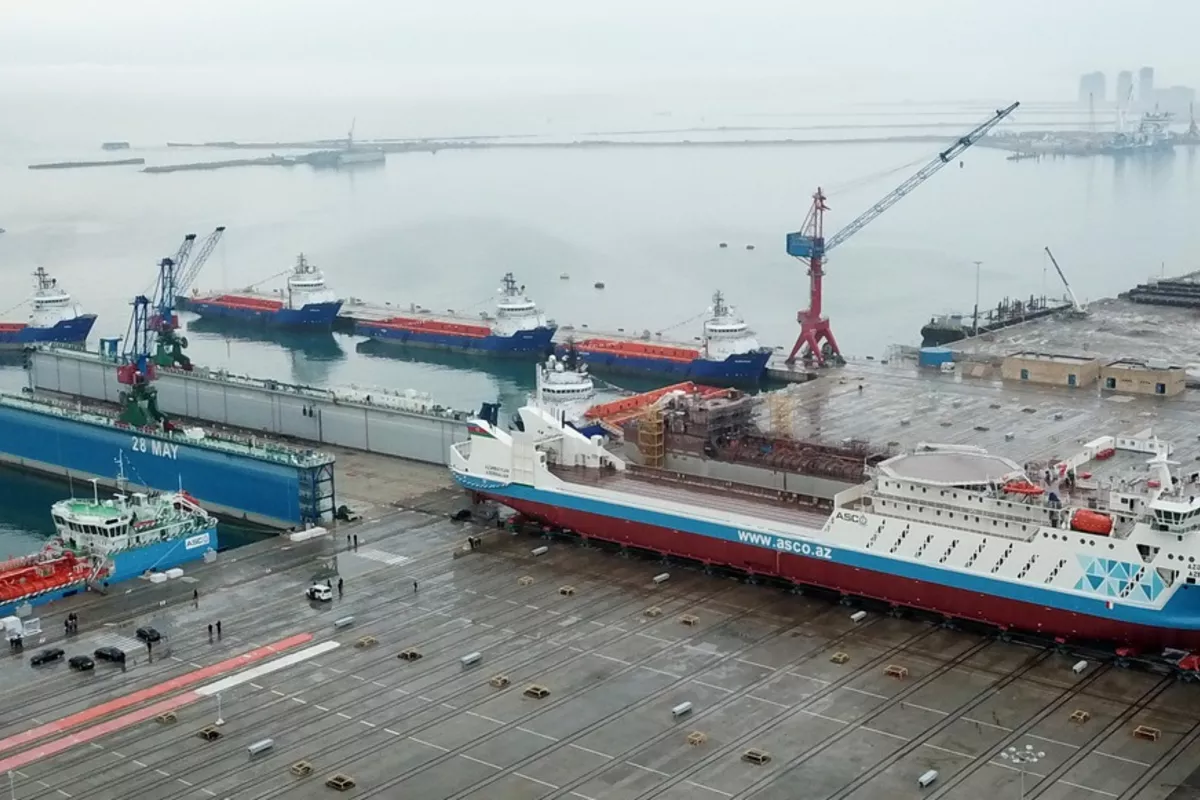
– Can the launch of construction of Kazakhstan’s first container vessel at the Baku Shipyard be viewed as evidence that the Middle Corridor is becoming a long-term strategic project?
– I believe it can. When states begin investing not only in infrastructure but also in their own transport fleets, it signals a transition from declarations and intentions to institutional development.
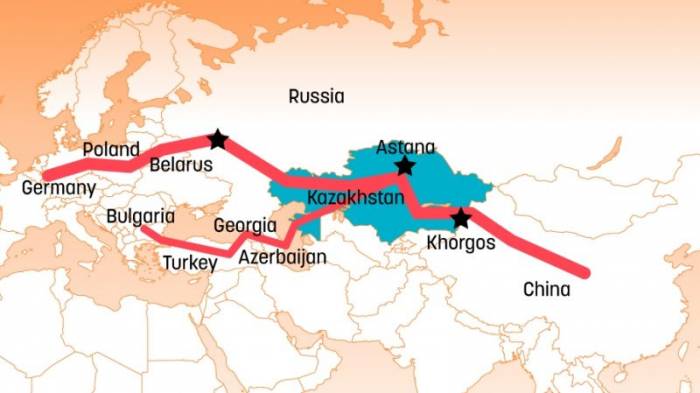
Currently, more than 80% of overland transit traffic along the China–Europe corridor passes through Kazakhstan. The country aims to attract approximately $20 billion in investment into the Trans-Caspian International Transport Route and increase cargo traffic to 500,000 containers annually by 2030.
Source: APA
However, achieving these goals requires addressing several bottlenecks. The key distinction between the Middle Corridor and most land-based routes is the need to cross the Caspian Sea, which presents specific challenges for Kazakhstan.
First, there is a shortage of ferries.
Second, Caspian ports have limited handling capacity.
Third, the declining water level of the Caspian Sea creates additional operational difficulties.
Any delay in the Caspian segment can disrupt the entire supply chain.
Against this backdrop, the construction of a container vessel demonstrates several important developments. Kazakhstan is clearly anticipating sustained growth in cargo traffic across the Caspian Sea, while Azerbaijan is further consolidating its role as the Caspian region’s primary maritime and logistics hub.
At the same time, a unified transport ecosystem is emerging, with participating countries investing in complementary infrastructure and capabilities.
Projects of this nature are typically designed with a planning horizon of 20 to 30 years, which makes them a clear indicator of long-term strategic vision.
– Does stronger coordination between Astana and Baku contribute not only to economic development but also to the expansion of political influence?
– Absolutely. At present, only two regions in the post-Soviet space have seen their geopolitical and geoeconomic importance increase since the outbreak of the war in Ukraine: Central Asia and the South Caucasus, where Azerbaijan has emerged as the leading regional actor.
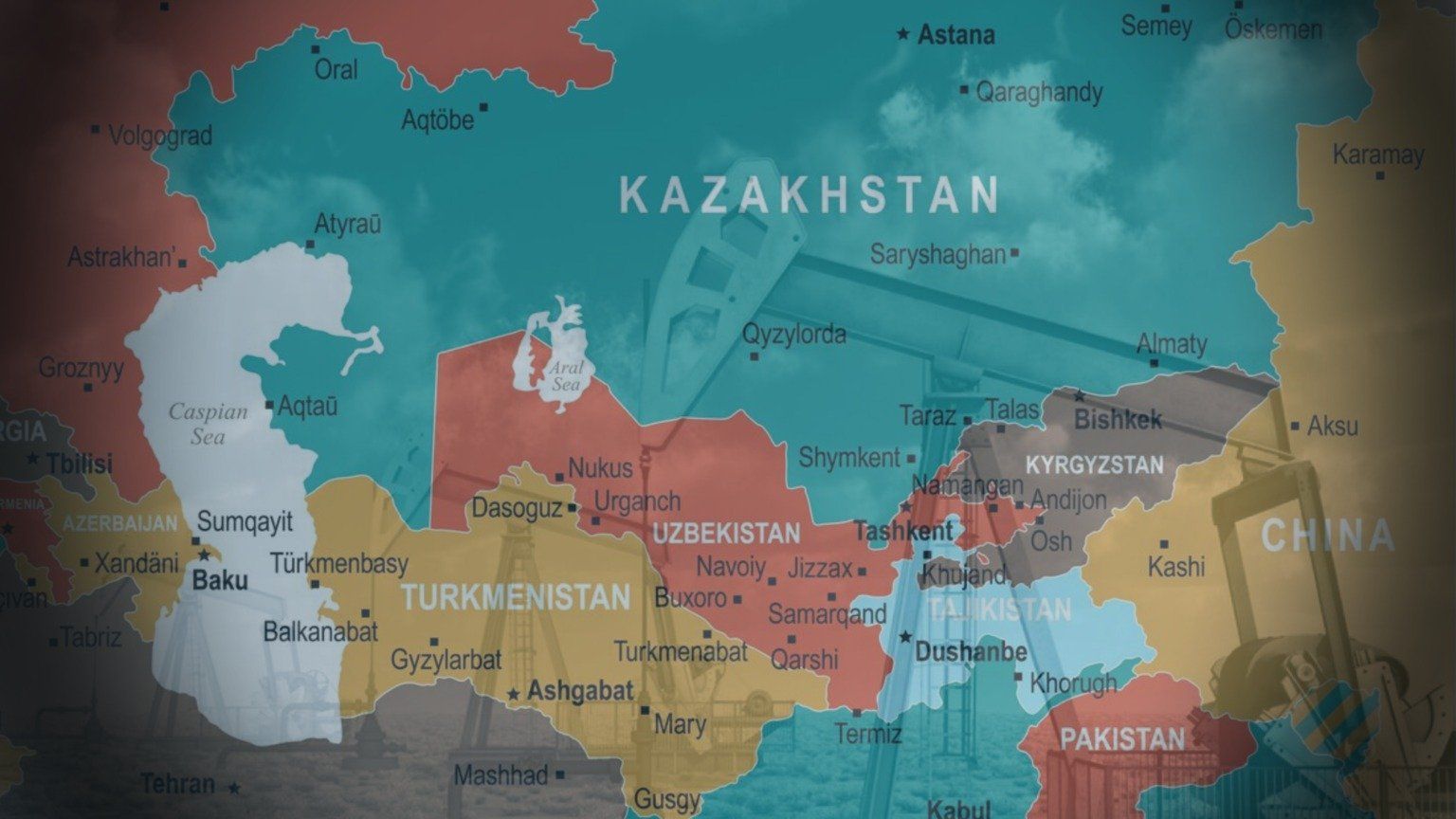
Today, nearly all major geopolitical players, except Russia, have a strong interest in developing the Trans-Caspian International Transport Route.
Source: Trend
For the United States, the route is important not only as a means of securing access to rare earth elements and critical raw materials, but also as a stable land-based logistics network for their transportation.
Europe’s primary objective is to establish transport and energy corridors that bypass Russia, including through initiatives such as Global Gateway.
For Türkiye, expanding transport opportunities through the Trans-Caspian Corridor is a strategic priority.
Importantly, Türkiye’s interests in this area align closely with those of Central Asian states, the European Union, China, and the United States.
Historically, transport corridors generate not only economic power but also political influence. Control over transport flows enables countries to shape regional agendas, act as intermediaries between major powers, attract investment, and enhance their international standing.
As the importance of the Middle Corridor continues to grow, Kazakhstan and Azerbaijan may become key intermediaries linking Europe and Central Asia, China and Europe, as well as Türkiye and Central Asia.
This will inevitably increase the geopolitical weight of both countries.
– Is the development of the Middle Corridor changing the regional balance of power by creating an alternative to Russia’s traditional transit advantage?
– For the past two centuries, the principal transport and geopolitical axes of Eurasia have largely passed either through Russian territory or via maritime routes.
The development of the Trans-Caspian International Transport Route is creating a third alternative, connecting China, Central Asia, the Caspian Sea, the South Caucasus, and Europe.
Source: TASS
For Kazakhstan and Azerbaijan, this represents a transition toward becoming key transit hubs within Eurasia.
Of course, the Middle Corridor is not yet capable of fully replacing Russian routes.
However, its most important function today is diversification.
In an era of geopolitical uncertainty, many governments and businesses consider it essential to have multiple transportation options.
No one wants to keep all their eggs in one basket.
That is precisely why the Middle Corridor is becoming increasingly important — not because it replaces existing routes, but because it reduces dependence on any single route.
– Could cooperation between Azerbaijan, Kazakhstan, and Türkiye create the conditions for the emergence of a unified geo-economic space across the Turkic world?
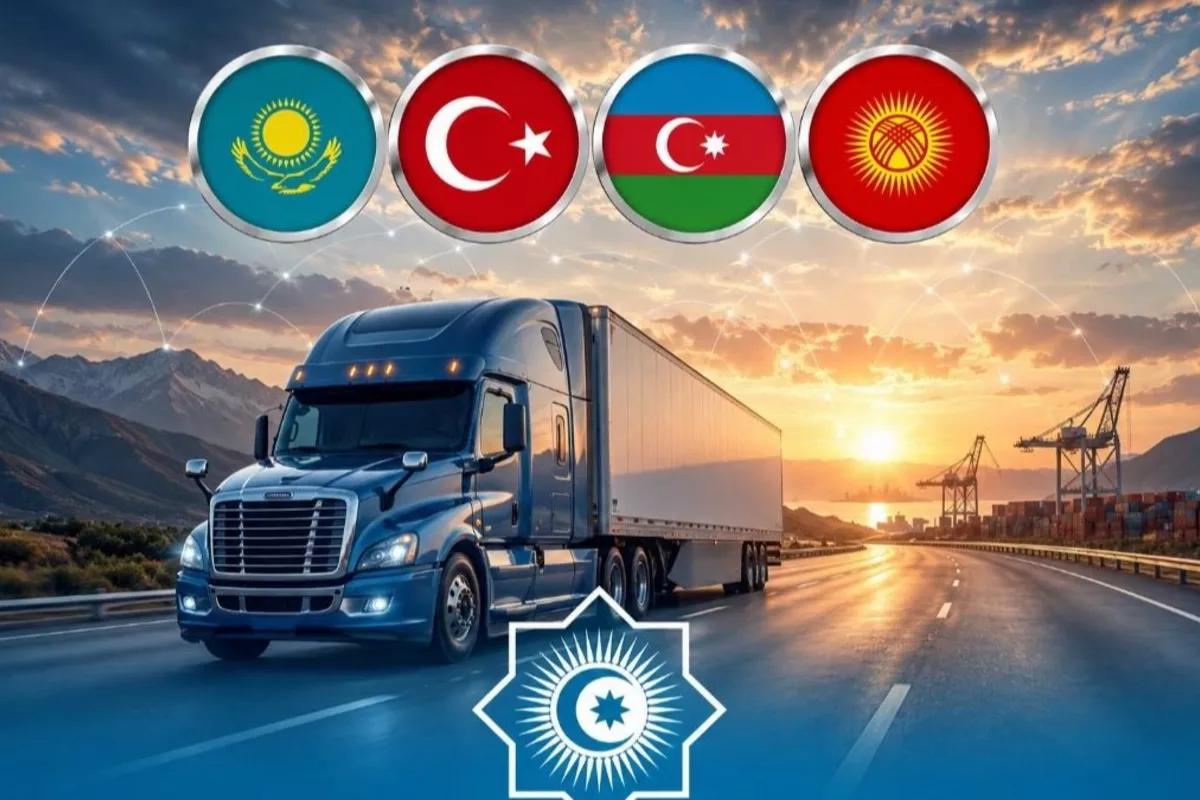
– Kazakhstan and Azerbaijan are members of the Organization of Turkic States (OTS), which has effectively become a significant geopolitical counterbalance to larger powers such as Russia, China, and the United States.
Today, the combined population of OTS member states exceeds 170 million people, providing a substantial foundation for economic integration and cooperation.
Source: Trend
The creation of the OTS Development Bank and the Turkic Investment Fund, with initial capital reaching up to $500 million, has been actively supported by Kazakhstan, Türkiye, Azerbaijan, Kyrgyzstan, and Uzbekistan.
The development of the Middle Corridor is also one of the key pillars strengthening economic cooperation within the organisation.
Moreover, cooperation is expanding beyond transport.
In the defence sector, Kazakhstan and Türkiye have signed agreements on the production of Turkish military drones.
In telecommunications, Azerbaijan and Kazakhstan are implementing a project to lay a submarine fibre-optic cable along the Aktau–Sumgayit route.
At the same time, Kazakhstan, Uzbekistan, and Azerbaijan have signed an agreement on the Green Corridor initiative, which aims to facilitate the export of green energy to the European Union.
Taken together, these developments demonstrate that cooperation among Turkic states is evolving into a multidimensional partnership encompassing transport, energy, digital connectivity, and security.
– How realistic is the scenario in which the key geopolitical axis of Eurasia over the next decade is formed not around the Moscow–Beijing line, but around the Baku–Astana–Ankara axis?
– Rather than replacing one axis with another, it is more accurate to speak of the diversification of geopolitical centres of gravity.
For example, it is not in Central Asia’s interest to be dominated by a single external power, as such dominance would undermine the region’s multi-vector foreign policy approach.
Today, Central Asian states seek to benefit from global competition without becoming directly involved in it.
However, this geopolitical balance remains fragile because many traditional pillars of stability are becoming increasingly unreliable.
Source: AA
Russia is deeply engaged in a prolonged war.
The United States has become less predictable.
Europe is facing internal challenges and relative decline.
China increasingly transforms partnerships into relationships of dependency.
At the same time, the region is surrounded by countries subject to Western sanctions, including Russia, Iran, and Afghanistan.
China and the United States remain locked in a state of frozen confrontation.
Against this backdrop, the Turkic partnership appears comparatively durable because it is not built around imperial ambitions, unlike some other integration projects.
Naturally, geography requires Kazakhstan and other Central Asian countries to take both Russian and Chinese interests into account.
However, as noted earlier, the more geopolitical counterbalances the region possesses, the better.
This means Eurasia is gradually moving away from a single dominant axis.
Instead, several centres of influence are emerging simultaneously, including China, the Organization of Turkic States, the Gulf states, and the European Union.
In such a multipolar Eurasia, the Baku–Astana–Ankara axis has the potential to become one of the most dynamic geo-economic axes of the 21st century.
If current trends continue, Kazakhstan and Azerbaijan may transform by the mid-2030s from transit territories into independent centres of power capable of influencing the flow of trade between East and West.
Such a transformation would likely represent one of the most significant geopolitical developments in the post-Soviet space in recent decades.
此内容由惯性聚合(RSS阅读器)自动聚合整理,仅供阅读参考。 原文来自 — 版权归原作者所有。