



惯性聚合 高效追踪和阅读你感兴趣的博客、新闻、科技资讯
阅读原文 在惯性聚合中打开

推荐订阅源

K
Kaspersky official blog
Engineering at Meta
Engineering at Meta
D
DataBreaches.Net
Stack Overflow Blog
Stack Overflow Blog
Microsoft Security Blog
Y
Y Combinator Blog
B
Blog RSS Feed
GbyAI
GbyAI
P
Proofpoint News Feed
aimingoo的专栏
aimingoo的专栏
MyScale Blog
MyScale Blog
D
Docker
阮一峰的网络日志
阮一峰的网络日志
Cyber Security Advisories - MS-ISAC
Recorded Future
Recorded Future
美团技术团队
The Register - Security
V
Visual Studio Blog
H
Hackread – Cybersecurity News, Data Breaches, AI and More
T
Tailwind CSS Blog
爱范儿
爱范儿
freeCodeCamp Programming Tutorials: Python, JavaScript, Git & More
T
The Blog of Author Tim Ferriss
博客园 - 司徒正美
量子位
B
Blog
F
Fortinet All Blogs
Martin Fowler
Martin Fowler
博客园 - 【当耐特】
MongoDB | Blog
MongoDB | Blog
A
About on SuperTechFans
I
InfoQ
钛媒体:引领未来商业与生活新知
钛媒体:引领未来商业与生活新知
有赞技术团队
有赞技术团队
雷峰网
雷峰网
大猫的无限游戏
大猫的无限游戏
J
Java Code Geeks
L
LangChain Blog
Latest news
Latest news
S
SegmentFault 最新的问题
Exploit-DB.com RSS Feed
Blog — PlanetScale
Blog — PlanetScale
Threat Intelligence Blog | Flashpoint
Cisco Talos Blog
Cisco Talos Blog
F
Full Disclosure
C
Cisco Blogs
D
Darknet – Hacking Tools, Hacker News & Cyber Security
W
WeLiveSecurity
T
Tenable Blog
T
Tor Project blog

PYMNTS.com

Crypto Payments Are Back. Will Merchants Actually Care This Time? Labor Department Proposes Unified Joint Employer Standard B2B’s New Battlefield Is Everything Before the Button Amazon Targets the GLP-1 Gap Big Pharma Left Open LendingClub Signals Expanded Capabilities With Happen Bank Rebrand Congress Moves to Give FinTechs Direct Fed Payment Access Microsoft Tests Mythos to Identify and Mitigate Vulnerabilities United Airlines Hikes Fares as Fuel Costs Surge OpenAI Images 2.0 Is a Real Leap With a Real Price Tag Morgan Stanley Says Gaming Could Score $22 Billion With AI FTC Shuts Down Alleged Healthcare Fraud Scheme Sam’s Club Offers eCommerce Shoppers Hour-or-Less Deliveries FinTechs Cut Staff as AI and Margins Redefine Growth JPMorganChase Extends Critical Industries Investment Program to Continental Europe OpenAI Lands $75 Million Investment From Robinhood Ventures House Bill Would Reduce Small Lenders’ Reporting Requirements Coinbase Lists tGBP to Expand Locally-Denominated Stablecoin Access BNY Names New Head for Payments/Trade Client Platform KnowBe4 Automates Global Cash Flow Via Flywire Partnership Treasury Calls for Programmable Financial Enforcement Across Crypto DeepSeek Seeks $20 Billion Valuation as Tech Giants Weigh Investment Google Accelerates Agentic AI Shift With New Enterprise Platform OpenAI Begins Briefing Governments on Cybersecurity Capabilities DeFi Security Suffers New Blow With $3 Million Volo Exploit Uninvited Users Access Anthropic’s Mythos AI Model Block and Uber Expand Partnership Across Several Global Markets OpenAI Pledges $1.5 Billion to PE Enterprise AI Project Podcast: Inside the $9 Billion DeFi Hack That’s Shaking Crypto’s Foundations Synchrony CFO Flags Momentum in Spending and Credit Banks Risk Slowing the Emerging Middle Market Firms Driving Growth Paysafe Expands Digital Wallet Availability Across 18 European Markets Bad Data Can Break Good AI in Payments 50% More Digital Shopping Days Put Parents at the Center of Retail’s Shift 65% Call Insurance Essential. Why Most Spending Isn’t So Clear-Cut Amazon Recasts Marketplace Fraud as a Broader Trust Problem Capital One’s Q1 Shifts Attention From Spending to Strategy Lawmakers Question JetBlue About Surveillance Pricing Allegations Payments Modernization Is Insurance’s Next Big Margin Engine How Visa Is Rewiring Bank Infrastructure for the AI Era Instant Payments Grow but the Real Barrier Is Human The Old-School Card Product Banks May Need Most 43% of SMBs Would Pay to Make Purchases in Installments The Real AI Edge in Payments Comes From Better Judgment In the Age of Agentic AI, Data Control Is Power Verizon’s Dan Schulman Tells CEOs to Be Open About AI Job Cuts Walmart Eyes Stores as Warehouse Space for Same-Day Delivery France’s CB Payments Network Aims to Take on Visa/Mastercard in EU QVC Was TikTok Shop Before TikTok Shop Loop Raises $95 Million to Bridge Supply Chain Data Gap Cursor Eyes $50 Billion Valuation as AI Coding Demand Surges Commercial Lending Rescues Regional Banks From Consumer Slowdown Anthropic and White House Aim to Make Peace in Friday Meeting Home Depot Buys SIMPL Automation to Support Same-Day Delivery The Riskiest Words in B2B: This Is How We’ve Always Done It France Urges Euro Stablecoins to Break Dollar Dependency Importers Prep for Monday Opening of Tariff Refund Portal Permitting Hurdles and Labor Shortages Threaten AI Data Center Timelines Token Freezes Force CFOs to Rethink Stablecoin Risk X Money Tests Whether Social Commerce Can Hold Consumer Deposits Anthropic Briefs EU Regulators on Mythos Cybersecurity Concerns Welcome to Vibe Ordering, ChatGPT Is Taking Your Order Now Nvidia Says AI Can Finally Make Quantum Computing Work QVC Files Chapter 11 to Slash Debt and Pursue Growth Uber Eats Lets Customers Return Their Retail Purchases Financial Officials Sound Alarm About Anthropic’s Banking Risk 71% of Billion-Dollar Firms Face Agent Identity Threats What If Clearing Had Its Stripe Moment? OpenAI Targets Pharma Giants With Purpose-Built AI Model California Claims Amazon Punishes Sellers for Lower Prices on Other Sites CFTC Chairman Says AI Helps Agency Run More Like a Business Global Finance Chiefs Call for Mythos Information Sharing Big Bank Earnings Show Digital Activity Drives Deposits OCC Clears JPMorgan Chase After Trade Surveillance Program Upgrade Accounts Receivable Gets an AI Upgrade BNY’s AI Strategy Signals a New Era of Platform Banking Bank of England Probes AI Threats to UK Financial Stability Rising AI Adoption Is Driving Up Enterprise Costs Google Faces EU Order to Share Search Data With Rivals Delivery Robots Lead Grab’s AI Expansion Circle Chief Says China Could Issue Stablecoin in 3 to 5 Years Amex Acquires Hyper to Boost AI and Expense Management Offerings Anthropic Ready to Offer Mythos to British Banks Issuers Face a New Reality as Credit Goes Real Time How Payments Gaps Are Limiting Deposit Growth at Community Banks AI May Run Payments but Humans Still Own the Risk 90% of Millennials Feel Pressure at the Grocery Store The New Checkout Is Where the Best Offer Wins Insurance Sector’s Private Credit Ties Has Investors Concerned Oil Price Spike Erodes Small Business Confidence, NFIB Says Synctera Looks to Beef Up Compliance With Cable Acquisition Velera Launches Cloud Platform to Modernize Credit Union Tech Kraken Lands $200 Million Investment From Deutsche Börse Walmart CFO Says Marketplace Revenue Up 20% Over 2025 The US Operationalized Stablecoins This Week, But Who’s Using Them? Fed Finds Stablecoins Idle, Confirms PYMNTS Usage Gap BMO Accelerates Quantum Push With New Tech Institute Bank of France Pushes EU to Rein in Non-Euro-Backed Stablecoins Perplexity Uses Plaid to Personalize Financial Insights Blackstone Accelerates Push to Lead AI Infrastructure Boom Feds Warn Major Banks of Anthropic Mythos Cyber Threat
AI Is the New Sales Associate in Physical Retail
PYMNTS · 2026-04-11 · via PYMNTS.com

AI, physical retail, shopping assistants

Walk into a Guitar Center on a busy Saturday, and the sales floor tells the story. Associates are stretched thin, and customers face a choice: wait for help, or scan a QR code and get instant answers.

That’s where artificial intelligence (AI) is stepping in. Tools like Guitar Center’s Rig Advisor, an AI-powered shopping assistant, are designed to replicate what a human associate can do, delivering product guidance on demand. And it’s not just one retailer or one category. Across the industry, AI is moving directly into the shopping experience, reshaping how customers browse, decide and buy.

“This is basically everything an associate can do, on your app or on your mobile device,” Guitar Center CEO Gabe Dalporto told Modern Retail.

From Fitting Rooms to the Aisle

When Vitamin Shoppe opened an innovation store on New York City’s Upper East Side in February, it introduced a “Shoppe Advisor” touch screen that delivers product information, wellness content and inventory data.

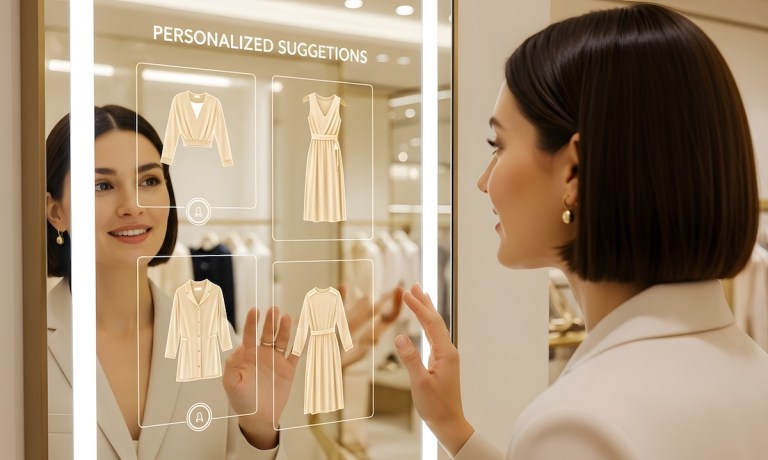
Crave Retail put smart fitting room screens inside Victoria’s Secret, Under Armour and Foot Locker locations, where customers can request different sizes, get styling suggestions or browse product information without flagging down an associate.

Nike’s House of Innovation flagship stores use RFID technology to identify customers as they enter and pull recommendations from their Nike profile—such as color preferences, favorite sports or foot measurements—before they’ve reached a single shelf.

Advertisement: Scroll to Continue

Meanwhile, Walmart added AI-generated audio summaries to product pages on its app for more than 1,000 beauty items. Shoppers using AI-powered tools spent 25% more on average, the retailer said in a release.

The common thread is personalization at the moment of decision.

The Invisible Layer

While customer-facing tools get the attention, deeper investments are often out of sight.

Starbucks has run its Deep Brew AI platform since 2019. The system drives labor scheduling, inventory levels and cold brew prep timing in the app, all adjusted to local demand and time of day. Deep Brew connects to point-of-sale systems so baristas can anticipate a customer’s order before it’s placed. The platform serves 17 million app users and handles about a quarter of all Starbucks transactions.

Melissa Minkow, global director of retail strategy and insights at CI&T, told Modern Retail that most in-store AI still operates out of view.

“AI has been used for two decades at this point in retail,” she said. “It’s used in a lot of processes, but it’s not a very front-facing tool. It’s a support tool to achieve something front-facing.” For instance, the RFID scanners at Uniqlo self-checkout areas may use AI on the back end to process scan data and flag replenishment needs. Customers never see it.

Consumer Appetite and Open Questions

Business consulting firm Capgemini found that 71% of consumers want generative AI integrated into their shopping experiences. Gen Z and millennial shoppers reported the strongest interest. As PYMNTS reported, 33% of consumers who have used AI for shopping discovery say it has replaced their previous methods, signaling a measurable shift away from traditional search and browsing toward conversational interfaces.

Greg Carlucci, a senior director analyst at Gartner, told Modern Retail that hesitation persists on the retailer side.

“Brands are still trying to figure out what consumers want, because it is such a new technology,” he said. “There’s this first-mover hesitation right now to understand what will be positively received and also what creates a value add.”

Minkow pointed to AI color-matching in beauty as a case where the technology hasn’t yet caught up to the human associate. “This technology is iterative, and it needs as many entries as possible to aggregate and then get smarter,” she said.

AI is becoming a permanent layer in physical retail, much like it already is online. Stores are no longer purely physical environments. They are hybrid spaces where digital intelligence shapes how customers browse, decide and buy.

For all PYMNTS AI and digital transformation coverage, subscribe to the daily AI and Digital Transformation Newsletters.