
惯性聚合 高效追踪和阅读你感兴趣的博客、新闻、科技资讯
阅读原文 在惯性聚合中打开

推荐订阅源

D
DataBreaches.Net
Apple Machine Learning Research
钛媒体:引领未来商业与生活新知
钛媒体:引领未来商业与生活新知
S
SegmentFault 最新的问题
博客园 - 聂微东
罗磊的独立博客
W
WeLiveSecurity
博客园_首页
Scott Helme
Scott Helme
V
Visual Studio Blog
T
The Exploit Database - CXSecurity.com
G
Google Developers Blog
大猫的无限游戏
大猫的无限游戏
Latest news
Latest news
L
Lohrmann on Cybersecurity
Cyber Security Advisories - MS-ISAC
A
About on SuperTechFans
F
Full Disclosure
Y
Y Combinator Blog
D
Darknet – Hacking Tools, Hacker News & Cyber Security
博客园 - 司徒正美
博客园 - Franky
C
CXSECURITY Database RSS Feed - CXSecurity.com
F
Fortinet All Blogs
Blog — PlanetScale
Blog — PlanetScale
Threat Intelligence Blog | Flashpoint
阮一峰的网络日志
阮一峰的网络日志
S
Schneier on Security
雷峰网
雷峰网
博客园 - 【当耐特】
P
Privacy International News Feed
C
Cyber Attacks, Cyber Crime and Cyber Security
Engineering at Meta
Engineering at Meta
aimingoo的专栏
aimingoo的专栏
MongoDB | Blog
MongoDB | Blog
J
Java Code Geeks
T
Tor Project blog
V
V2EX
爱范儿
爱范儿
C
Check Point Blog
T
Threatpost
Project Zero
Project Zero
量子位
V
Vulnerabilities – Threatpost
Know Your Adversary
Know Your Adversary
I
Intezer
G
GRAHAM CLULEY
P
Privacy & Cybersecurity Law Blog
GbyAI
GbyAI
让小产品的独立变现更简单 - ezindie.com

Silicon Republic

Ireland’s solar sector hits 1GW of energy for first time After Amazon, Google commits up to $40bn in Anthropic Cohere buys Aleph Alpha to forge sovereign AI alternative to US Big Tech 4 easy ways to stay on top of cybersecurity in the workplace 15 companies you’ll see at NIBRT Careers in Biopharma 2026 Bloomberg: Bezos’ Project Prometheus bags $10bn at $38bn value Meta to lay off 10pc of its workforce amid an AI push China's DeepSeek unveils long-awaited V4 AI model Intel’s shares soar as Q1 results signal brighter future MongoDB to create 200 new jobs as it invests €74m into Irish operations Why it's full STEAM ahead for young people upskilling in Ireland's west Swedish legal-tech Legora buys AI legal research start-up Qura Belfast’s Cloudsmith eyes ‘massive growth’ with $72m raise France's Univity raises €27m to allow European telecoms compete with Starlink France's Univity raises €27m to allow European telecoms to compete with Starlink AI race intensifies with Google's new agent management platform Government launches new AI initiative for greater access to essential skills Free and inexpensive cybersecurity courses to undertake in 2026 UL looking for ‘changemakers’ amid Research Week 2026 OpenAI taps Airbnb exec as first EMEA managing director EAM platform Blue Mountain acquires Cork’s CompuCal Calibration Solutions SpaceX agrees right to buy AI coding darling Cursor for $60bn Anthropic probing reported Mythos leak on Discord Professional job openings across Ireland increased in Q1, finds report Contract hiring evidence of a cautious jobs market, finds report Can you rely on AI chatbots for medical advice? €6.9m awarded to final four National Challenge Fund winners Amazon investing up to $25bn in Anthropic AI infrastructure deal Vodafone Ireland to invest €360m over the next four years Tim Cook passes Apple leadership to hardware head John Ternus Stripe alum's Seapoint raises €7.5m as ‘financial home’ to start-ups When it comes to leadership, do companies know what they are doing? Amazon gets go-ahead for subsea cable landing station in Cork Communication and storytelling key skills, finds strategy manager Space-tech Mbryonics plans new production facility in Shannon Irish co-founded AI start-up Lua raises $5.8m AIM Centre strengthening medtech and life sciences link with new Galway base Kerry Group expands Cork facility as lactose-free demand grows Are electric vehicles about to take off for good? Nearly 75pc of AI’s economic value captured by just 20pc of companies Major gap between leaders' traits and employee expectations, finds report Dublin tech company Vox Talk raises €1.35m in pre-seed round Netflix shares fall on Q2 forecast as co-founder Hastings steps aside OpenAI to rival Google’s AlphaFold with new AI model for life sciences research Irish-founded Ulysses raises $46m in rounds featuring A16Z How are balance, inclusion and skills critical to the workforce of the future? Anthropic’s Mythos to bolster cybersecurity at UK banks Solidroad raises $25m as demand for QA product sparks fresh hiring Are we ready to place lab experiments in non-human hands? Danish finance AI start-up Spektr raises $20m What interview mistakes are jobseekers still making in 2026? Irish space AI start-up Ubotica on board for NASA’s FAME Dublin's Audrey AI closes $1.8m pre-seed funding round The Leaders' Room: Equinix's Peter Lantry on powering Ireland sustainably ‘No more excuses’ as EU launches free age verification app Waterford's HCS unveils €13.2m investment, plans 125 new jobs Waterford's HCS unveils €13.2m investment, plans 125 new jobs The death of ETL: Is zero-copy a ‘liberation’ for data teams? Snap cuts 16pc workforce to prioritise AI and savings Do data and AI talent needs conflict with a workforce seeking stability? Amazon buys Globalstar to bolster Leo's satellite capabilities Dublin start-up Otel AI raises €2m to expand hotel AI platform Boston Scientific announces €75m R&D investment in Galway After Anthropic, OpenAI launches cyber-specific AI model ASML forecasts €36bn in 2026 net sales amid AI race chip demand The Interview: Dentons' Carlo Salizzo on three forces defining digital law How this master’s programme is building tech leadership talent Nvidia unveils open-source quantum AI model Ising Bull and Equal1 to advance next gen of hybrid quantum tech in Europe Anthropic's Mythos a game-changer, NCSC chief tells Oireachtas Klaviyo building out its engineering team at Dublin facility Stanford: China ‘effectively’ closes AI model performance gap to US Mythos just first of power models to come: Anthropic co-founder Ireland to invest €17m in leading facilities for AI, medtech and more UK neobank Monzo makes Irish launch after US market exit Cork Airport to get Ireland's largest solar carport next year New XP95 hacker group targets Dublin recruitment platform Healthdaq OpenAI apps for MacOS exposed by threat Mythos testing begins as governments raise cyber concerns The biopharma senior associate whose career was fuelled by FUEL Opinion: The future of insurance is AI, so why the hesitation? Meta to pay CoreWeave $21bn for additional cloud capacity Investing in part of the workforce creates an AI skills gap, finds report Digital rights group EFF leaves X Alibaba leads $293m round in Chinese AI start-up after HappyHorse reveal Anthropic reportedly mulls designing own chips amid shortage How are software engineering graduates adjusting to AI? OpenAI pauses Stargate UK over energy costs The diverse responsibilities of a principal software engineer Dublin AI SaaS provider Apex B2B launches with €1.5m backing Equal1 partners with Q-Ctrl for quantum data centre deployment Meta’s Superintelligence Labs debuts first product Muse Spark US court won't pause Anthropic ban, but wants case expedited Agentic commerce and purchase disputes: Did you mean to buy that? New Artemis II images give fresh look at our lunar neighbour Circuléire makes fresh call for 2026 accelerator applicants ‘Positive workplace culture starts with respect, trust and communication' Anthropic's Glasswing project employs Mythos to prevent AI cyberattacks Medtech start-up Vertigenius raises €2.55m for US expansion Meath ITAD provider ICT acquired by US recycling firm Paladin
How can you make your memory work more effectively?
2026-04-13 · via Silicon Republic

Trinity College Dublin’s Elva Arulchelvan highlights five tips for improving both your working and long-term memory.

As a researcher investigating how electric brain stimulation can improve people’s powers of recollection, I’m often asked how memory works – and what we can do to use it more effectively. Happily, decades of research have given us some clear answers to both questions.

Memory essentially operates in three stages, with different brain regions contributing to each one.

Sensory memory, which can last only milliseconds, registers raw information such as sights, sounds and smells. These are first processed by the brain’s five primary sensory cortices (visual cortex for sights, auditory cortex for sounds and so on).

Working (short-term) memory holds and manipulates a small amount of information over several seconds or more. Think of this as your brain’s mental workspace: the system that lets you do mental arithmetic, follow instructions and comprehend what you’re reading. So it mainly involves the prefrontal cortex – the front part of your brain that supports attention, decision-making and reasoning.

Finally, long-term memory stores information more permanently, from minutes to a lifetime. This includes both ‘explicit’ memories (facts and life events) and ‘implicit’ ones (skills, habits and emotional associations).

For long-term memories, the hippocampus and temporal lobes – located deep within the brain, around the sides of your head near your temples – contribute largely to memories involving facts or life events, while the amygdala (near the hippocampus), cerebellum (at the back of the brain) and basal ganglia (deep in the brain) process emotional or procedural memories.

Working memory often acts as a conscious gateway to long-term memory – but it has its limits. In 1956, the American psychologist George Miller proposed that we can only hold about seven ‘chunks’ of information in our working memory at any time.

While the exact number is debated to this day, the principle holds: working memory is limited. And that limitation can shape how effectively we learn and remember things.

But you can also get your memory working more effectively. Here are five easy steps for improving both your working and long-term memory.

Put your phone away

Smartphones reduce your working memory capacity. Even just having a phone nearby – no matter if it’s face down and on silent – can reduce performance on memory and reasoning tasks.

The reason is that part of your brain is still subtly monitoring it. Even resisting the urge to check notifications consumes mental resources – which is why researchers sometimes call smartphones a “brain drain”. The solution is simple: put your phone in another room when you need to focus. Out of sight really does free up mental capacity.

Stop your mind racing

Stress and anxiety can take up valuable mental space. When you’re worrying about something or are distracted by racing thoughts, part of your working memory is already in use.

Relaxation training and mindfulness practices can improve both working memory and academic performance, probably by reducing stress levels. And if meditation feels intimidating, try breathing techniques such as ‘cyclic sighing’. Inhale deeply through your nose, take a second shorter inhale, then slowly exhale through your mouth. Repeating this for five minutes can calm the nervous system and create better conditions for learning.

Get chunking

Everyone can expand their working memory using the technique of chunking – grouping information into meaningful units. In fact, you probably already do it to remember some phone numbers or lists of words – breaking long sequences into bite-size chunks that your brain can recall as a mini-group.

The same principles apply if you’re delivering a presentation, to help your audience remember your key points more effectively. Chunking would involve grouping 10 case studies, say, into three or four themes, each with a short headline and single key takeaway.

Repeat this structure on each slide: one idea, a few supporting details, then move on. By organising information into meaningful patterns, you reduce cognitive load and make it more memorable.

Become a retriever

In the 19th century, German psychologist Hermann Ebbinghaus demonstrated how quickly we forget information after learning it. Within about 30 minutes, we lose roughly half of what we have learned, with much more fading over the next day. Ebbinghaus called this the forgetting curve. The light blue line on the chart below illustrates this.

The forgetting curve – and how to disrupt it
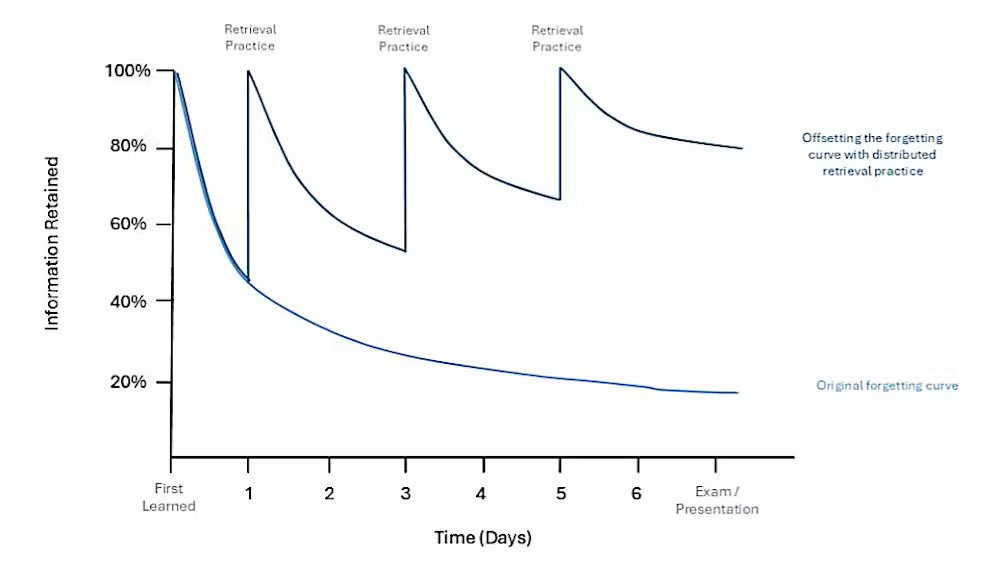
The forgetting curve. Image: Elva Arulchelvan (CC BY-SA 4.0)

However, there is a way of ensuring that more sinks in when you are trying to learn a lot of information in a short period of time: retrieval practice.

When preparing to give a talk or studying for an exam, rather than simply rereading your notes, keep testing how much you remember. Use flash cards, answer practice questions, or try explaining the material out loud without notes.

Memory works through associations. Each time you successfully retrieve information, you link the material to new prompts, examples and contexts. This builds more cues to accessing the information, and strengthens each memory pathway. Often when we ‘forget’, the memory isn’t gone – we just lack the right retrieval cue.

Give yourself a break

Research shows that memory is more effective when study or practice sessions are spread out, rather than massed together. If you are studying for an exam, build solid blocks of downtime into your revision schedule. The dark blue line on the chart above illustrates how spacing out your practice sessions can help you remember more information over time, by adjusting Ebbinghaus’s forgetting curve.

One study suggests leaving gaps between each revision session that equate to 10-20pc of the time left until your exam or presentation. So, if your deadline is five days away and you do hours of revision a day, you should still take between a half and full day off in between sessions. In other words, don’t overdo it – you probably won’t see the rewards!

If you only remember one thing from this article about improving memory, make it this. Memory isn’t just about intelligence, it’s about strategy. Small changes in how you study or work can make a real difference in how well, and how long, you remember crucial information.

The Conversation

By Elva Arulchelvan

Elva Arulchelvan is completing a PhD in psychology and neuroscience for the Lab for Clinical and Integrative Neuroscience in Trinity College Dublin (TCD), Ireland. She is also a lecturer in psychology for social work students in TCD. Arulchelvan’s PhD research focuses on memory and forgetting processes. In particular, her PhD research involves investigating peripheral nerve stimulation’s effect on memory and forgetting in both clinical and non-clinical groups. 

Don’t miss out on the knowledge you need to succeed. Sign up for the Daily Brief, Silicon Republic’s digest of need-to-know sci-tech news.