


Z.ai has released GLM-5.2, a new flagship text model built for long-horizon coding agents, project-scale software work, automated research, debugging, refactoring, mobile development, and code-driven video generation. The model offers a 1M-token context window and up to 128K output tokens, positioning it for full-repository tasks where it needs to retain architecture, API contracts, file boundaries, prior decisions, and engineering rules across long sessions.
— Z.ai (@Zai_org) June 16, 2026Introducing GLM-5.2: Frontier Intelligence, Open Weights
- Significant improvements in coding and agentic tasks
- Strong long-horizon capabilities with a 1M context window
- Two levels of reasoning effort: GLM-5.2 (max) pushes the limits, while GLM-5.2 (high) strikes a strong… pic.twitter.com/SjGPSVhePJ
GLM-5.2 is available to GLM Coding Plan users across Lite, Pro, and Max tiers, with switching support inside coding agents such as Claude Code, OpenClaw, and Cline through custom model configuration. Developers can enable the 1M-token version with the glm-5.2[1m] model name, map Claude Code effort modes to GLM-5.2’s high or max reasoning levels, and use Z.ai’s OpenAI-compatible API endpoint for integrations.
The core upgrade is not just context length. Z.ai says GLM-5.2 was trained for long-horizon coding agent scenarios, including large-scale implementation, automated research, performance optimization, and complex debugging. The company claims GLM-5.2 trails Claude Opus 4.8 by 1 percentage point on FrontierSWE, beats GPT-5.5 and Opus 4.7 on multiple long-horizon benchmarks, and scores 81.0 on Terminal-Bench 2.1 versus 62.0 for GLM-5.1. On SWE-bench Pro, it scores 62.1, compared to 58.4 for GLM-5.1.
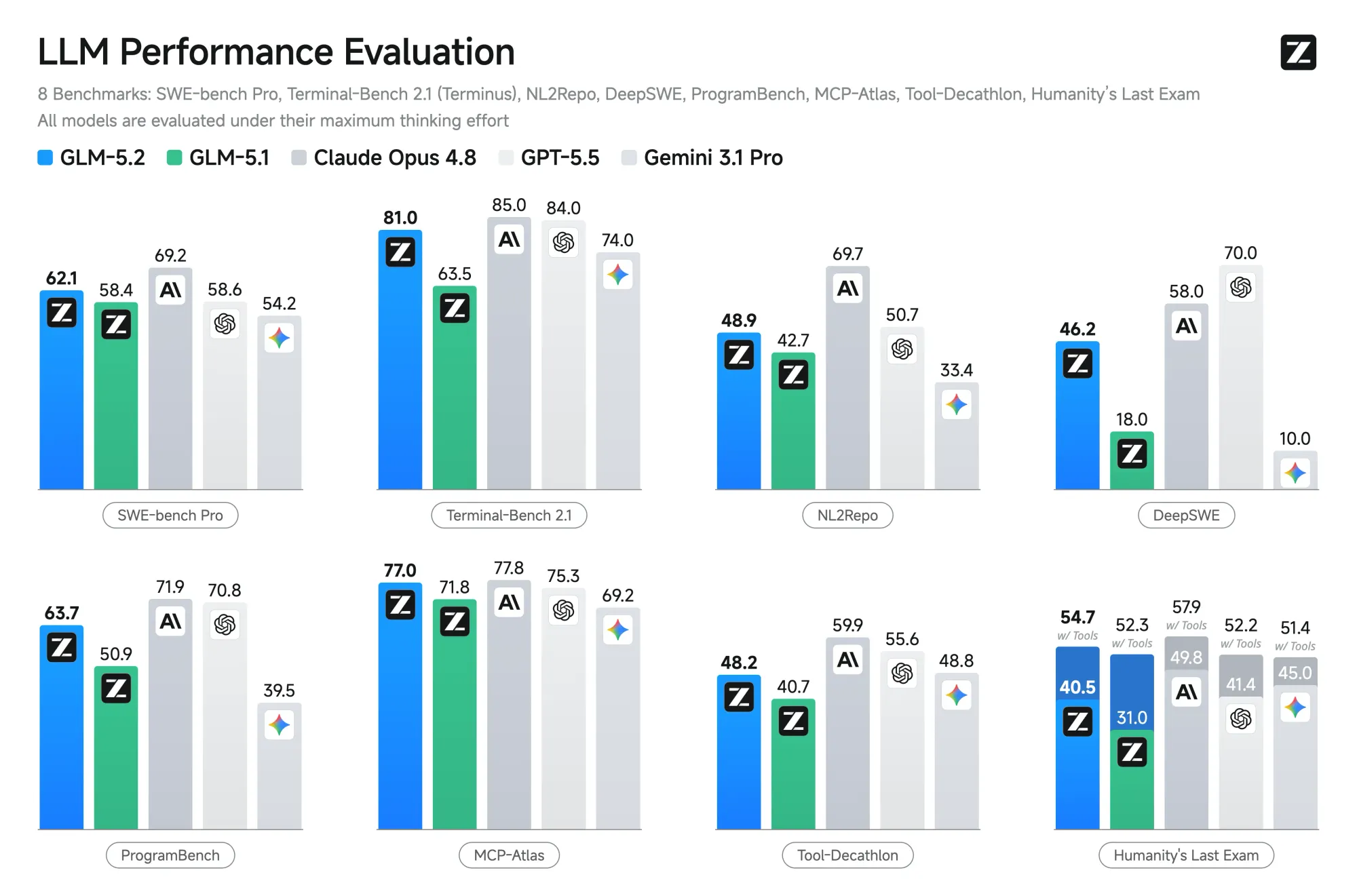
The model also adds architectural changes for long-context inference. Z.ai says GLM-5.2 uses IndexShare, a sparse-attention method that reuses the same indexer across every 4 sparse-attention layers, reducing per-token FLOPs by 2.9x at a 1M context length. The company also says it updated the model’s MTP layer for speculative decoding, increasing acceptance length by up to 20%. Download listings show GLM-5.2 and GLM-5.2-FP8 builds with 744B total parameters and 40B active parameters on Hugging Face and ModelScope.
Early developer feedback cited by Z.ai centers on project-level context capacity, steadier long-running execution, stricter adherence to production engineering constraints, and stronger client-side and mobile workflows, including ADB, logcat, screenshots, runtime logs, Mini Program migration, and real-device debugging loops. That makes GLM-5.2 less of a chatbot release and more of a direct play for coding-agent infrastructure.
Z.ai, formerly ZhipuAI, is the company behind the GLM model family. It was founded in 2019 from Tsinghua University's technological work and has since released GLM, GLM-130B, ChatGLM, GLM-4, GLM-4-Voice, AutoGLM, and other agent and model products. The company says ChatGLM-6B has surpassed 20 million global downloads, giving GLM-5.2 a clear role in its push from open-model research to developer-facing AI coding infrastructure.