







Mora has opened public access to its AI-native analytics platform, positioning itself as a data tool rebuilt for the AI era. The premise is direct: a person asks a hard revenue, churn, or product question in plain English, and Mora returns a verified answer in seconds, with the underlying SQL shown in a side panel so every number can be inspected and edited rather than taken on trust.
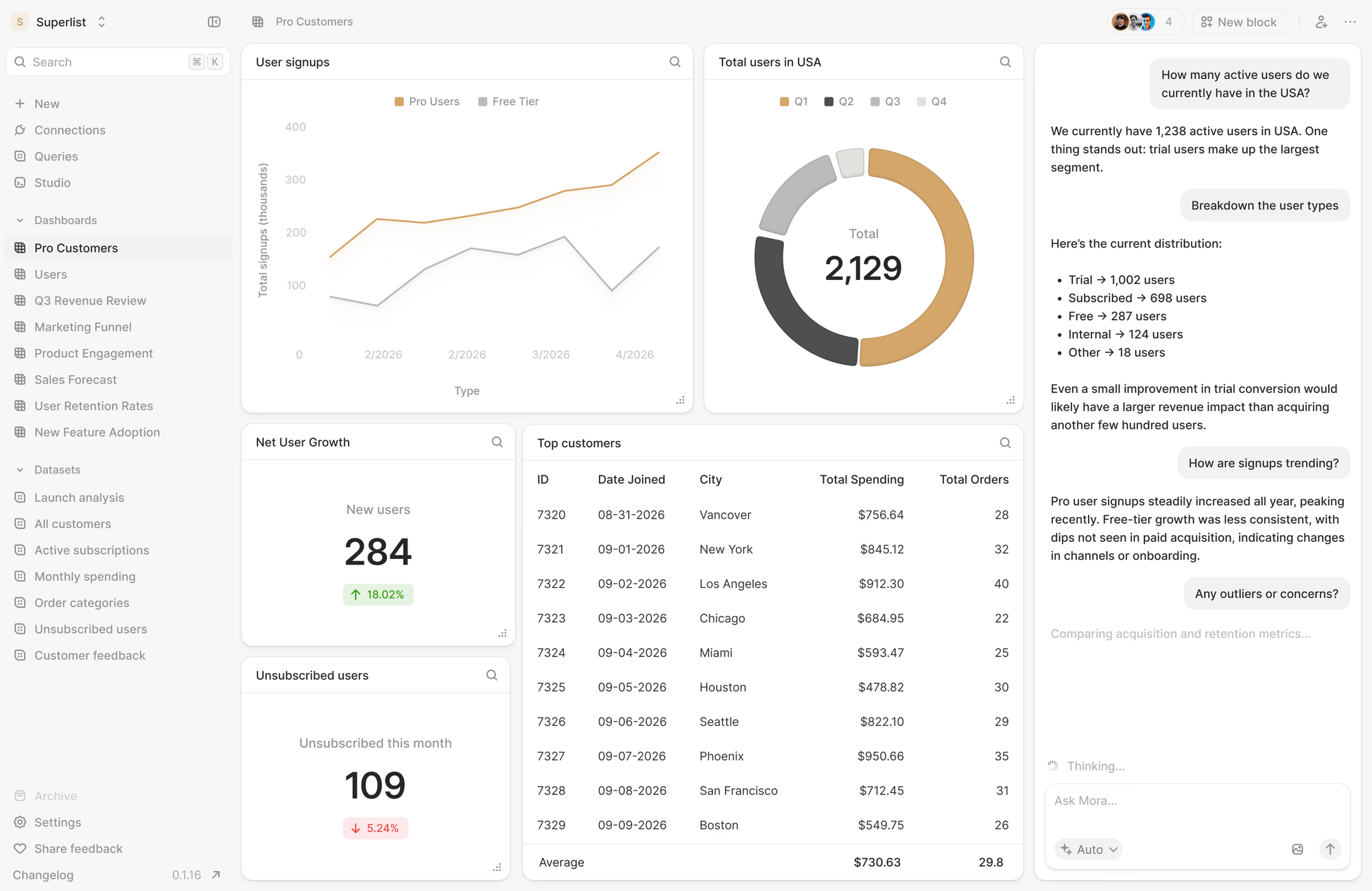
The platform connects to the systems a business already runs on, including BigQuery, Snowflake, Postgres, Stripe, and common CRMs, with more than 500 integrations available when teams need them. Once connected, Mora maps each question to a semantic layer, writes SQL against the actual schema, and then cross-references multiple sources in a single query. When an answer is worth keeping, a follow-up prompt builds and lays out the dashboard, selects the chart, and updates the view in one pass, removing the manual chart-building and weekly rebuilds that come with older dashboards. The same intelligence spans surfaces, running inside the product, through an API, in Slack, and in AI tools such as Claude and Cursor over MCP. Mora credits an in-process analytical engine built on DuckDB for query speed that holds steady whether a table has a thousand rows or ten million, and pairs the software with a forward-deployed model in which hands-on analysts handle migration, setup, query writing, metric validation, and ongoing guidance.
The audience splits into two groups:
- The first is data analysts, analytics engineers, and data scientists at B2B SaaS companies who live in SQL and dbt and have grown tired of maintaining Looker or Tableau dashboards and acting as the bottleneck for every metric request.
- The second is founders and leaders at growing teams of roughly 30 to 200 people who own revenue, churn, and board preparation but lack a full data org and cannot wait days for answers pulled from fragmented Stripe, CRM, and warehouse data.
The pitch to both is governed by self-serve with verified SQL and a semantic layer, set against the habit of copy-pasting exports into ChatGPT for numbers that cannot be checked.
Mora is the public rebrand of Index, the business intelligence platform founded by Xavier Pladevall and Eduardo Portet, childhood friends from the Dominican Republic who both studied computer science in the United States before building the company. Backed by Y Combinator and early investors including Gradient Ventures, Index grew past 1,000 customers on a model that connected warehouses and APIs into a unified access layer with a SQL and visual editor. Mora carries that lineage forward and rebuilds it around an agent layer, betting that natural language on top of a real semantic layer, rather than another set of dashboards, is where business analytics moves next.