







Latitude has released an open-source platform for monitoring AI agents in production, built to show what an agent is doing once it meets real users, catch where it breaks down, and route the fix back to the editor where the code already lives.
At the base is a discovery layer that gathers thousands of live conversations and clusters them into one picture of what people ask for and where they hesitate, escalate, or drop off. Usage can be broken down by who is behind it, from power users to one-time visitors to the accounts hitting failures most often, and individual sessions can be inspected alongside their cost, latency, and problems. A semantic search lets a team type a question in plain language, such as where users mention a feature the agent does not offer, and the matching conversations come back directly.
The second layer turns scattered breakages into something a team can act on. When an agent keeps failing the same way, Latitude collapses those moments into a single signal that names the problem, counts how often it occurs, and attaches the likely reason. Signals come from automatic flaggers, annotations, or manual creation, and an evaluation is generated for each one. A saved search can be promoted into a monitor that runs against every new conversation, so a pattern reaches the team before it reaches more users.
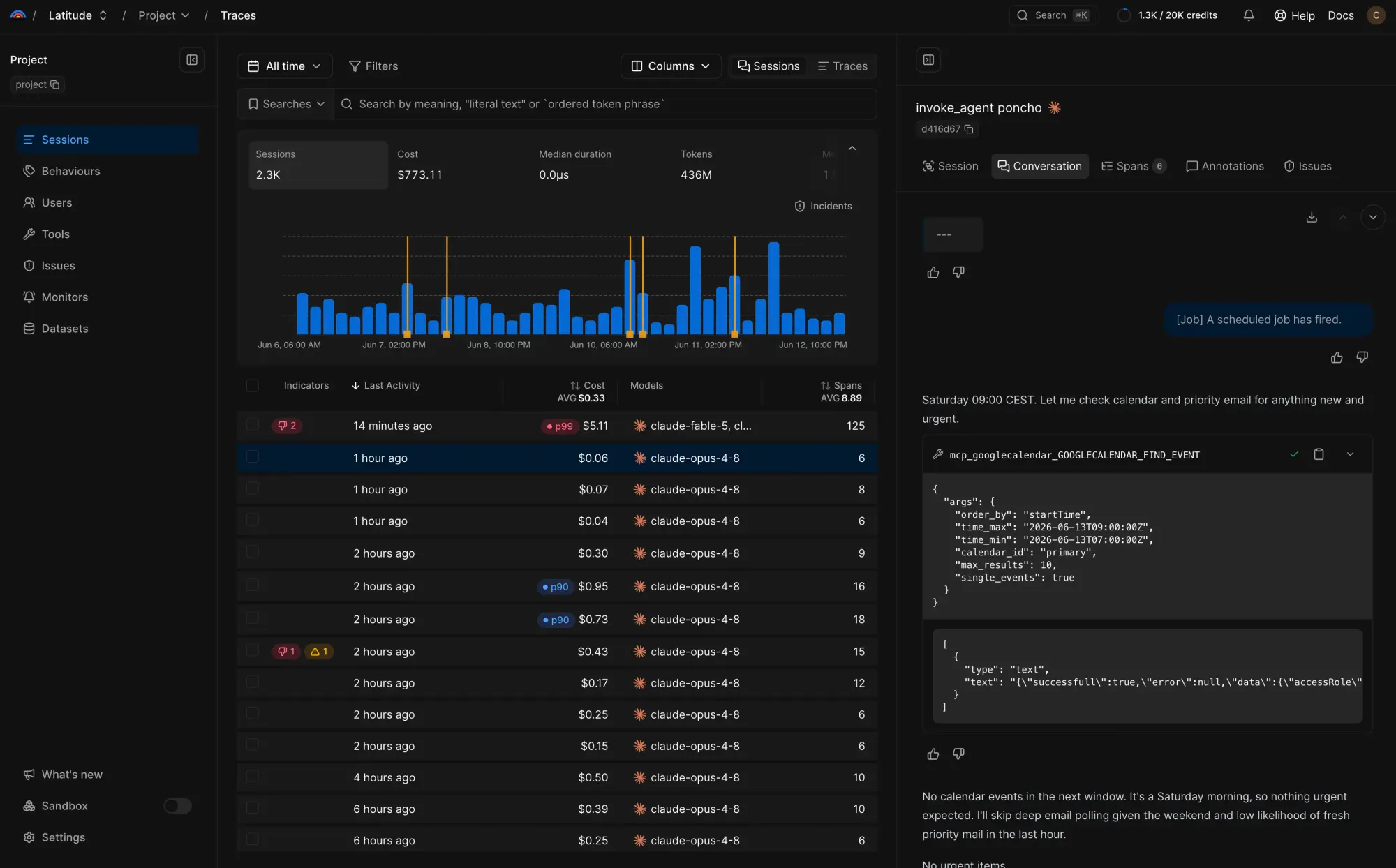
The third layer closes the loop inside the developer workflow. An MCP server delivers projects, traces, signals, searches, and datasets directly to a coding agent, so the work happens where engineers already operate rather than in a separate console. Production conversations can be turned into datasets and reused as test sets, allowing a team to confirm that a fix holds before shipping. The platform also connects to Claude Code to track token spend per task, surfacing where the budget goes.
Latitude is distributed under an MIT license and can run on a team's own infrastructure, with a free tier and full source access for anyone who wants to read or modify it. The framing treats an agent as the richest record a company holds about its own product, and the platform as the way to read that record back rather than leaving it unused.
Latitude is the team behind the open-source project of the same name, maintained under the latitude-dev organization on GitHub. The release reflects a move toward treating agent monitoring as a loop in which the system reports what went wrong and points to the fix, rather than a dashboard to be watched, and it arrives as agent reliability becomes a defining concern for teams shipping to real users at scale.