惯性聚合 高效追踪和阅读你感兴趣的博客、新闻、科技资讯
阅读原文 在惯性聚合中打开

推荐订阅源

D
Docker
cs.AI updates on arXiv.org
C
Cisco Blogs
Scott Helme
Scott Helme
Know Your Adversary
Know Your Adversary
NISL@THU
NISL@THU
C
Cyber Attacks, Cyber Crime and Cyber Security
D
Darknet – Hacking Tools, Hacker News & Cyber Security
C
CXSECURITY Database RSS Feed - CXSecurity.com
S
Schneier on Security
I
Intezer
Spread Privacy
Spread Privacy
AWS News Blog
AWS News Blog
V
Vulnerabilities – Threatpost
Cloudbric
Cloudbric
V2EX - 技术
V2EX - 技术
Google Online Security Blog
L
Lohrmann on Cybersecurity
Recent Commits to openclaw:main
L
LINUX DO - 热门话题
S
Secure Thoughts
T
The Exploit Database - CXSecurity.com
博客园 - 【当耐特】
Recent Announcements
Security Archives - TechRepublic
Stack Overflow Blog
Stack Overflow Blog
罗磊的独立博客
OSCHINA 社区最新新闻
OSCHINA 社区最新新闻
K
Kaspersky official blog
阮一峰的网络日志
阮一峰的网络日志
博客园_首页
Latest news
Latest news
B
Blog
F
Full Disclosure
大猫的无限游戏
大猫的无限游戏
博客园 - 叶小钗
L
LangChain Blog
GbyAI
GbyAI
Last Week in AI
Last Week in AI
S
Security Affairs
Apple Machine Learning Research
N
Netflix TechBlog - Medium
Security Latest
Security Latest
Vercel News
Vercel News
Y
Y Combinator Blog
G
GRAHAM CLULEY
S
Securelist
T
Troy Hunt's Blog
Hacker News - Newest:
Hacker News - Newest: "LLM"
雷峰网
雷峰网

The GitHub Blog

GitHub for Beginners: Your roadmap to mastering the GitHub essentials Better tools made Copilot code review worse. Here's how we actually improved it. How GitHub gave every repository a durable owner Automating cross-repo documentation with GitHub Agentic Workflows GitHub availability report: June 2026 How GitHub Copilot enables zero DNS configuration for GitHub Pages Q1 2026 Innovation Graph update: Open source collaboration is accelerating worldwide How GitHub used secret scanning to reach inbox zero 6 security settings every GitHub maintainer should enable this week How GitHub maintains compliance for open source dependencies Highlights from Git 2.55 Inside the Advisory Database and what happens when vulnerability volume breaks records GitHub and UNDP team up to advance development priorities in Ghana with open source Transitioning as a Hubber Evaluating performance and efficiency of the GitHub Copilot agentic harness across models and tasks I automated my job (and it made me a better leader) GitHub joins coalition advocating for fixes to California AI Transparency Act to protect open source From pledge to practice: Building a more inclusive open source ecosystem How pull request limits are cutting down the noise Getting more from each token: How Copilot improves context handling and model routing What are git worktrees, and why should I use them? GitHub Copilot CLI for Beginners: Overview of common slash commands Accelerating researchers and developers building multilingual AI with a new open dataset How we made GitHub Copilot CLI more selective about delegation GitHub availability report: May 2026 Making secret scanning more trustworthy: Reducing false positives at scale Give GitHub Copilot CLI real code intelligence with language servers From one-off prompts to workflows: How to use custom agents in GitHub Copilot CLI GitHub for Beginners: Answers to some common questions GitHub Universe is back: All together now, in the agentic era GitHub Copilot app: The agent-native desktop experience Still a developer. Just outside. Our latest GitHub Shop collection is here. GitHub for Beginners: Getting started with Git and GitHub in VS Code GitHub recognized as a Leader in the Gartner® Magic Quadrant™ for Enterprise AI Coding Agents for the third year in a row Beyond the engine: 10 open source projects shaping how games actually get made Building GitHub’s next chapter in accessibility Investigation update: GitHub Enterprise Server signing key rotation Take your local GitHub sessions anywhere Building a general-purpose accessibility agent—and what we learned in the process Raising the bar: Quality, shared responsibility, and the future of GitHub’s bug bounty program GitHub availability report: April 2026 From latency to instant: Modernizing GitHub Issues navigation performance Dungeons & Desktops: 10 roguelikes that never die (because their communities won’t let them) GitHub Copilot individual plans: Introducing flex allotments in Pro and Pro+, and a new Max plan Dungeons & Desktops: Building a procedurally generated roguelike with GitHub Copilot CLI GitHub for Beginners: Getting started with OSS contributions Why age assurance laws matter for developers How researchers are using GitHub Innovation Graph data to reveal the “digital complexity” of nations Improving token efficiency in GitHub Agentic Workflows Agent pull requests are everywhere. Here’s how to review them. Validating agentic behavior when “correct” isn’t deterministic Welcome to Maintainer Month: Celebrating the people behind the code Register now for OpenClaw: After Hours @ GitHub GitHub Copilot CLI for Beginners: Interactive v. non-interactive mode GitHub for Beginners: Getting started with Markdown Securing the git push pipeline: Responding to a critical remote code execution vulnerability Highlights from Git 2.54 Building an emoji list generator with the GitHub Copilot CLI Bringing more transparency to GitHub’s status page How GitHub uses eBPF to improve deployment safety Build a personal organization command center with GitHub Copilot CLI Developer policy update: Intermediary liability, copyright, and transparency Hack the AI agent: Build agentic AI security skills with the GitHub Secure Code Game How exposed is your code? Find out in minutes—for free GitHub for Beginners: Getting started with GitHub Pages GitHub Copilot CLI for Beginners: Getting started with GitHub Copilot CLI GitHub availability report: March 2026 GitHub Universe is back: We want you to take the stage GitHub Copilot CLI combines model families for a second opinion The uphill climb of making diff lines performant Securing the open source supply chain across GitHub Run multiple agents at once with /fleet in Copilot CLI Agent-driven development in Copilot Applied Science GitHub for Beginners: Getting started with GitHub security What’s coming to our GitHub Actions 2026 security roadmap
How we built an internal data analytics agent
Natalie Guevara · 2026-06-20 · via The GitHub Blog

Large data and analytics organizations often struggle to make access to data and insights truly self-serve. The industry tried to solve this problem, quite unsuccessfully, for decades, but now AI is giving us a credible way to do just that.

At GitHub scale, providing dedicated analytics support to dozens of product teams is challenging, and therefore many teams are left to solve this problem on their own. Though there is a lot of valuable product telemetry that product and engineering teams can use to make decisions, figuring out which data model, which grain, which filter, and then write the query and validate the result has always been difficult without the support of a data analyst.

Enter Qubot, our internal GitHub Copilot-powered analytics agent. Qubot allows any Hubber (that’s what we call GitHub employees) to ask questions about any data model in GitHub’s data warehouse in plain language and get an answer within seconds.

Qubot is not a reporting tool or a dashboard replacement. Instead, it’s intended for exploratory questions like “Which cohort of users has the highest retention on this feature?” or “What product contributed to move this metric the most last week?” Qubot has zero cost maintenance and helps teams ramp up quickly on datasets they may be unfamiliar with.

In this blog post, we’ll go over how we built Qubot, how it’s changed, and what we learned.

How Qubot works

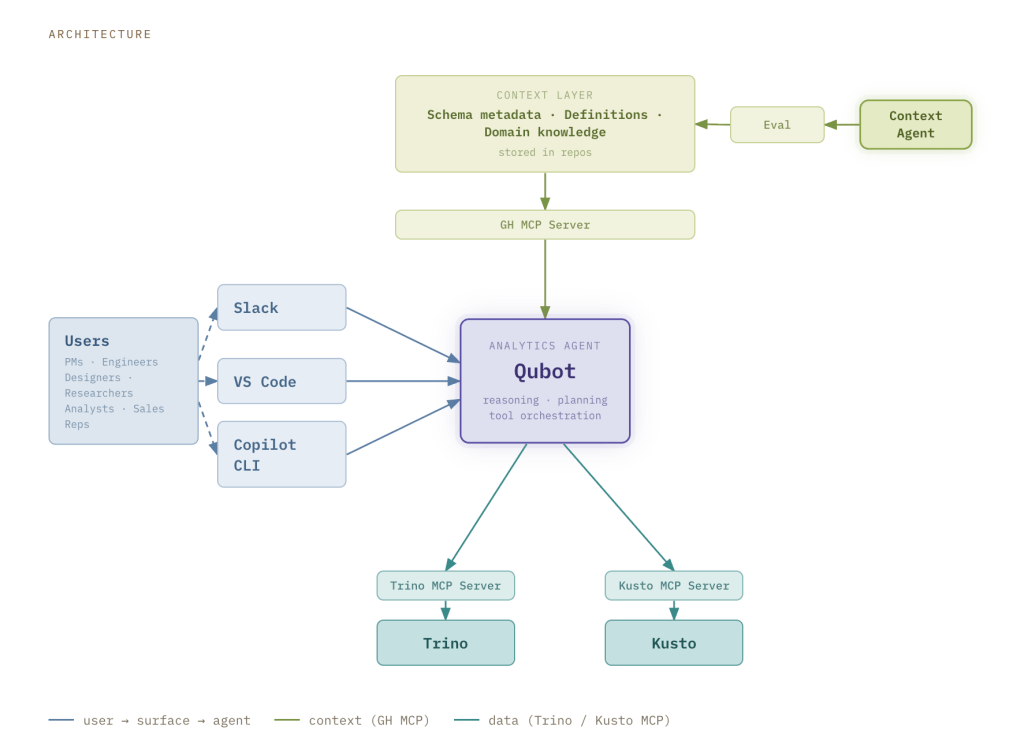
The architecture has three main components: user interface, context layer, and query engine.

Diagram showing the architecture of the Qubot analytics agent. Context and users feed into Qubot, which references Trino and Kusto for answers.

User interface

Qubot is accessible through Slack, VS Code, and the Copilot CLI. The Slack interface doesn’t require any configuration, and it is the preferred collaboration tool of Hubbers. When someone posts a question in the Qubot Slack channel, a Qubot instance is spawned as a Copilot Cloud Agent running on github.com. The answer is provided directly in Slack, allowing the user to share the result with others, but also iterate in the thread to evolve or refine the question. All the results are also stored as a markdown report in a pull request that the user can reference to fine tune the query or use it in a dashboard.

Qubot is also available in VS Code and the Copilot CLI, for users that want an experience more integrated with their workflows. Qubot can be installed with one command as a plugin, and it becomes available in any agent session in VS Code or Copilot CLI alongside any other custom agents, skills, and tools configured by the user.

Context layer

Our data warehouse contains data at different stages of curation: raw events (bronze), conformed facts and dimensions (silver), and curated datasets designed for specific business use cases (gold). The context layer is built in a federated way, with knowledge that is tailored to the type of data.

  • For bronze data, we have telemetry context contributed by product teams, with schema information and metadata.
  • For silver data, we have examples of queries, usage guidance, mandatory filters etc, maintained by the data and analytics team.
  • For gold data, we have business rules and metric definitions, contributed by teams owning those datasets.

We also leverage our ETL pipelines to systematically enrich the context layer with additional signals and derived metadata. The context is loaded at runtime via the GitHub MCP Server, fetching it from the context layer.

Context agent

The context layer is constantly enriched with new knowledge persisted across multiple repositories. At GitHub, we primarily use markdown for documentation, so we don’t need to interface with multiple different tools.

We’ve streamlined federated context contribution through a context agent. Teams can contribute via a standardized template or by referencing a repository containing relevant context. The agent then ingests, organizes, and normalizes this information into a structured format that has proven effective for Qubot based on our evaluations.

Evaluation framework

Every change to the context layer or agent configuration gets evaluated before it ships. When someone wants to enrich the context layer with new knowledge, they can open a pull request. The new context goes through an offline eval framework that measures accuracy of the response, latency in finding the right answer, and catches regressions before they reach users.

The benchmarking framework for evaluating Qubot across structured test cases has three components:

  • Test cases: A curated dataset of prompts with known correct answers, ground-truth SQL, and metadata (domain, difficulty).
  • Automated run orchestration: A script that automates launching each test case as an agent task with the GitHub CLI gh agent-task create, runs multiple parallel trials, polls for completion, and saves detailed JSON results.
  • Stats aggregation: A reporting script that reads the saved results and computes per-test-case metrics: completion rate, accuracy, and duration (avg/min/max).

The end-to-end flow is: define test cases → run Qubot N times per case → collect results → aggregate stats → compare configurations.

Query engine

Qubot connects to both Kusto and Trino, the two query engines that power most of GitHub’s analytics workloads, via a MCP server. We developed a custom implementation of the Trino MCP server, while for Kusto we deployed a local version of the Fabric RTI MCP Server. Kusto is fast and well-suited to exploratory questions over recent event data. Trino handles complex joins and deeper historical analysis.

Rather than forcing users to know which to use, Qubot defaults to Kusto and switches to Trino automatically when the question requires it.

What changed, and what we learned

Qubot has been widely adopted at GitHub, with hundreds of enthusiastic users running thousands of queries. The number of questions that Hubbers ask in the data and analytics Slack channels has reduced dramatically, because now they can explore the data with greater autonomy and reach out only for complicated questions. It also allows Hubbers that never dared to dip into the data warehouse to access the data they need to drive their decision making. That is one of the reasons for offering multiple interfaces like Slack, Copilot CLI, and VS Code; Hubbers are very technical, but we wanted to offer an option with no barrier to entry and zero configuration.

We quickly discovered that the context layer is key to enriching the reasoning capabilities of Copilot and to create an expert analytics agent. In our experiments we found that structured and well curated context not only makes Qubot more accurate, but also three times faster at returning the right answer. This has profound implications on the analytics engineering discipline, because it makes this type of artifact a first class citizen in how data is modeled, rather than an afterthought.

Qubot has been a rare example of successful hub-and-spoke execution. It removes strain from the data and analytics team, as product teams own the telemetry for their surfaces and business teams own the definition of their gold data. Qubot acted as a gravitational force to centralize all this distributed knowledge into a single tool that can benefit all GitHub, providing incentives to partner teams to contribute to Qubot, instead of creating multiple tools limited to their own domains.


Acknowledgements

Qubot engineering team: Weijie Tan, Tobias Tschuemperlin, Vamsi Anamaneni

Special thanks: Yaswanth Anantharaju

Written by

Matteo Vasirani

As a staff manager of software engineering, Matteo Vasirani leads product analytics and data science at GitHub.

Cynthia Joseph

Cynthia Joseph is senior product manager for the Data team.

Explore more from GitHub

Docs

Docs

Everything you need to master GitHub, all in one place.

Go to Docs

GitHub

GitHub

Build what’s next on GitHub, the place for anyone from anywhere to build anything.

Start building

Customer stories

Customer stories

Meet the companies and engineering teams that build with GitHub.

Learn more

GitHub Universe 2026

GitHub Universe 2026

Join us October 28-29 in San Francisco or online for GitHub Universe, our flagship developer event uniting people, agents, and the world’s code.

Register now