

惯性聚合 高效追踪和阅读你感兴趣的博客、新闻、科技资讯
阅读原文 在惯性聚合中打开

推荐订阅源

酷 壳 – CoolShell
酷 壳 – CoolShell
H
Hacker News: Front Page
P
Palo Alto Networks Blog
T
ThreatConnect
Apple Machine Learning Research
博客园_首页
T
True Tiger Recordings
P
Privacy & Cybersecurity Law Blog
B
Blog
IT之家
IT之家
Last Week in AI
Last Week in AI
F
Full Disclosure
Hacker News: Ask HN
Hacker News: Ask HN
C
Comments on: Blog
Microsoft Azure Blog
C
Cybersecurity and Infrastructure Security Agency CISA
Microsoft Security Blog
博客园 - 【当耐特】
N
News and Events Feed by Topic
NISL@THU
NISL@THU
腾讯CDC
雷峰网
雷峰网
Security Latest
Security Latest
李成银的技术随笔
M
Microsoft Research Blog - Microsoft Research
L
LangChain Blog
L
Lohrmann on Cybersecurity
cs.CL updates on arXiv.org
C
Check Point Blog
Y
Y Combinator Blog
Recent Announcements
博客园 - Franky
N
News | PayPal Newsroom
V
V2EX
A
About on SuperTechFans
The Register - Security
月光博客
月光博客
奇客Solidot–传递最新科技情报
奇客Solidot–传递最新科技情报
Google Online Security Blog
MyScale Blog
MyScale Blog
Cisco Talos Blog
Cisco Talos Blog
Vercel News
Vercel News
WordPress大学
WordPress大学
C
Cyber Attacks, Cyber Crime and Cyber Security
The Hacker News
The Hacker News
IntelliJ IDEA : IntelliJ IDEA – the Leading IDE for Professional Development in Java and Kotlin | The JetBrains Blog
爱范儿
爱范儿
A
Arctic Wolf
L
LINUX DO - 最新话题
freeCodeCamp Programming Tutorials: Python, JavaScript, Git & More

The GitHub Blog

Investigating unauthorized access to GitHub-owned repositories Take your local GitHub sessions anywhere Building a general-purpose accessibility agent—and what we learned in the process Raising the bar: Quality, shared responsibility, and the future of GitHub’s bug bounty program GitHub availability report: April 2026 From latency to instant: Modernizing GitHub Issues navigation performance Dungeons & Desktops: 10 roguelikes that never die (because their communities won’t let them) GitHub Copilot individual plans: Introducing flex allotments in Pro and Pro+, and a new Max plan Dungeons & Desktops: Building a procedurally generated roguelike with GitHub Copilot CLI GitHub for Beginners: Getting started with OSS contributions Why age assurance laws matter for developers How researchers are using GitHub Innovation Graph data to reveal the “digital complexity” of nations Improving token efficiency in GitHub Agentic Workflows Agent pull requests are everywhere. Here’s how to review them. Validating agentic behavior when “correct” isn’t deterministic Welcome to Maintainer Month: Celebrating the people behind the code Register now for OpenClaw: After Hours @ GitHub GitHub Copilot CLI for Beginners: Interactive v. non-interactive mode GitHub for Beginners: Getting started with Markdown Securing the git push pipeline: Responding to a critical remote code execution vulnerability An update on GitHub availability GitHub Copilot is moving to usage-based billing Changes to GitHub Copilot Individual plans Highlights from Git 2.54 Building an emoji list generator with the GitHub Copilot CLI Bringing more transparency to GitHub’s status page How GitHub uses eBPF to improve deployment safety Build a personal organization command center with GitHub Copilot CLI Developer policy update: Intermediary liability, copyright, and transparency Hack the AI agent: Build agentic AI security skills with the GitHub Secure Code Game How exposed is your code? Find out in minutes—for free GitHub for Beginners: Getting started with GitHub Pages GitHub Copilot CLI for Beginners: Getting started with GitHub Copilot CLI GitHub availability report: March 2026 GitHub Copilot CLI combines model families for a second opinion The uphill climb of making diff lines performant Securing the open source supply chain across GitHub Run multiple agents at once with /fleet in Copilot CLI Agent-driven development in Copilot Applied Science GitHub for Beginners: Getting started with GitHub security What’s coming to our GitHub Actions 2026 security roadmap
GitHub Universe is back: We want you to take the stage
2026-04-08 · via The GitHub Blog

Get inspired by five of the most memorable, magical, and quirky Universe sessions to date.

|

5 minutes

Everyone’s favorite global developer event is back for another year of learning, connection, building, and donuts. We hope you’re excited to join us at Fort Mason Center in San Francisco on October 28–29. Of course, you don’t just have to be in attendance this year: Our Call for Sessions is open now through Friday, May 1 at 11:59 p.m. PT. If you’ve been thinking about taking the stage, this is your moment. Submit a proposal that shares what you’ve been building over the past year, what you’ve learned, and what other builders can take away from it. And if you know someone who deserves a mic, you can also nominate a speaker.

Need some inspiration? Below, we have five past Universe sessions that have captured our imaginations (so much so that we’re still talking about them). These sessions perfectly encapsulate what Universe is all about: learning, fun, and just a little magic. We can’t wait to see what they spark for you.
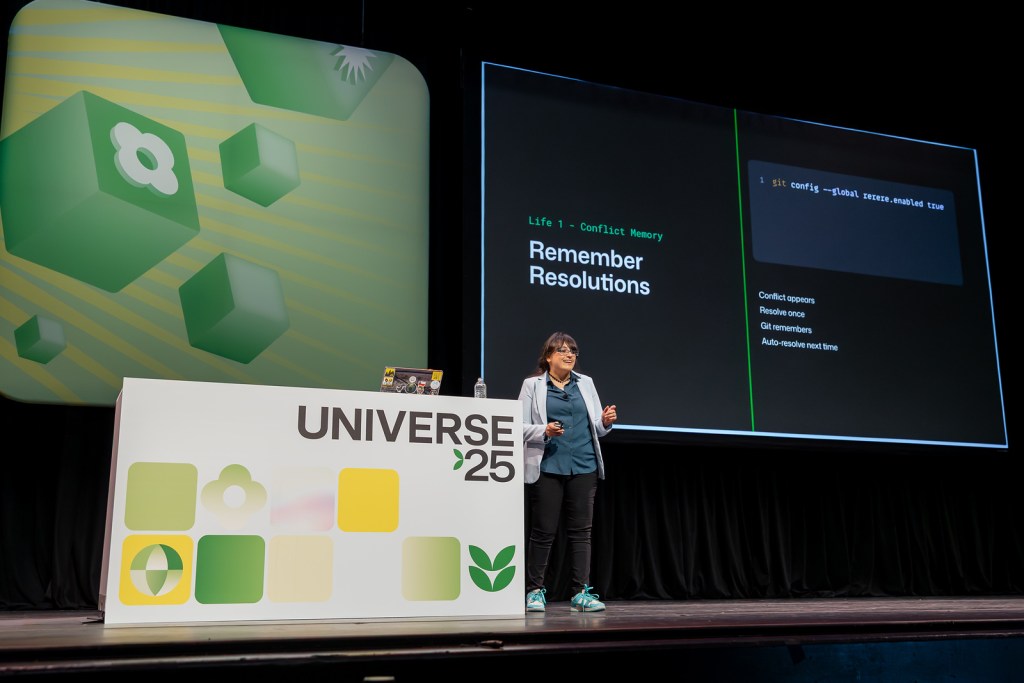
Pillippa Pérez Pons on stage at GitHub Universe 2025.

Pillippa Pérez Pons took a problem every frontend team recognized: messy rebases, ever-growing monorepos, mysteriously vanishing commits, and general Git chaos, and made it delightfully weird by framing the whole thing as a cat’s nine lives. Each “life” unlocked a lesser-known Git feature or optimization—sparse checkouts, partial clones, reflog rescues, and performance boosts—delivered with storytelling, visuals, and just enough humor to make the tricky parts stick.
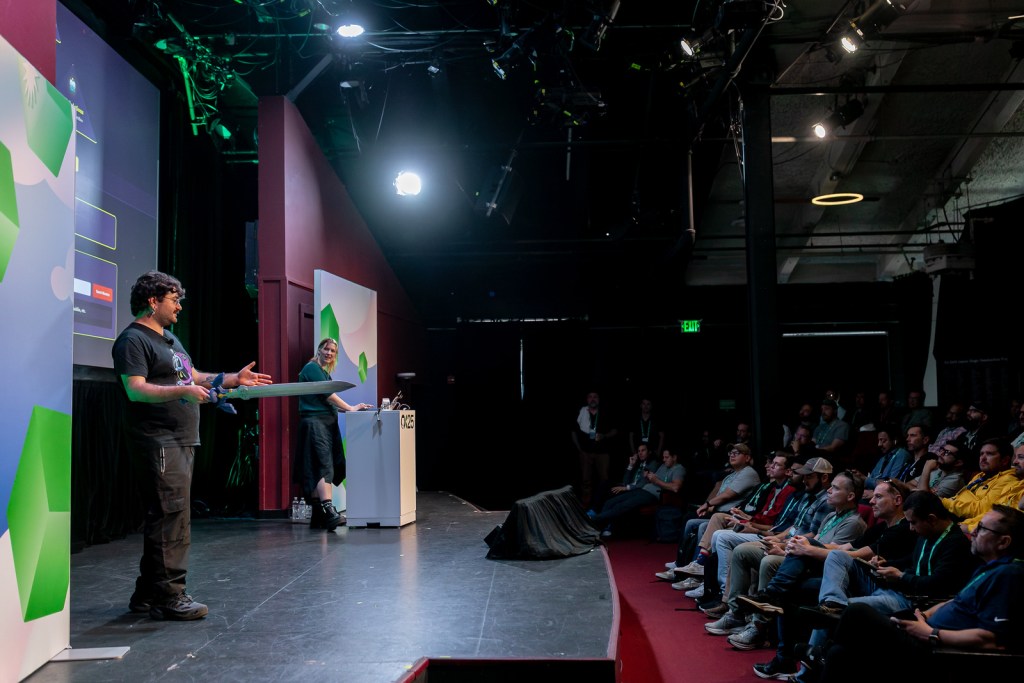
Breath of Copilot: Level up your DevEx with GitHub Actions and GitHub Advanced Security (2025)

Matteo Bianchi (GitHub) and Alexandra Aldershaab (Eficode) on stage at GitHub Universe 2025

This full-on fantasy adventure, presented by Matteo Bianchi (GitHub) and Alexandra Aldershaab (Eficode), cast CI/CD as a castle, reframed ancient scripts as lurking monsters, and sent the audience on a quest to modernize automation without inviting supply chain dragons into the build. Under the playful storytelling, the session delivered a genuinely practical payoff: secure GitHub Actions patterns (with Copilot as a trusty sidekick) that helped teams speed up workflows while keeping security front and center.

Dream it in the morning, build it in the afternoon: Collapsing the distance from idea to impact (2025)

In Martin Woodward’s (GitHub) hands, “speed” became less of a productivity metric and more of a creative superpower (and yes, occasionally a little Furby-powered). The session zoomed out to the big shift underway in software: ideas moving from sketch to prototype to shipped experience faster than ever, and the new questions that came with that acceleration. Instead of obsessing over velocity, Martin challenged the audience with the idea that the best developers never stop experimenting. They stay curious. “If you can dream it,” he said. “You can build it.”

Dungeons and deployments: The clusters of chaos (2024)

If you’ve ever wished Kubernetes security training came with a party of adventurers and a ridiculous quest narrative, this one absolutely delivered. Noah Abrahams, Ian Coldwater, Kat Cosgrove, Seth McCombs, and Natali Vlatko walked the audience through a serious cluster of security concepts while roleplaying their way through a chaotic fantasy world, complete with memorable villains and dramatic stakes.

Mission Copilot Autofix: Securing the world’s software (2024)

With true cinematic excitement, Nick Liffen (GitHub) and Niroshan Rajadurai turned application security into a near-future mission briefing. During their session, they pulled back the curtain on how GitHub applies AI to streamline remediation and make alerts easier to interpret—then pushed the story forward into what comes next: AI that can fortify defenses and even spot emerging threats before they turn into incidents. They even saved a special surprise for the finale, giving the whole session that “stay until the credits” energy. This blog post will self-destruct in 3…2…1…just kidding.

Universe ’26 sessions and submissions TL;DR

If you need help polishing your proposal or making your idea stand out, check out our submission guide, which covers this year’s content tracks, provides an in-depth look at session types, and outlines the anatomy of a great submission.

This year’s sessions fall into three categories:

  • Demo-style sessions: Product demos and Ship & Tell are for speakers who want to show what’s possible and share learnings.
  • Thought leadership: Breakout Sessions, Panels, and Fireside chats are built for longer narratives, perspectives, and big ideas, with room for Q&A.
  • Interactive learning: Workshops and Sandbox sessions focus on guided, participatory learning where attendees can practice new skills in real time.

💡 Pro tip: Ship & Tell is a new format this year that’s ideal for startup founders and builders to tell their story. What did you ship? How did you scale it? What broke? What worked? Your takeaways will provide inspiration for the next generation of builders.

See you on stage

Ready to pitch your own Universe-worthy idea? If these sessions have one thing in common, it’s this: they’re grounded in real engineering lessons, then delivered with personality, creativity, and a clear point of view. That’s exactly the kind of proposal we’re excited to see for Universe.

Before you submit, review the submission guide for what makes a strong proposal, plus tips to match your idea to the right format.

And don’t wait: the deadline to submit a session proposal or nominate a speaker is Friday, May 1 at 11:59 pm PT.

Written by

Rachel Cohen

Related posts

We do newsletters, too

Discover tips, technical guides, and best practices in our biweekly newsletter just for devs.