
惯性聚合 高效追踪和阅读你感兴趣的博客、新闻、科技资讯
阅读原文 在惯性聚合中打开

推荐订阅源

云风的 BLOG
云风的 BLOG
Help Net Security
Help Net Security
Y
Y Combinator Blog
WordPress大学
WordPress大学
D
DataBreaches.Net
N
Netflix TechBlog - Medium
U
Unit 42
爱范儿
爱范儿
MyScale Blog
MyScale Blog
CTFtime.org: upcoming CTF events
博客园 - 司徒正美
Google DeepMind News
D
Docker
H
Help Net Security
Stack Overflow Blog
Stack Overflow Blog
宝玉的分享
宝玉的分享
博客园_首页
Microsoft Security Blog
Engineering at Meta
Engineering at Meta
Know Your Adversary
Know Your Adversary
P
Privacy & Cybersecurity Law Blog
P
Proofpoint News Feed
T
Tenable Blog
S
Schneier on Security
V
Vulnerabilities – Threatpost
V
V2EX
T
Tor Project blog
Security Latest
Security Latest
S
Securelist
G
Google Developers Blog
NISL@THU
NISL@THU
Schneier on Security
Webroot Blog
Webroot Blog
小众软件
小众软件
Google Online Security Blog
阮一峰的网络日志
阮一峰的网络日志
W
WeLiveSecurity
IT之家
IT之家
I
InfoQ
cs.CV updates on arXiv.org
月光博客
月光博客
I
Intezer
T
The Blog of Author Tim Ferriss
C
Cisco Blogs
博客园 - 【当耐特】
The GitHub Blog
The GitHub Blog
Cloudbric
Cloudbric
Scott Helme
Scott Helme
The Cloudflare Blog
L
LINUX DO - 热门话题

The GitHub Blog

The cost of saying yes has changed GitHub for Beginners: Your roadmap to mastering the GitHub essentials Better tools made Copilot code review worse. Here's how we actually improved it. How GitHub gave every repository a durable owner Automating cross-repo documentation with GitHub Agentic Workflows GitHub availability report: June 2026 How GitHub Copilot enables zero DNS configuration for GitHub Pages Q1 2026 Innovation Graph update: Open source collaboration is accelerating worldwide How GitHub used secret scanning to reach inbox zero 6 security settings every GitHub maintainer should enable this week How GitHub maintains compliance for open source dependencies Highlights from Git 2.55 Inside the Advisory Database and what happens when vulnerability volume breaks records GitHub and UNDP team up to advance development priorities in Ghana with open source Transitioning as a Hubber Evaluating performance and efficiency of the GitHub Copilot agentic harness across models and tasks I automated my job (and it made me a better leader) GitHub joins coalition advocating for fixes to California AI Transparency Act to protect open source From pledge to practice: Building a more inclusive open source ecosystem How we built an internal data analytics agent Getting more from each token: How Copilot improves context handling and model routing What are git worktrees, and why should I use them? GitHub Copilot CLI for Beginners: Overview of common slash commands Accelerating researchers and developers building multilingual AI with a new open dataset How we made GitHub Copilot CLI more selective about delegation GitHub availability report: May 2026 Making secret scanning more trustworthy: Reducing false positives at scale Give GitHub Copilot CLI real code intelligence with language servers From one-off prompts to workflows: How to use custom agents in GitHub Copilot CLI GitHub for Beginners: Answers to some common questions GitHub Universe is back: All together now, in the agentic era GitHub Copilot app: The agent-native desktop experience Still a developer. Just outside. Our latest GitHub Shop collection is here. GitHub for Beginners: Getting started with Git and GitHub in VS Code GitHub recognized as a Leader in the Gartner® Magic Quadrant™ for Enterprise AI Coding Agents for the third year in a row Beyond the engine: 10 open source projects shaping how games actually get made Building GitHub’s next chapter in accessibility Investigation update: GitHub Enterprise Server signing key rotation Take your local GitHub sessions anywhere Building a general-purpose accessibility agent—and what we learned in the process Raising the bar: Quality, shared responsibility, and the future of GitHub’s bug bounty program GitHub availability report: April 2026 From latency to instant: Modernizing GitHub Issues navigation performance Dungeons & Desktops: 10 roguelikes that never die (because their communities won’t let them) GitHub Copilot individual plans: Introducing flex allotments in Pro and Pro+, and a new Max plan Dungeons & Desktops: Building a procedurally generated roguelike with GitHub Copilot CLI GitHub for Beginners: Getting started with OSS contributions Why age assurance laws matter for developers How researchers are using GitHub Innovation Graph data to reveal the “digital complexity” of nations Improving token efficiency in GitHub Agentic Workflows Agent pull requests are everywhere. Here’s how to review them. Validating agentic behavior when “correct” isn’t deterministic Welcome to Maintainer Month: Celebrating the people behind the code Register now for OpenClaw: After Hours @ GitHub GitHub Copilot CLI for Beginners: Interactive v. non-interactive mode GitHub for Beginners: Getting started with Markdown Securing the git push pipeline: Responding to a critical remote code execution vulnerability Highlights from Git 2.54 Building an emoji list generator with the GitHub Copilot CLI Bringing more transparency to GitHub’s status page How GitHub uses eBPF to improve deployment safety Build a personal organization command center with GitHub Copilot CLI Developer policy update: Intermediary liability, copyright, and transparency Hack the AI agent: Build agentic AI security skills with the GitHub Secure Code Game How exposed is your code? Find out in minutes—for free GitHub for Beginners: Getting started with GitHub Pages GitHub Copilot CLI for Beginners: Getting started with GitHub Copilot CLI GitHub availability report: March 2026 GitHub Universe is back: We want you to take the stage GitHub Copilot CLI combines model families for a second opinion The uphill climb of making diff lines performant Securing the open source supply chain across GitHub Run multiple agents at once with /fleet in Copilot CLI Agent-driven development in Copilot Applied Science GitHub for Beginners: Getting started with GitHub security What’s coming to our GitHub Actions 2026 security roadmap
How pull request limits are cutting down the noise
Natalie Guevara · 2026-06-19 · via The GitHub Blog

More people are contributing to open source than ever, most of them trying to help. The challenge is keeping up with the volume. Creating a pull request has never been easier. Reviewing one still takes a human about as long as it ever did. When great contributions and low-quality noise land in the same queue, the ones that deserve attention are harder to find.

That’s why we’ve introduced pull request limits. It takes on the problem we hear most: too many incoming pull requests, too much low-quality noise, and too few ways to manage the flow.

How it works

A pull request limit sets the maximum number of pull requests a user without write access can have open at once in your repository. Hit the limit, and you must close or merge one before opening another. Pull requests opened by Copilot or another AI agent will counts toward your limit. Trusted contributors can be placed on a bypass list, where they are exempted from limits, but don’t gain full contributor access. Draft pull requests will not count towards your limit.
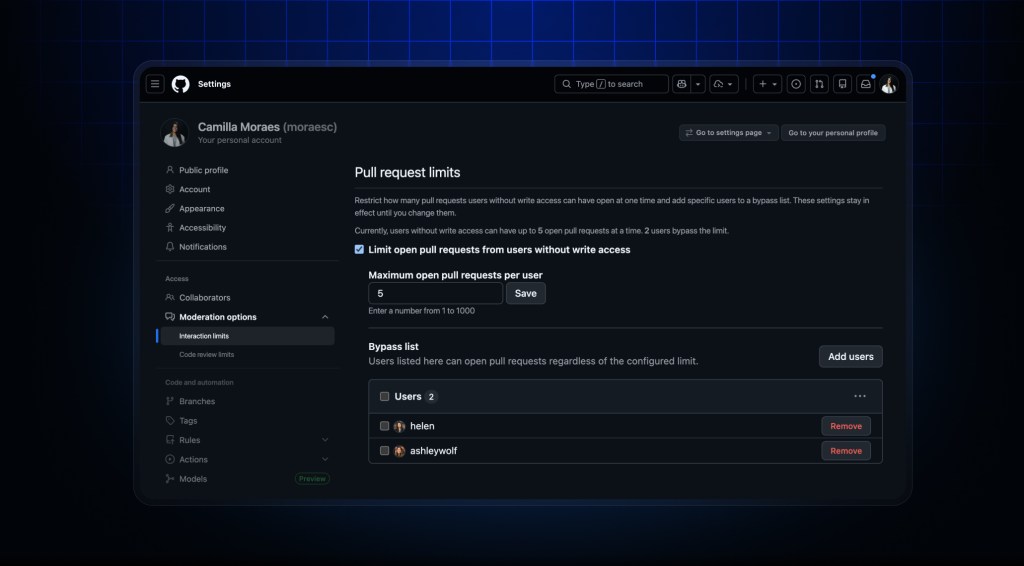
A screenshot of the 'Moderation options menu' open to the 'Interaction limits' submenu, with 'Pull request limits' at the top. The checkbox 'Limit open pull requests from users without write access' is selected.

GitHub already has interaction limits, but those are temporary cooldowns. These new pull request limits are persistent and configurable—giving maintainers the control they told us they were missing.

A cap also changes how contributors behave. When anyone can open a pull request in seconds, a polished change and a rough draft look the same in the queue. But when only a few pull requests can be open at once, a contributor must be selective and prioritize which contributions they want to be reviewed. That first judgment call happens before the pull request reaches you, and a smaller pool makes good work easier to spot.

It’s helped us want to review pull requests again. Knowing that someone hasn’t just opened 5–10 pull requests that are slop makes it much easier to want to look. Going forward we expect it to help us manage our backlog and ensure the things people are working on are the things we need.

Nicholas Tindle, AutoGPT

This feature is great. We’ve had problems on Homebrew for a while with enthusiastic users submitting many pull requests that need near identical review. AI further accelerated it. This allows us to still have outside contribution and maintainers contribute more while gating users to a level of pull requests we can cope with.

Mike McQuaid, Homebrew

At OpenClaw we get a huge volume of pull requests from the community and had to build our own bots for fighting spam. We are super glad GitHub has been able to develop out-of-the-box solutions for maintainers now to manage this volume.

Vincent Koc, OpenClaw

The cost to create outran the cost to review

These limits are especially crucial right now because of a change in the ecosystem. In January 2023, developers merged about 25 million pull requests a month across GitHub. Today that number tops 90 million—a roughly 3.6x increase. More people are building in the open than at any point in GitHub’s history.

Most contributions come in good faith, and even good-faith work can pile up faster than one volunteer can answer. In February, we wrote that open source was hitting its own Eternal September. A pull request limit gives maintainers some of that attention back, without closing the door on the next contributor.

What’s coming next: More controls for managing contributions

Pull request limits are just the first step. The same feedback is pointed straight at what comes after: more flexible, more granular control over how contributions flow in.

Archiving pull requests (shipping soon): Repository admins will be able to archive pull requests, hiding low-quality or spammy pull requests out of the main pull request view. Archived pull requests stay accessible to admins, but can be filtered out of the default list. We chose archive over delete on purpose: some organizations can’t permanently delete pull requests for legal or compliance reasons, and many maintainers want to keep them for context.

Issue limits (in development): The controls you now have on pull requests will be applied to issues: per-repository caps on how many open issues a user without write access can have at once, with a bypass list, plus an option to restrict issue creation to collaborators.

Smarter bypass signals (up next): The goal is less manual trust management. Instead of curating a bypass list by hand, you could let contributors clear a limit automatically based on real signals: a previously merged pull request in the repo, account age, or organization membership. That frees maintainers from curating lists by hand and gives them more time to focus on the work itself.

Cross-repository controls (exploring): A per-repository cap helps with repeated activity in one project, but it does nothing when someone opens pull requests across hundreds of repositories at once. We’re exploring ways to catch contributors who spray pull requests across multiple repositories, whether through trust signals, rate limiting, or other cross-repository controls. 

Thank you

Open source runs on the people who show up every day. To everyone who reviews pull requests late at night, mentors a first-time contributor, triages a backlog, files issues, or tells us where our tools fall short: thank you. You shaped this feature, and your input is critical in helping us decide what comes next. We’ll keep building with you.

Try the pull request limit in your repository settings, and tell us where it helps and where it doesn’t.

See you in the pull request queue. 🧡

Written by

Camilla Moraes

Product Manager

Ashley Wolf

Director, Open Source Programs at GitHub

I work on open source strategy and programs that support maintainers inside GitHub and across the ecosystem. I also serve on the Steering Committee for the TODO Group, where we help organizations use and sustain open source responsibly.

Related posts

Explore more from GitHub

Docs

Docs

Everything you need to master GitHub, all in one place.

Go to Docs

GitHub

GitHub

Build what’s next on GitHub, the place for anyone from anywhere to build anything.

Start building

Customer stories

Customer stories

Meet the companies and engineering teams that build with GitHub.

Learn more

GitHub Universe 2026

GitHub Universe 2026

Join us October 28-29 in San Francisco or online for GitHub Universe, our flagship developer event uniting people, agents, and the world’s code.

Register now