GitHub and UNDP team up to advance development priorities...
Mathias Schindler·2026-06-27·via The GitHub Blog
Open source software is commonplace. Many people use it without even knowing, whether for everyday web browsing or building tools to improve efficiency. At its core, open-source software is built on code that is publicly available for anyone to use, adapt, and improve. It’s more complex, however, when a government sets out to adopt open source at scale to drive development impact.
This discussion is happening in Ghana, where the Ministry of Communications, Digital Technology, and Innovation (MoCDTI) is undertaking an ambitious and deliberate digital reset to create more jobs, grow enterprises, and empower youth. This effort includes advancing more than a dozen legislative reforms at once, covering areas such as cybersecurity, data protection, electronic communications, data exchange and emerging technologies. Some are new legislation, while others replace existing laws. Together, they are redefining the country’s ICT legal framework.
What does long-term sustainability look like in practice? Will the systems built on these foundations be open and auditable? Or will they end up trapped behind proprietary walls, with a limited number of vendors able to assess and support them?
Governments pivot to open source adoption
For governments and other large organizations, making a strategic shift towards adopting open source is a significant undertaking that presents both challenges and opportunities.
A ministry might deploy an open-source tool for a particular project, however systems-wide questions on managing licensing compliance, building internal maintenance capacity and coordinating across other ministries within a government may be unanswered. As a result, this adoption of open source, whilst transformative in value, could remain in isolation–without ever becoming the institutional default.
This is the gap the OSPO (Open Source Programme Office) model is designed to fill. OSPOs are a common setup in the private sector, providing structured governance for open source: policies, compliance, community engagement, and skills development. The model is now increasingly being adopted by universities, civil society, and within the public sector that has underscored the need for readiness to ensure effective adoption.
The Open Source Programme Office Readiness Assessment, known as OSPORA, is a UNDP-led initiative that does exactly this for countries. Supported by the government of France, OSPORA is a structured diagnostic approach that helps governments assess their readiness for open source adoption and governance. Critical for identifying practical steps, it could be thought of as the equivalent of running an audit before an architecture migration except the architecture is institutional, not technical.
OSPORA asks: What policies exist? What’s the technical capacity? Who are the internal champions? Where are the coordination failures? Does procurement deter open source adoption? And crucially: what’s politically realistic given the current government’s priorities?
Ghana demonstrating what’s possible
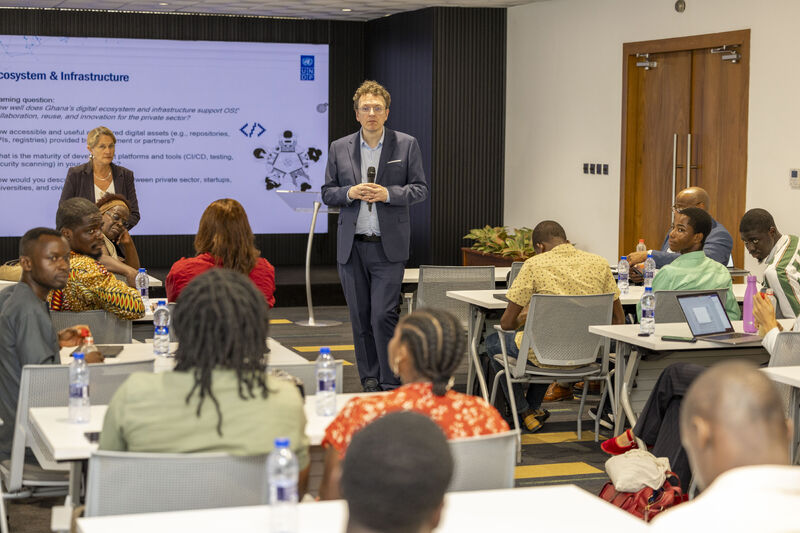
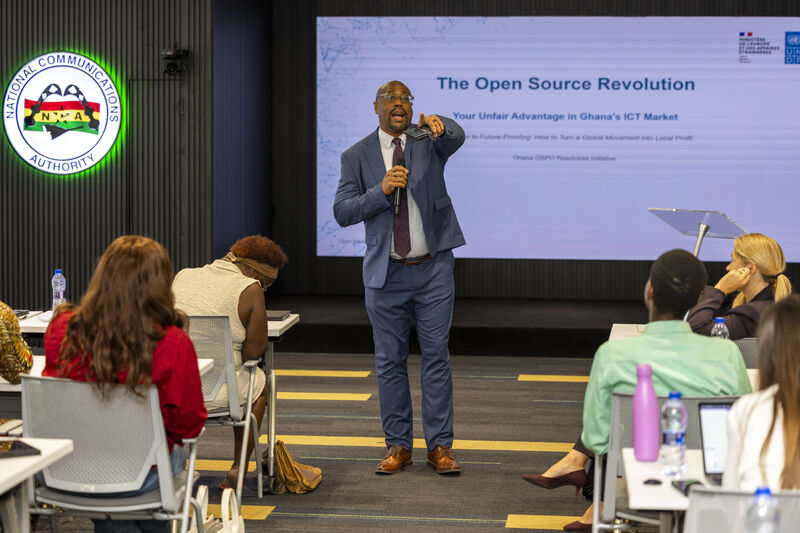
Early last month in Ghana, the GitHub Policy team teamed up with UNDP to carry out of these assessments. Over the course of a week, the team ran interviews and workshops with diverse stakeholders, including:
Senior officials at MoCDTI, including the National IT Agency and the Kofi Annan-India Center of Excellence, who are leading the digital transformation and legislative reform process
Heads of IT departments across government ministries
Community tech groups building open source within Ghana’s developer ecosystem
The local Linux user group, which bridges global open source governance, community and local implementation
The OSPORA methodology draws on Public Digital’s framework on open source in government, which is a structured set of questions covering not just technical readiness but institutional structures and policies, procurement practices, legal frameworks, and political will.
What emerged was nuanced. Ghana has political commitment to digitalization, clear champions backed by over a decade of open source delivery experience, and a growing tech community eager to contribute. Importantly, the case for open source is being made from within—by officials who see it as an essential means to build a more digitally sovereign future, and a closely linked ambition to grow Ghana’s national digital economy and local technology capabilities.
At the same time, there are gaps: the lack of a clear, centralized policy on open source; coordination challenges between the National Information Technology Authority (NITA) and individual ministries operating in siloes; and under-resourced IT teams, especially in rural areas. In instances where progress have stalled, it was rarely attributed to technical reasons—the more significant barriers are institutional inertia and resistance to change, particularly where existing procurement patterns and vendor relationships are well entrenched.
These findings are an opportunity to make meaningful improvements and expand the delivery of public services through open source to better serve the people who rely on them.
A call to action for development impact
Ghana is home to one of West Africa’s fastest-growing tech communities, as well as some of the region’s first accredited Digital Public Goods. It also has the second highest number of GitHub developer accounts in West Africa. With Ghana’s One Million Coders initiative underway to skill up a massive developer workforce by 2028 and others digital development initiatives emerging, the foundations are being built, and the talent pipeline is growing.
Open source governance shapes what gets built. Codes that get contributed can support the building of a national infrastructure. For example, UNDP maintains open source projects on GitHub that governments deploy such as the National Carbon Registry to help countries implement and manage carbon markets. The policy decisions being made in Ghana and other countries today about data exchange standards, content liability, emerging tech regulation will determine the future of an open source in expanding choices for countries on their digital transformation journeys.
Ghana’s story illustrates what open source sustainability looks like at the national level. While conversations around open source frequently focus on maintainer burnout and funding models, OSPORA represents a different piece of the puzzle on how institutions can sustain open source adoption over time and across administrations at scale. It’s also why GitHub alongside UNDP is excited to participate in the United Nations Open Source Week taking place this week in New York City.
The GitHub team is deeply grateful to the UNDP Digital, AI and Innovation Hub and the Country Office team in Ghana whose vision, persistence, and on-the-ground leadership have made this possible. Partnerships like this don’t happen in the abstract, they happen because people show up, do the hard work of building trust across institutions, and stay committed to the long game. This collaboration underscores our shared belief that open source is a powerful catalyst for sustainable development and the growth of digital public goods.
Open source offers a structurally different path.
The author is grateful for contributions from Cynthia Lo from GitHub, and Laura Hildebrandt, Benjamin Bertelsen, and Dwayne Carruthers from UNDP.
Written by
Mathias Schindler is passionate about open source, open content and open collaboration. For over 15 years, he has been involved in EU legislation on copyright, transparency and open data, both as an employee at German NGOs and also as a staffer for several members of various parliaments in Europe. He likes and writes encyclopedias.
Explore more from GitHub
Docs
Everything you need to master GitHub, all in one place.