



惯性聚合 高效追踪和阅读你感兴趣的博客、新闻、科技资讯
阅读原文 在惯性聚合中打开

推荐订阅源

U
Unit 42
罗磊的独立博客
博客园 - 聂微东
T
The Blog of Author Tim Ferriss
博客园 - 司徒正美
Stack Overflow Blog
Stack Overflow Blog
F
Fortinet All Blogs
A
About on SuperTechFans
腾讯CDC
Apple Machine Learning Research
B
Blog RSS Feed
IT之家
IT之家
V
Visual Studio Blog
freeCodeCamp Programming Tutorials: Python, JavaScript, Git & More
宝玉的分享
宝玉的分享
C
Check Point Blog
Cyber Security Advisories - MS-ISAC
Vercel News
Vercel News
爱范儿
爱范儿
Microsoft Security Blog
月光博客
月光博客
T
Tailwind CSS Blog
The Cloudflare Blog
Hugging Face - Blog
Hugging Face - Blog

Futurism

Man Creates Tiny Submarine for His Parakeet to Experience Life Underwater The Effects of AI-Generated Code Tearing Through Corporations Is Actually Kind of Funny Trump Hires Orbital Towing Company to Build Space Interceptors Psychologists Found Something Horrible About the Kind of Men Seeking Trad Wives To Get Swole, Teens Are Pumping Themselves Full of Drugs Meant for Fattening Cows for the Slaughterhouse Foolish Pollsters Are Now Just Asking AI What Voters Would Say in Response to Questions and Publishing It at Face Value OpenAI Says It’s Already Made $100 Million by Stuffing ChatGPT With Ads Man Punished for Breaking Into Moo Deng’s Zoo Enclosure AI Is Causing Healthcare Costs to Surge There’s a Mass Rebellion Against AI in the Workplace People Who Lose Their Job to AI Are in for a World of Pain, Goldman Sachs Report Finds OpenAI Says Not to Worry About UBI, Because It Has Another Idea Police Officer Helplessly Waves Arms at Waymo That Careened Wrong Way Through Whataburger Drive-Thru Someone Just Threw a Molotov Cocktail At Sam Altman’s House New York Times Makes Substantial Changes to Article That Glazed a Sleazy AI Startup: “Our Piece Should Have Included That Information” Space Scientists Wince as Astronauts’ Lives Depend on Artemis 2’s Controversial Heat Shield During Plunge Back to Earth The Moon Astronauts Have Been Working Out With a NASA Rowing Machine in Space First AI Model From Zuckerberg’s Wildly Expensive Superintelligence Lab Flops Compared to Virtually All Rivals Economists Starting to Admit They May Have Been Wrong About AI Never Replacing Human Jobs AI-Powered Drug Marketer Medvi Responds After Allegations About Fake Doctors and Patients As Astronauts Visit the Moon, NASA Insider Says Agency Is in Shambles Behind the Scenes Man Lights 1.2 Million Square Foot Warehouse on Fire for Not Paying Him Enough NASA Scientists Screamed With Delight When They Saw Something Smashing Into the Moon Google Says Showing Polymarket Bets on Google News Was a Mistake Las Vegas Sphere Turns Into Huge Moon to Celebrate NASA Mission The New York Times Says It’s Identified the Creator of Bitcoin We Talked to a Writer Accused of Publishing An AI-Generated Essay in The New York Times Naked Man Bursts Into Tesla Service Center With a Shotgun Student Dies When Hospital Has No ICU Doctors, Calls One on Videochat Who Pronounces Him Dead Remotely, Lawsuit Claims Analysis Finds That Google’s AI Overviews Are Providing Misinformation at a Scale Possibly Unprecedented in the History of Human Civilization
Scientists Building World's Most Powerful Radio Telescope...
Victor Tangermann · 2026-06-19 · via Futurism

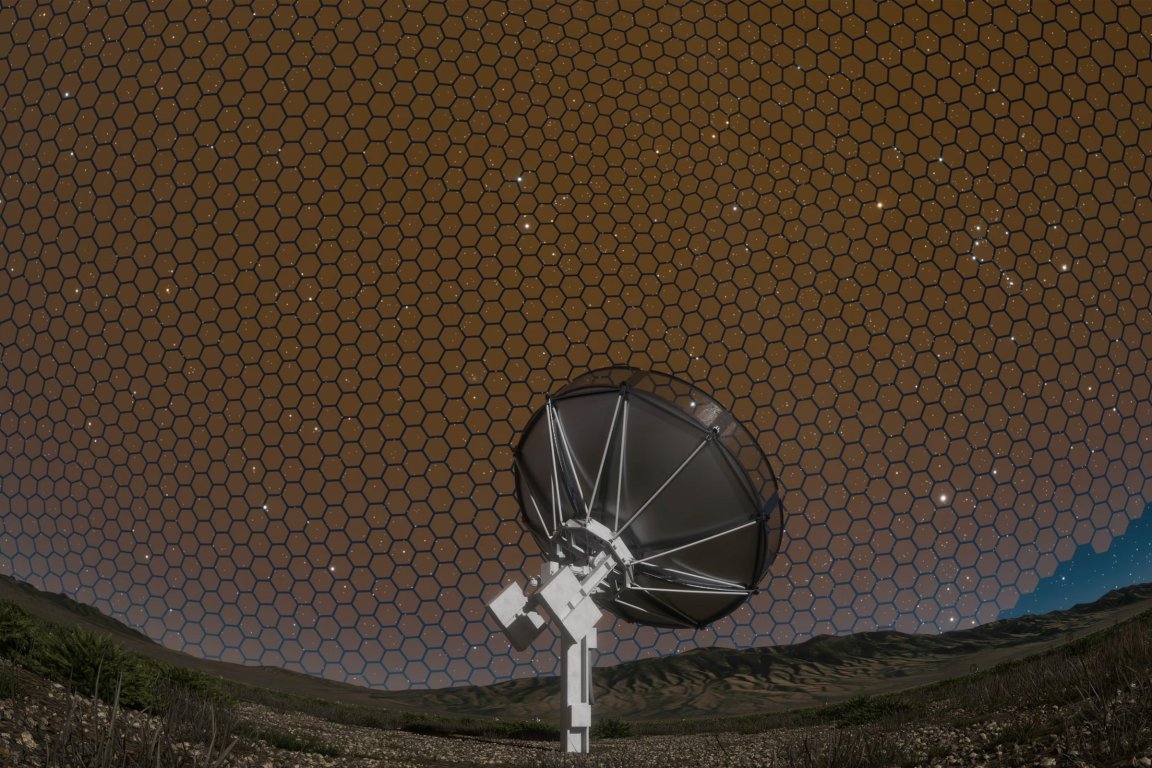
A screenshot of a video depicting a radio telescope as it scans the sky, depicted as a honeycomb pattern.

Caltech via YouTube

Sign up to see the future, today

Can’t-miss innovations from the bleeding edge of science and tech

Researchers at Caltech are gearing up to begin construction on what could become the most sensitive and fastest radio telescope array ever built.

The ambitions are staggeringly vast. Once completed in 2029, the Deep Synoptic Array (DSA) will feature a whopping 1,650 radio dishes, each measuring just shy of 20 feet across, spanning an area of 12 by 10 miles in a remote Nevada desert valley.

To put those numbers into perspective, New Mexico’s Very Large Array, one of the largest radio telescopes, is made up of just 27 radio dishes.

Arrays made up of large numbers of dishes have a key advantage: they can dramatically improve the spatial resolution of deep space observations by effectively acting as one enormous instrument. However, one drawback is that they are far less sensitive to light than one giant dish, making them only suitable for luminous astronomical objects, like pulsars, the highly magnetized remains of dead stars, and fast radio bursts, brief flashes of powerful radio waves.

To reduce the chance of radio frequency interference — unwanted external electromagnetic signals or “noise” that have plagued astronomers for decades — the team chose an extremely remote part of the Nevada desert, not far from Great Basin National Park.

Scientists behind the DSA promise that the new array will improve on the sensitivity of existing radio telescope arrays while dramatically speeding up the process of scanning wide swathes of the night sky.

“The DSA will survey the entire visible sky several times in its first five years at unprecedented speeds,” said Caltech astronomy professor and DSA principal investigator Gregg Hallinan in a statement. “While all other radio telescopes combined have so far found about 20 million radio sources, the DSA will match that in the first day of operations.”

“By the end of its initial survey, it will have discovered about 1 billion new radio sources,” he added.

Researchers are hoping to use the array to study mysterious and little-understood phenomena like fast radio bursts, as well as much broader concepts, like how dark energy influences the expansion of the universe.

“Radio astronomy is about to go from sketch to photograph,” said DSA co-principal investigator and Caltech astronomy professor Vikram Ravi in the statement.

The speed of the DSA also offers a key advantage: it will give astronomers access to data in near-real-time, allowing them to start processing it almost immediately. Best of all, the public will have unfettered access from the get go.

“We want the whole world to also have access to the data just as quickly as we do,” DSA lead project manager Katie Jameson explained. “The DSA functions like a photo lab that is developing these radio images in real time for all to use.”

To keep costs down, Caltech researchers turned to a highly unusual manufacturing partner: cake pan maker Fat Daddio’s. The team contracted the company to produce thousands of baking pans — which turned out to be the perfect shape to help convert electromagnetic waves to electrical signals.

“It’s all about metal fabrication, and this is something Fat Daddio’s has a lot of experience in!” DSA lead project engineer Francois Kapp explained.

More on radio telescopes: Scientists Release Results After Scanning 3I/ATLAS for Alien Signals