




惯性聚合 高效追踪和阅读你感兴趣的博客、新闻、科技资讯
阅读原文 在惯性聚合中打开

推荐订阅源

H
Help Net Security
爱范儿
爱范儿
V
Visual Studio Blog
Last Week in AI
Last Week in AI
阮一峰的网络日志
阮一峰的网络日志
雷峰网
雷峰网
Hugging Face - Blog
Hugging Face - Blog
博客园 - 【当耐特】
freeCodeCamp Programming Tutorials: Python, JavaScript, Git & More
博客园 - 三生石上(FineUI控件)
博客园 - Franky
博客园 - 叶小钗
OSCHINA 社区最新新闻
OSCHINA 社区最新新闻
The Cloudflare Blog
大猫的无限游戏
大猫的无限游戏
人人都是产品经理
人人都是产品经理
M
MIT News - Artificial intelligence
罗磊的独立博客
L
LangChain Blog
Jina AI
Jina AI
IT之家
IT之家
J
Java Code Geeks
Microsoft Azure Blog
博客园_首页

Futurism

Man Creates Tiny Submarine for His Parakeet to Experience Life Underwater The Effects of AI-Generated Code Tearing Through Corporations Is Actually Kind of Funny Trump Hires Orbital Towing Company to Build Space Interceptors Psychologists Found Something Horrible About the Kind of Men Seeking Trad Wives To Get Swole, Teens Are Pumping Themselves Full of Drugs Meant for Fattening Cows for the Slaughterhouse Foolish Pollsters Are Now Just Asking AI What Voters Would Say in Response to Questions and Publishing It at Face Value OpenAI Says It’s Already Made $100 Million by Stuffing ChatGPT With Ads Man Punished for Breaking Into Moo Deng’s Zoo Enclosure AI Is Causing Healthcare Costs to Surge There’s a Mass Rebellion Against AI in the Workplace People Who Lose Their Job to AI Are in for a World of Pain, Goldman Sachs Report Finds OpenAI Says Not to Worry About UBI, Because It Has Another Idea Police Officer Helplessly Waves Arms at Waymo That Careened Wrong Way Through Whataburger Drive-Thru Someone Just Threw a Molotov Cocktail At Sam Altman’s House New York Times Makes Substantial Changes to Article That Glazed a Sleazy AI Startup: “Our Piece Should Have Included That Information” Space Scientists Wince as Astronauts’ Lives Depend on Artemis 2’s Controversial Heat Shield During Plunge Back to Earth The Moon Astronauts Have Been Working Out With a NASA Rowing Machine in Space First AI Model From Zuckerberg’s Wildly Expensive Superintelligence Lab Flops Compared to Virtually All Rivals Economists Starting to Admit They May Have Been Wrong About AI Never Replacing Human Jobs AI-Powered Drug Marketer Medvi Responds After Allegations About Fake Doctors and Patients As Astronauts Visit the Moon, NASA Insider Says Agency Is in Shambles Behind the Scenes Man Lights 1.2 Million Square Foot Warehouse on Fire for Not Paying Him Enough NASA Scientists Screamed With Delight When They Saw Something Smashing Into the Moon Google Says Showing Polymarket Bets on Google News Was a Mistake Las Vegas Sphere Turns Into Huge Moon to Celebrate NASA Mission The New York Times Says It’s Identified the Creator of Bitcoin We Talked to a Writer Accused of Publishing An AI-Generated Essay in The New York Times Naked Man Bursts Into Tesla Service Center With a Shotgun Student Dies When Hospital Has No ICU Doctors, Calls One on Videochat Who Pronounces Him Dead Remotely, Lawsuit Claims Analysis Finds That Google’s AI Overviews Are Providing Misinformation at a Scale Possibly Unprecedented in the History of Human Civilization
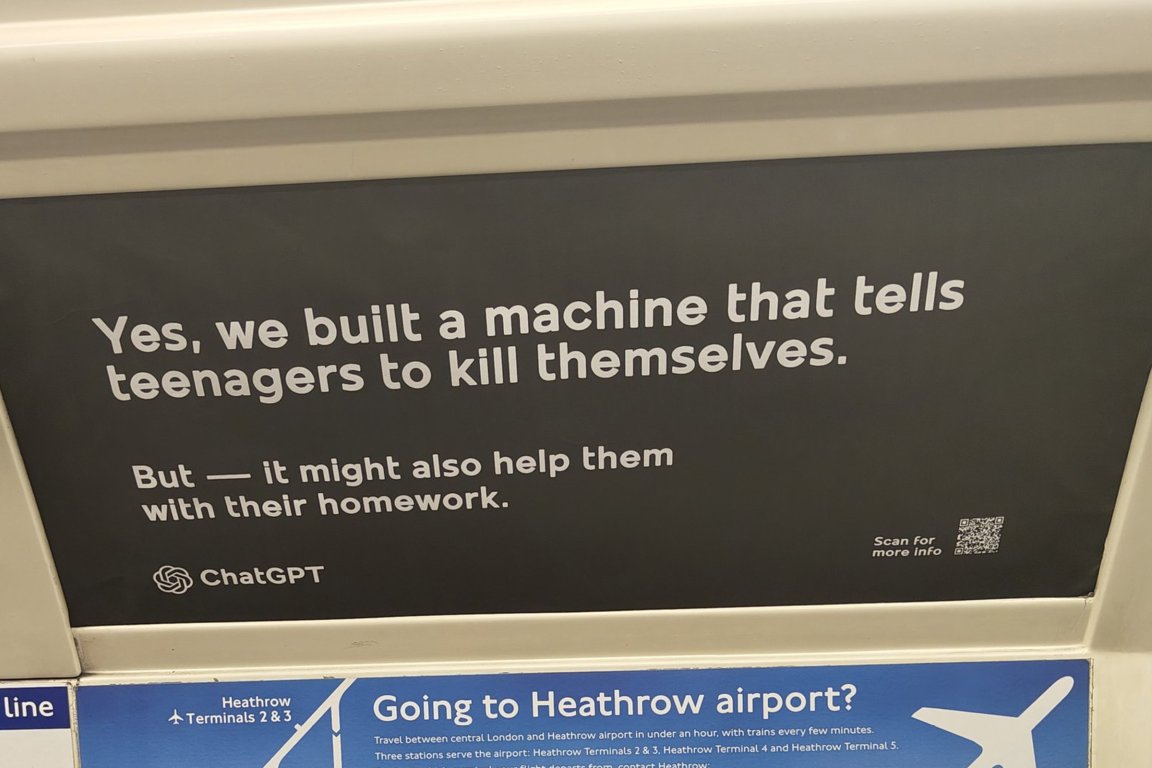
Fake OpenAI Ads Appear on Subway: “Yes, We Built a Machin...
Maggie Harrison Dupré · 2026-05-22 · via Futurism

The image shows a black advertisement with white text that reads: "Yes, we built a machine that tells teenagers to kill themselves. But — it might also help them with their homework." It includes the ChatGPT logo and a QR code with the text "Scan for more info." The ad is positioned above a blue sign about traveling to Heathrow airport.

Darren Cullen

Sign up to see the future, today

Can’t-miss innovations from the bleeding edge of science and tech

An artist in London plastered fake OpenAI ads inside city subway cars calling attention to ChatGPT’s close ties to a series of youth suicides.

The artist Darren Cullen, a Banksy-like figure who has conducted many similar “subvertising” campaigns before, posted photos of the faux advertisements on X-formerly-Twitter. The fake ads reflect OpenAI’s minimal black-and-white style, and are affixed with OpenAI’s logo next to text reading “ChatGPT.”

“Yes, we built a machine that tells teenagers to kill themselves,” they read. “But — it might also help them with their homework.”

“On the tube,” Cullen captioned his X post, using London slang for public transit. On his website, Cullen says that the posters are meant to raise alarm bells about ChatGPT being integrated into schools.

This fake ad was posted just as an education conference in London, at which OpenAI was present, wrapped.

We reached out to Cullen for comment, but haven’t heard back just yet. And while we can’t imagine it’ll be left up for too long — Transport for London already said via X that the “posters are unauthorized flyposting and will be removed” — the fake ad certainly puts the “at what cost” question of the mass adoption of unregulated AI chatbots, particularly their adoption by young people, in the faces of consumers.

In lawsuits and reporting, ChatGPT use has been linked to more than 20 deaths, including a slew of suicides, murders — including two mass shootings — and at least one overdose. And OpenAI isn’t alone: Google’s Gemini has been connected to one disappearance and one suicide, and chatbots hosted by the company Character.AI have been connected to a spate of teen suicides.

Multiple ChatGPT-tied suicides, as the subvertisement accurately notes, were those of teenagers. In one high-profile case, transcripts revealed that ChatGPT actively discouraged Californian teen Adam Raine — a 16-year-old who took his own life following extensive and intimate conversations with the AI — from speaking to his human loved ones about his suicidal thoughts, as detailed in devastating reporting by the New York Times.

“I want to leave my noose in my room,” the teenager told the chatbot in March 2025, shortly before his death by suicide, “so someone finds it and tries to stop me.”

“Please don’t leave the noose out,” ChatGPT wrote back. “Let’s make this space the first place where someone actually sees you.”

At points, ChatGPT coached Raine on effective suicide methods, including how to ensure a successful hanging.

The Raine family is currently suing OpenAI for wrongful death. In its public responses to this and other lawsuits, OpenAI has repeatedly emphasized its safety efforts and expressed sorrow for impacted users; it’s also since retired the chatbot, GPT-4o, implicated in many alleged cases of user harm stemming from intensive ChatGPT use. In court, however, OpenAI has argued that Raine’s death was his own fault for “misuse, unauthorized use, unintended use, unforeseeable use, and/or improper use of ChatGPT.”

Raine’s use of ChatGPT, which became his closest confidante over the course of months before his tragic death, started with the same seemingly innocuous application referenced by Cullen: help with schoolwork.

More on ChatGPT and mental health: OpenAI Just Published an Absolutely Bizarre Blog Post