



惯性聚合 高效追踪和阅读你感兴趣的博客、新闻、科技资讯
阅读原文 在惯性聚合中打开

推荐订阅源

N
Netflix TechBlog - Medium
I
InfoQ
Engineering at Meta
Engineering at Meta
Jina AI
Jina AI
Recent Announcements
T
The Blog of Author Tim Ferriss
P
Proofpoint News Feed
钛媒体:引领未来商业与生活新知
钛媒体:引领未来商业与生活新知
D
Docker
Microsoft Security Blog
宝玉的分享
宝玉的分享
Last Week in AI
Last Week in AI
OSCHINA 社区最新新闻
OSCHINA 社区最新新闻
GbyAI
GbyAI
博客园 - Franky
博客园 - 聂微东
Microsoft Azure Blog
博客园 - 叶小钗
酷 壳 – CoolShell
酷 壳 – CoolShell
B
Blog RSS Feed
WordPress大学
WordPress大学
MyScale Blog
MyScale Blog
月光博客
月光博客
罗磊的独立博客

Futurism

Man Creates Tiny Submarine for His Parakeet to Experience Life Underwater The Effects of AI-Generated Code Tearing Through Corporations Is Actually Kind of Funny Trump Hires Orbital Towing Company to Build Space Interceptors Psychologists Found Something Horrible About the Kind of Men Seeking Trad Wives To Get Swole, Teens Are Pumping Themselves Full of Drugs Meant for Fattening Cows for the Slaughterhouse Foolish Pollsters Are Now Just Asking AI What Voters Would Say in Response to Questions and Publishing It at Face Value OpenAI Says It’s Already Made $100 Million by Stuffing ChatGPT With Ads Man Punished for Breaking Into Moo Deng’s Zoo Enclosure AI Is Causing Healthcare Costs to Surge There’s a Mass Rebellion Against AI in the Workplace People Who Lose Their Job to AI Are in for a World of Pain, Goldman Sachs Report Finds OpenAI Says Not to Worry About UBI, Because It Has Another Idea Police Officer Helplessly Waves Arms at Waymo That Careened Wrong Way Through Whataburger Drive-Thru Someone Just Threw a Molotov Cocktail At Sam Altman’s House New York Times Makes Substantial Changes to Article That Glazed a Sleazy AI Startup: “Our Piece Should Have Included That Information” Space Scientists Wince as Astronauts’ Lives Depend on Artemis 2’s Controversial Heat Shield During Plunge Back to Earth The Moon Astronauts Have Been Working Out With a NASA Rowing Machine in Space First AI Model From Zuckerberg’s Wildly Expensive Superintelligence Lab Flops Compared to Virtually All Rivals Economists Starting to Admit They May Have Been Wrong About AI Never Replacing Human Jobs AI-Powered Drug Marketer Medvi Responds After Allegations About Fake Doctors and Patients As Astronauts Visit the Moon, NASA Insider Says Agency Is in Shambles Behind the Scenes Man Lights 1.2 Million Square Foot Warehouse on Fire for Not Paying Him Enough NASA Scientists Screamed With Delight When They Saw Something Smashing Into the Moon Google Says Showing Polymarket Bets on Google News Was a Mistake Las Vegas Sphere Turns Into Huge Moon to Celebrate NASA Mission The New York Times Says It’s Identified the Creator of Bitcoin We Talked to a Writer Accused of Publishing An AI-Generated Essay in The New York Times Naked Man Bursts Into Tesla Service Center With a Shotgun Student Dies When Hospital Has No ICU Doctors, Calls One on Videochat Who Pronounces Him Dead Remotely, Lawsuit Claims Analysis Finds That Google’s AI Overviews Are Providing Misinformation at a Scale Possibly Unprecedented in the History of Human Civilization
Mowing Down Simulated Elephants Could Help Self-Driving C...
Frank Landym · 2026-04-27 · via Futurism

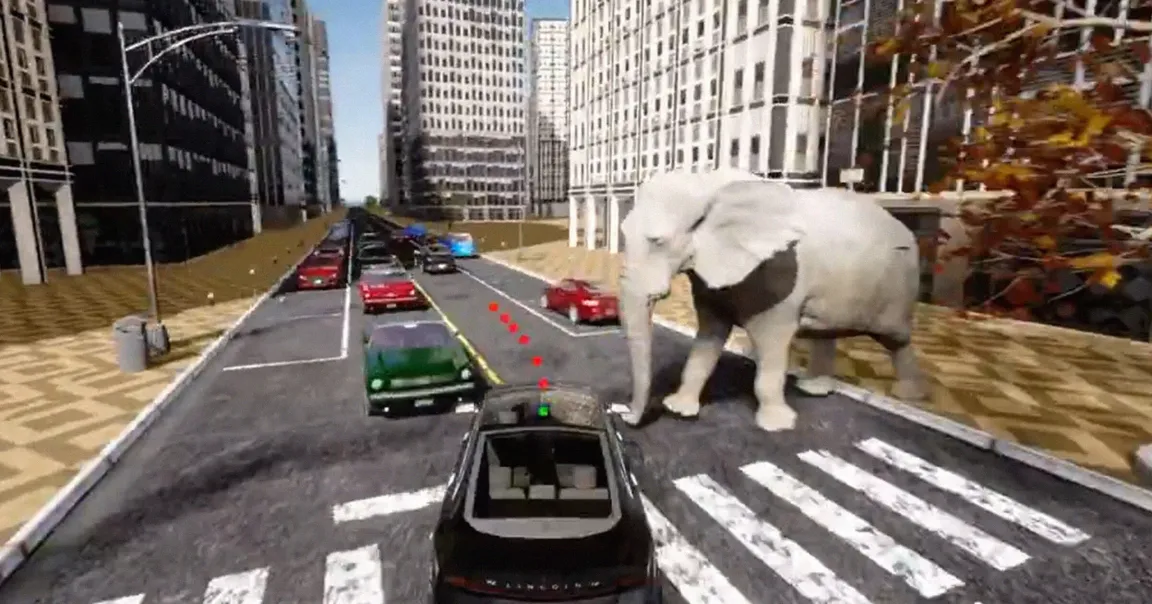
A large white elephant is standing on a city street intersection among several cars. The scene includes tall buildings on both sides of the street, with multiple vehicles lined up in traffic. The image is digitally rendered from a simulation.

Renz et al. via X

Sign up to see the future, today

Can’t-miss innovations from the bleeding edge of science and tech

Even the best self-driving cars keep getting confused and crashing into stuff, sometimes with fatal results.

Here’s a thought: maybe the simulations being used to test them aren’t wacky enough.

A team of researchers have unveiled a new benchmark for testing autonomous vehicles that subjects them to all sorts of “unseen” and truly random scenarios — such as an elephant lumbering across a city street.

“Why did the elephant cross the road? To expose how fragile your model is,” Andreas Geiger, head of the Autonomous Vision Group at the University of Tübingen in Germany, and coauthor of a new preprint paper, wrote in a LinkedIn post.  

In footage provided by the researchers, a simulated AV veers into one of these gentle giants, mowing it down. In another test, the car stops in front of — and then slams into, for some reason — a playground slide sitting in the middle of the road. The car also gets foiled by a Looney Tunes-style wall painted to look like the road ahead (a ruse that’s confounded real-life self-driving cars.)

Why did the elephant cross the road? To expose how fragile your model is.

There's a relatively quiet but serious problem in autonomous driving research: most models are trained and evaluated on the same scenarios. pic.twitter.com/eAXHiZTZ1U

— Katrin Renz (@KatrinRenz) April 23, 2026

Without the added context, you could mistake these for clips of a hacker trolling players in “GTA Online.” But they serve a serious purpose, according to Geiger.

“There’s a relatively quiet but serious problem in autonomous driving research: most models are trained and evaluated not on the same exact data, but on the same scenarios,” he said. “What looks like strong benchmark performance may just be strong memorization.”

Geiger’s new benchmark, dubbed Fail2Drive, is designed to address that. It introduces heaps of so-called out-of-distribution scenarios into an open source simulator for AV research called CARLA, which is widely used in the industry. Some of the scenarios are as outlandish as crosswalk-abiding elephants, but others aren’t. One depicted in the video shows a firetruck parked in a road, which the car brainlessly smashes into at full speed. (And that beside, AVs have been involved in the deaths of numerous animals.)

When Geiger and his team tested autonomous driving models using Fail2Drive, they uncovered a worrying discrepancy. On average, their success rate dropped by 22.8 percent, “highlighting fundamental robustness concerns in current approaches,” he wrote.

Whether this proves to be an effective way of preparing AVs for the chaos of driving in the real world, it could probably at least save the lives of a few wayward elephants.

More on self-driving: Elon Musk Admits He Lied to Tesla Customers’ Faces for Years About Self-Driving