




惯性聚合 高效追踪和阅读你感兴趣的博客、新闻、科技资讯
阅读原文 在惯性聚合中打开

推荐订阅源

V
Visual Studio Blog
罗磊的独立博客
宝玉的分享
宝玉的分享
奇客Solidot–传递最新科技情报
奇客Solidot–传递最新科技情报
V
V2EX
酷 壳 – CoolShell
酷 壳 – CoolShell
T
Tailwind CSS Blog
博客园_首页
量子位
月光博客
月光博客
钛媒体:引领未来商业与生活新知
钛媒体:引领未来商业与生活新知
博客园 - 司徒正美
人人都是产品经理
人人都是产品经理
让小产品的独立变现更简单 - ezindie.com
爱范儿
爱范儿
S
SegmentFault 最新的问题
雷峰网
雷峰网
小众软件
小众软件
博客园 - 聂微东
美团技术团队
Apple Machine Learning Research
WordPress大学
WordPress大学
Jina AI
Jina AI
Hugging Face - Blog
Hugging Face - Blog

Futurism

Man Creates Tiny Submarine for His Parakeet to Experience Life Underwater The Effects of AI-Generated Code Tearing Through Corporations Is Actually Kind of Funny Trump Hires Orbital Towing Company to Build Space Interceptors Psychologists Found Something Horrible About the Kind of Men Seeking Trad Wives To Get Swole, Teens Are Pumping Themselves Full of Drugs Meant for Fattening Cows for the Slaughterhouse Foolish Pollsters Are Now Just Asking AI What Voters Would Say in Response to Questions and Publishing It at Face Value OpenAI Says It’s Already Made $100 Million by Stuffing ChatGPT With Ads Man Punished for Breaking Into Moo Deng’s Zoo Enclosure AI Is Causing Healthcare Costs to Surge There’s a Mass Rebellion Against AI in the Workplace People Who Lose Their Job to AI Are in for a World of Pain, Goldman Sachs Report Finds OpenAI Says Not to Worry About UBI, Because It Has Another Idea Police Officer Helplessly Waves Arms at Waymo That Careened Wrong Way Through Whataburger Drive-Thru Someone Just Threw a Molotov Cocktail At Sam Altman’s House New York Times Makes Substantial Changes to Article That Glazed a Sleazy AI Startup: “Our Piece Should Have Included That Information” Space Scientists Wince as Astronauts’ Lives Depend on Artemis 2’s Controversial Heat Shield During Plunge Back to Earth The Moon Astronauts Have Been Working Out With a NASA Rowing Machine in Space First AI Model From Zuckerberg’s Wildly Expensive Superintelligence Lab Flops Compared to Virtually All Rivals Economists Starting to Admit They May Have Been Wrong About AI Never Replacing Human Jobs AI-Powered Drug Marketer Medvi Responds After Allegations About Fake Doctors and Patients As Astronauts Visit the Moon, NASA Insider Says Agency Is in Shambles Behind the Scenes Man Lights 1.2 Million Square Foot Warehouse on Fire for Not Paying Him Enough NASA Scientists Screamed With Delight When They Saw Something Smashing Into the Moon Google Says Showing Polymarket Bets on Google News Was a Mistake Las Vegas Sphere Turns Into Huge Moon to Celebrate NASA Mission The New York Times Says It’s Identified the Creator of Bitcoin We Talked to a Writer Accused of Publishing An AI-Generated Essay in The New York Times Naked Man Bursts Into Tesla Service Center With a Shotgun Student Dies When Hospital Has No ICU Doctors, Calls One on Videochat Who Pronounces Him Dead Remotely, Lawsuit Claims Analysis Finds That Google’s AI Overviews Are Providing Misinformation at a Scale Possibly Unprecedented in the History of Human Civilization
Earth's Underground Fungus Network Is So Gigantic That If...
Frank Landymore · 2026-06-14 · via Futurism

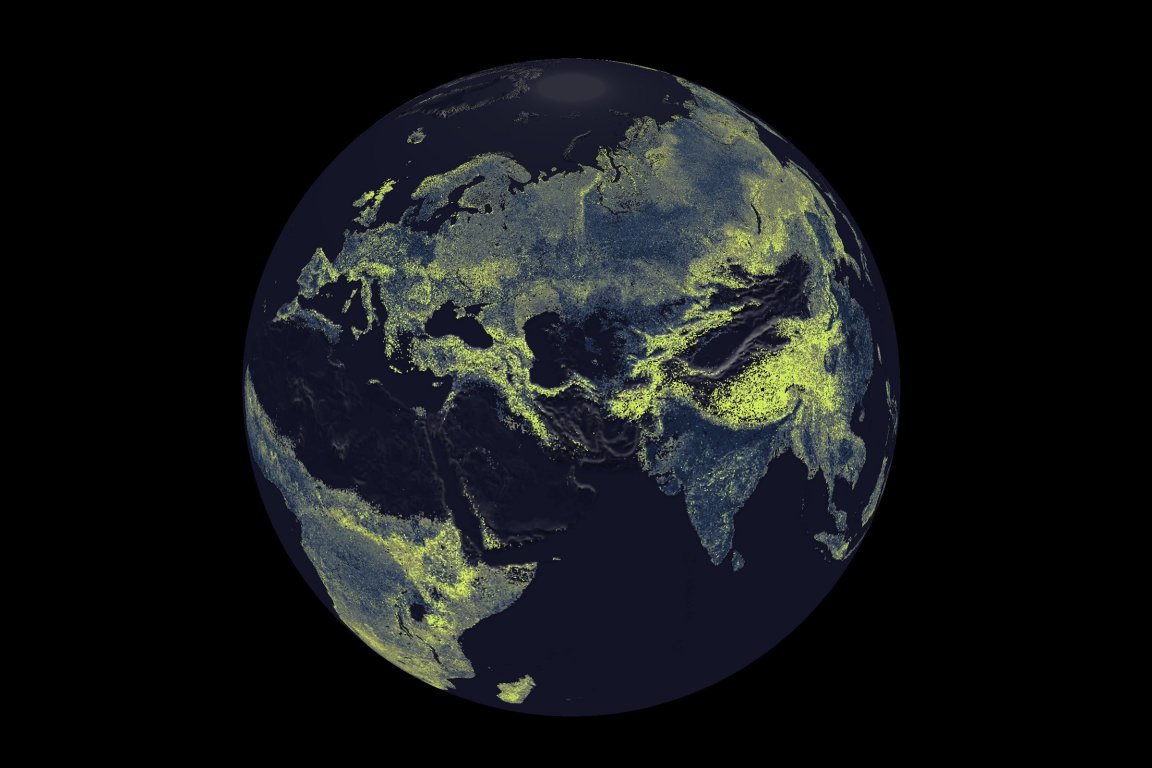
A rendering of the globe with an overlay featuring the extensive underground fungal network on Earth.

Society for the Protection of Underground Networks (SPUN)

Sign up to see the future, today

Can’t-miss innovations from the bleeding edge of science and tech

Scientists have mapped the Earth’s entire underground fungal network, showing that it’s so extensive that if it were stretched into a straight line, it would reach other star systems — and span a sizable chunk of the Milky Way galaxy, for that matter.

The groundbreaking work, published in a study in the journal Science, focused on microorganisms known as arbuscular mycorrhizal fungi. Forming the hidden backbone of our planet’s soil, they circulate water and nutrients and regulate the climate by locking away vast stores of carbon

Altogether, the global fungal network weighs around 300 megatons, the study found, which is four to six times more than the biomass of all human beings. Around 40 percent of that fungal mass resides in high-altitude or flooded grasslands, like the Everglades in Florida. 

The authors hope that their work will highlight the indispensable but overlooked role that these fungal networks play in the Earth’s ecosystems, with around 70 percent of all ground-based plant life depending on the fungi.

“People just aren’t paying attention to these ecosystems,” coauthor Toby Kiers, an evolutionary biologist at Vrije University Amsterdam and director of the Society for the Protection of Underground Networks (SPUN), told The New York Times. “What we want to do with these data is really shine a light on some of these hidden patterns underground.”

“I hope this builds into the conversation for their protection because wild grasslands are going away quite quickly,” lead author Justin Stewart, a fellow SPUN biologist, told Live Science. “These are areas that people are really ripping up because it’s much easier to rip up a grass than it is to rip up a tree.”

To unearth this subterranean network, the researchers used data from over 16,000 soil samples across 300 previous papers that calculated the local density of fungal filaments, or hyphae, across the globe. They then fed this data into a machine learning model to predict the density of these hyphal networks per square kilometer of topsoil.

The results were staggering. In all, the model found that the planet is lined with more than 110 quadrillion kilometers of hyphae, or 68 quadrillion miles, which is almost a billion times the distance between the Earth and the Sun. On a cosmic ruler, that equals nearly 12,000 light years, or about a tenth the diameter of our galaxy, which is enough to take you to the Westlund 1 super star cluster.

It’s the clearest picture yet of just how much fungal networks underpin our terrestrial ecosystems. What’s fuzzier from the model, though, is what it says about their health. The density of the fungal networks were about half as lower in soil used for growing crops, but “we don’t know where networks are very healthy and where they’re threatened,” Kiers told the NYT.

More on biology: There’s Something Living Inside Fog, Scientists Find